Tiếng Việt
 中文 (中国)
 日本語

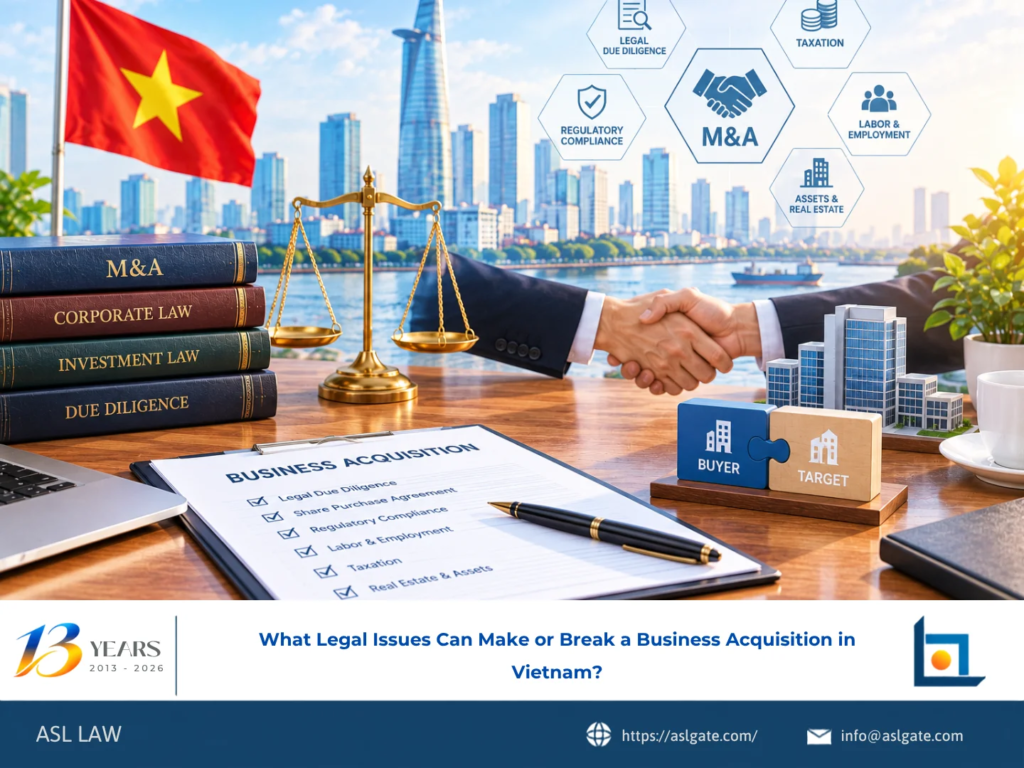
Critical legal issues in Vietnam business acquisitions can determine whether a transaction creates long-term value or exposes the buyer to unexpected liabilities, regulatory delays, and costly disputes. From corporate due diligence and ownership verification to merger control, tax exposure, and contractual protections, each legal factor can influence the transaction’s feasibility and final price. Buyers and sellers who identify these issues early are better positioned to negotiate appropriate terms and complete an acquisition with greater certainty.
Corporate Due Diligence and Ownership Verification
One of the most important legal issues in Vietnam business acquisitions is confirming that the target company legally owns its assets and that its ownership structure is accurately documented.
Buyers should review enterprise registration records, charter documents, shareholder or member registers, capital contribution records, corporate approvals, and material contracts. They should also identify existing disputes, security interests, unpaid obligations, and restrictions on transferring shares or contributed capital.
Unclear ownership, incomplete capital contributions, or missing corporate approvals can delay completion or undermine the intended transaction structure. These problems may require additional documentation, renegotiation, or changes to the acquisition plan.
A thorough review should also examine whether the target’s registered business activities match its actual operations and whether it holds the licenses required to conduct those activities.
Foreign Investment Conditions and Regulatory Approvals
Deal-breakers in Vietnam M&A transactions often arise when the proposed acquisition does not satisfy applicable investment or sector-specific requirements.
Foreign buyers should determine whether acquiring shares or capital contributions triggers foreign investment registration procedures, ownership restrictions, or other approvals. Requirements may differ depending on the investor, the target’s business lines, and the proposed ownership percentage.
The parties should establish a clear regulatory approval plan before agreeing on a completion date. Failure to obtain a required approval may prevent the buyer from acquiring the intended ownership interest or exercising the anticipated control over the business.
Transactions involving multiple jurisdictions may also require coordination between Vietnamese procedures and approvals in other countries. A Vietnam M&A Law Firm can help identify relevant requirements and structure the transaction to reduce avoidable regulatory delays.
Merger Control and Competition Law
Vietnam M&A merger control is another critical consideration, particularly where a transaction involves substantial economic interests, market concentration, or businesses operating in concentrated sectors.
Under Vietnam’s Competition Law and implementing regulations, certain economic concentrations may need to be notified to the competition authority before implementation if applicable thresholds are met. The assessment may involve factors such as assets, revenue, transaction value, or combined market share, depending on the relevant rules.
The parties should evaluate notification obligations early and avoid implementing a transaction before receiving any required clearance. Failure to comply may lead to sanctions, delays, or other legal consequences.
Competition analysis can also influence the transaction’s structure, timetable, and commercial terms. Buyers should therefore assess regulatory exposure before finalizing their acquisition strategy.
Hidden Liabilities, Tax, and Employment Risks
Key legal risks in buying a business in Vietnam include liabilities that may not be immediately visible in the target’s financial statements.
Due diligence should cover tax declarations, outstanding payments, accounting records, employee contracts, compulsory insurance contributions, pending litigation, environmental obligations, and compliance with sector-specific rules. Intellectual property ownership and data protection practices may also require review.
A share acquisition generally leaves the target company in place, meaning its existing obligations may continue after the change in ownership. An asset acquisition may allow the parties to select particular assets and liabilities for transfer, but it can involve separate transfer procedures, consents, and licensing considerations.
The findings should inform the purchase price, warranties, indemnities, conditions precedent, and any escrow or retention arrangements. Vietnam M&A Legal Services can support this process by coordinating legal due diligence and translating identified risks into contractual protections.
Transaction Documents and Completion Conditions
The acquisition agreement determines how the parties allocate risks and what happens if the transaction does not proceed as planned.
Important provisions include the purchase price and adjustment mechanism, representations and warranties, indemnification, confidentiality, interim operating covenants, termination rights, and dispute resolution. The parties should also specify which regulatory approvals, third-party consents, and corporate resolutions must be obtained before completion.
Legal factors determining acquisition success Vietnam investors should evaluate include whether the agreement provides workable remedies for inaccurate disclosures and whether the seller has the financial capacity to satisfy post-completion obligations.
Where the target operates a franchised business, the parties should check change-of-control restrictions, intellectual property rights, and whether any necessary franchise registration in Vietnam or related regulatory formalities affect the transaction.
Vietnam M&A Legal Consultation can help buyers and sellers evaluate these provisions before signing and identify issues that could otherwise emerge late in negotiations.
Turning Legal Findings into an Acquisition Strategy
Making or breaking a business acquisition Vietnam transactions depend on more than identifying legal defects. The parties must determine which issues can be resolved, which require additional protections, and which make the proposed deal commercially unacceptable.
A practical approach is to classify findings by severity, estimate their financial and operational impact, and assign responsibility for resolving each issue. Some risks may justify a price adjustment or indemnity, while others may require restructuring, additional approvals, or withdrawal from the transaction.
Early coordination among legal, financial, tax, and operational advisers helps ensure that the acquisition agreement reflects the actual condition of the target business rather than assumptions made during initial negotiations.
FAQ
1. What are the most critical legal issues in Vietnam business acquisitions?
Key issues include ownership verification, corporate authority, foreign investment conditions, merger control, tax liabilities, employment compliance, intellectual property, and the allocation of risks in the acquisition agreement.
2. Can foreign investors acquire shares in Vietnamese companies?
Yes, subject to applicable foreign investment conditions, ownership restrictions, sector-specific rules, and any required registration or approval procedures.
3. When is merger control notification required in Vietnam?
Certain economic concentrations must be notified when the applicable statutory thresholds are met. The parties should assess the transaction against current competition regulations before implementation.
4. Why is legal due diligence important before buying a business?
It helps identify undisclosed liabilities, ownership problems, licensing gaps, and contractual restrictions. The findings can influence the purchase price, transaction structure, and contractual protections.
5. What should buyers do if due diligence reveals serious legal risks?
Buyers should assess the severity and financial impact of each issue. Depending on the circumstances, they may seek additional warranties, indemnities, price adjustments, corrective actions before completion, restructuring, or termination where contractually permitted.
ASL Law is a leading full-service and independent Vietnamese law firm made up of experienced and talented lawyers. ASL Law is ranked as the top tier Law Firm in Vietnam by Legal500, Asia Law, WTR, and Asia Business Law Journal. Based in both Hanoi and Ho Chi Minh City in Vietnam, the firm’s main purpose is to provide the most practical, efficient and lawful advice to its domestic and international clients. If we can be of assistance, please email to [email protected].
ASL LAW is the top tier M&A law firm in Vietnam. If you need any advice, please contact us for further information or collaboration.