Tiếng Việt
 中文 (中国)
 日本語

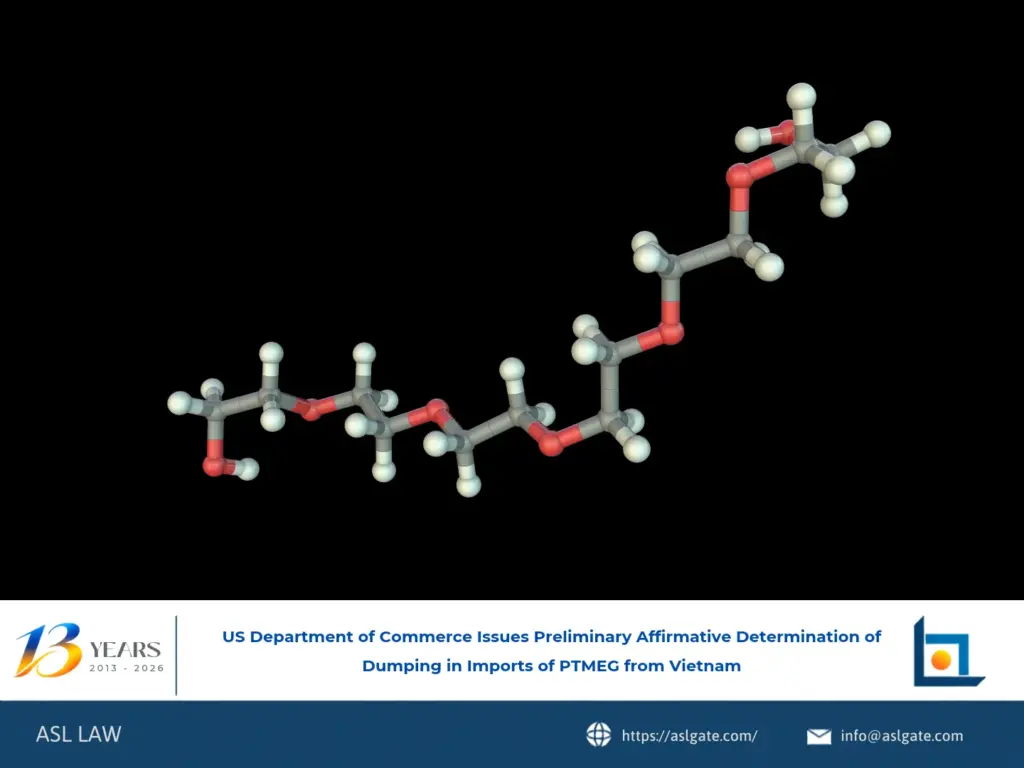
On November 10, 2026, the US Department of Commerce (DOC) issued a preliminary affirmative determination that polytetramethylene ether glycol (PTMEG) imported from Vietnam was being dumped in the US market, with a preliminary dumping margin of 36.55%. This determination triggers cash deposit requirements for imports of products covered by the investigation, placing considerable pressure on Vietnamese chemical manufacturers and exporters. In particular, enterprises should urgently review their export activities, prepare supporting documentation, and assess the financial implications before the United States issues its final determination.
Overview of the PTMEG Antidumping Investigation
The investigation, Case No. A-552-855, was initiated following a petition filed by BASF Corporation to investigate alleged dumping of PTMEG imports from Vietnam, China, South Korea, and Taiwan (China).
PTMEG, also known as PTHF, PTMG, or Polybutylene Glycol, is an important chemical raw material used in the production of spandex fibres, polyurethane materials, elastomers, adhesives, and industrial coatings. Given its role in various manufacturing sectors, the imposition of antidumping duties on PTMEG could affect chemical supply chains and related industrial products.
The product under investigation is primarily classified under HS code 3907.29.0000. It may also be imported under codes 2932.11.0000 and 3404.90.5150. The period of investigation (POI) was established as October 1, 2025, to March 31, 2026.
Preliminary Determination and 36.55% Cash Deposit Rate
The DOC determined a preliminary dumping margin of 36.55% for Vietnamese producers and exporters, as well as other companies subject to the all-others rate.
Effective November 10, 2026, imports of products covered by the investigation into the United States will be subject to suspension of liquidation and must provide cash deposits at the applicable preliminary antidumping duty rate.
Notably, this cash deposit requirement also applies to goods exported through third countries if they are supplied by Vietnamese producers or exporters covered by the investigation. Therefore, changing shipping routes or using commercial intermediaries does not automatically allow enterprises to avoid trade remedy measures.
In addition, the DOC rejected a request by an interested party to exclude PTMEG products with a molecular weight of 1,800 (1800 MW), while maintaining the product scope as originally defined in the Notice of Initiation. This means that enterprises trading in PTMEG products within this category should pay particular attention when determining their cash deposit obligations.
Upcoming Investigation Milestones
According to the DOC’s notice, interested parties should take note of the following key deadlines:
- Comments on product scope: Due before 5:00 PM on November 12, 2026 (US Eastern Time).
- Rebuttal comments on product scope: Due before 5:00 PM on November 17, 2026.
- Requests for hearings: Within 30 days of the publication of the preliminary determination in the US Federal Register.
- Final determination: The DOC is expected to issue its final determination within a maximum of 135 days from the publication of the preliminary determination.
At the request of the mandatory respondent, the DOC agreed to extend the deadline for issuing the final determination and extend the period for which provisional measures may remain in effect from four months to a maximum of six months.
If the final determination continues to find dumping, the US International Trade Commission (ITC) will proceed with its assessment of whether the US domestic industry has suffered or is threatened with material injury.
Recommendations for Vietnamese Exporters
The preliminary determination imposing a 36.55% dumping margin presents a significant challenge for Vietnamese enterprises exporting PTMEG to the United States. Enterprises should proactively take the following measures:
- Review cash deposit obligations: Assess the impact of the 36.55% cash deposit rate on selling prices, cash flow, contracts, and delivery schedules.
- Prepare documentation for verification: Check the consistency and accuracy of accounting data, production costs, revenue, export prices, and transaction records previously submitted to the DOC.
- Review the product scope: Assess the chemical characteristics, molecular weight, composition, and HS codes of each product to accurately determine whether it falls within the investigation’s scope.
- Develop an investigation participation strategy: Prepare comments, rebuttals, and appropriate legal arguments to protect the enterprise’s interests during the period preceding the final determination.
Importantly, enterprises should bear in mind that the 36.55% dumping margin is currently only a preliminary finding and does not constitute a final determination. Proactively providing accurate data, fully participating in verification procedures, and developing appropriate legal arguments may play an important role in protecting the export interests of Vietnamese enterprises in the US market.
To protect their legitimate interests, manufacturers and exporters should familiarize themselves with the procedure and actively contact Vietnam Antidumping Law Firm specializing in anti-dumping and trade remedy for timely assistance.
ASL Law is a leading full-service and independent Vietnamese law firm made up of experienced and talented lawyers. ASL Law is ranked as the top tier Law Firm in Vietnam by Legal500, Asia Law, WTR, and Asia Business Law Journal. Based in both Hanoi and Ho Chi Minh City in Vietnam, the firm’s main purpose is to provide the most practical, efficient and lawful advice to its domestic and international clients. If we can be of assistance, please email to [email protected].
ASL LAW is the top-tier Vietnam law firm for Anti-dumping & countervailing. If you need any advice, please contact us for further information or collaboration.