Tiếng Việt
 中文 (中国)
 日本語
日本語
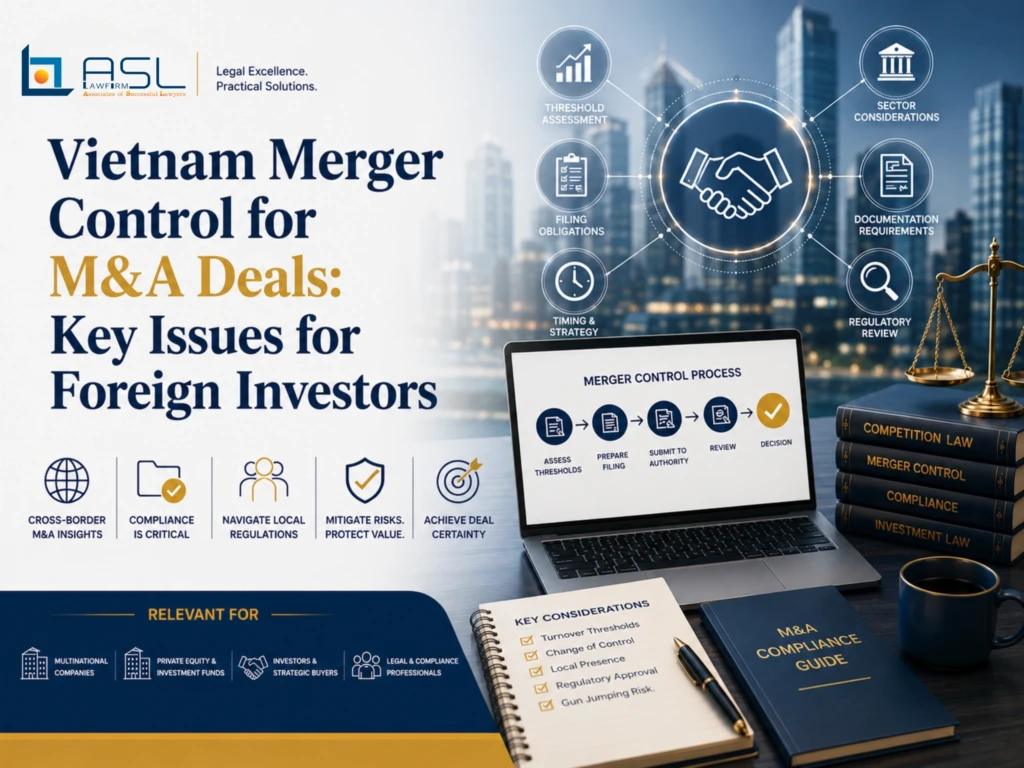
From 1 July 2026, Vietnam increased several financial thresholds for merger notification under Resolution No. 66.18/2026/NQ-CP. However, the 20% combined market share threshold remains unchanged. For foreign investor merger control Vietnam, the practical question is not only whether a transaction exceeds the new financial thresholds, but also whether the acquisition, joint venture or restructuring falls within the scope of Vietnam M&A merger control, including offshore transactions Vietnam merger control. A deal may fall below the revised financial thresholds but still require review. As part of Vietnam M&A legal due diligence, this assessment should be completed before signing, with advice from experienced Vietnam merger control lawyers where appropriate.
For cross-border transactions, merger control should form part of transaction planning from the beginning. An early assessment reduces execution risk, helps coordinate regulatory approvals across jurisdictions and allows the parties to reflect merger clearance requirements appropriately in the transaction documents.
Why Merger Control Matters in Vietnam M&A Deals
Merger control is no longer a regulatory issue considered only after commercial terms have been agreed.
For many acquisitions involving enterprises doing business in Vietnam, it is part of the overall transaction strategy.
Whether the investor is acquiring shares, purchasing business assets or establishing a joint venture, the transaction should first be assessed to determine whether it qualifies as an economic concentration Vietnam under Vietnamese competition law.
The revised financial thresholds introduced by Resolution No. 66.18/2026/NQ-CP reduce filing obligations for certain transactions. Nevertheless, they do not change the scope of the Competition Law Vietnam or the authority’s ability to review transactions that satisfy the applicable notification criteria.
For investors, the practical issue is timing.
Merger control analysis should begin during transaction planning rather than during completion preparations.
This approach is particularly important in Vietnam M&A merger control because regulatory timing may directly affect signing, closing and post-closing integration.
When Should Foreign Investors Assess Filing Obligations?
The assessment should begin as soon as the transaction structure becomes sufficiently clear.
Waiting until the transaction documents are substantially negotiated may create unnecessary delays if notification is later found to be required.
An early foreign investor merger control Vietnam assessment should normally consider:
- the proposed acquisition structure;
- the target’s business activities in Vietnam;
- turnover and assets in Vietnam;
- transaction value;
- market position of the parties;
- potential competition issues.
The objective is not simply to determine whether notification is required.
The assessment also identifies whether merger clearance should become a condition precedent and whether sufficient time should be allocated for regulatory review before the expected closing date.
What Changed from 1 July 2026?
Resolution No. 66.18/2026/NQ-CP temporarily increases several financial notification thresholds from 1 July 2026 until 28 February 2027 while maintaining the existing 20% combined market share threshold.
The principal changes can be summarised as follows.
| Notification Criterion | Before 1 July 2026 | From 1 July 2026 |
| Total assets | VND 3,000 billion | VND 6,000 billion |
| Total turnover | VND 3,000 billion | VND 6,000 billion |
| Transaction value | VND 1,000 billion | VND 2,000 billion |
| Combined market share | 20% | 20% (unchanged) |
The increased financial thresholds mean that some medium-sized acquisitions may no longer require notification solely because of their financial size.
However, the unchanged market share criterion means that competition analysis remains necessary even where the revised financial thresholds are not exceeded.
A deal may fall below the new financial thresholds but still require review.
Do Offshore Transactions Need to Be Reviewed?
Yes.
The location where a transaction is signed or completed is not the decisive factor.
An overseas acquisition may still fall within the Vietnamese merger control regime if the statutory jurisdictional criteria are met and the transaction affects competition in Vietnam.
This issue frequently arises in regional acquisitions involving multinational groups.
Examples include:
- acquisition of a foreign holding company owning Vietnamese subsidiaries;
- global mergers involving competitors already operating in Vietnam;
- regional private equity investments;
- international joint ventures with commercial activities expected in Vietnam.
Accordingly, offshore transactions Vietnam merger control analysis should be incorporated into the overall regulatory workstream for cross-border acquisitions.
Ignoring Vietnam until shortly before closing may result in avoidable execution risks.
What Should Be Reviewed During Vietnam M&A Legal Due Diligence?
Legal due diligence should extend beyond reviewing corporate records and material contracts.
Where Vietnam merger control thresholds 2026 may become relevant, the due diligence process should also collect information necessary to assess notification requirements.
Typical information includes:
- corporate ownership structure;
- business activities in Vietnam;
- Vietnamese subsidiaries and branches;
- turnover generated in Vietnam;
- assets located in Vietnam;
- principal customers;
- competitors;
- market position;
- existing competition law investigations, if any.
This information supports both the merger control assessment and the wider Vietnam M&A legal due diligence exercise.
Where information is unavailable during the early stages of a transaction, additional requests may be included in the legal due diligence questionnaire before signing.
Does Every Cross-Border Acquisition Create Filing Obligations?
No.
Many foreign acquisitions involving enterprises doing business in Vietnam will not require notification.
The revised financial thresholds have reduced the number of transactions captured by the notification regime.
Nevertheless, every significant transaction should be screened.
The assessment should determine:
- whether the transaction constitutes an economic concentration Vietnam;
- whether any notification threshold is satisfied;
- whether the transaction affects competition in Vietnam;
- whether merger clearance may become a condition precedent.
This initial review is generally more efficient than attempting to resolve regulatory issues immediately before completion.
How Should Merger Control Be Addressed in Transaction Documents?
If a transaction may require notification, merger control should be reflected clearly in the transaction documents rather than being left as a post-signing issue.
The approach will depend on the structure of the deal and the outcome of the regulatory assessment. Where notification may be required, the parties should consider allocating responsibilities for preparing the filing, responding to requests from the competition authority and managing the review process.
For investors, the practical issue is timing.
The transaction documents should also establish how the parties will cooperate during the notification process and whether closing can proceed before regulatory clearance is obtained.
This should be checked before signing, not after closing.
Should Merger Clearance Be a Condition Precedent?
In many transactions, the answer is yes.
Where a filing obligation may arise, merger clearance should be considered as one of the conditions precedent to completion. This provides greater certainty regarding transaction timing and reduces the risk of disputes if regulatory approval takes longer than expected.
The issue becomes particularly important in transactions involving multiple jurisdictions, where regulatory approvals may need to be obtained in parallel.
Depending on the transaction, the parties may also agree on:
- responsibility for preparing the notification;
- allocation of filing costs;
- obligations to provide supporting information;
- cooperation during the review process;
- long-stop dates and extension mechanisms.
These provisions should be consistent with the overall transaction timetable and the regulatory strategy adopted for the deal.
How Does Merger Control Affect Signing and Closing?
Signing and closing often occur on different dates.
Where merger notification is required, signing may take place before regulatory approval, while closing is postponed until all applicable conditions precedent have been satisfied.
This distinction is particularly important for cross-border acquisitions involving several regulatory authorities.
Early assessment helps the parties:
- determine whether notification is required;
- prepare a realistic completion timetable;
- coordinate regulatory approvals across jurisdictions;
- reduce execution risk;
- avoid unnecessary delays after signing.
A transaction that proceeds without considering merger control requirements may face avoidable disruptions during implementation.
Practical Due Diligence Checklist Before Signing
Merger control should form part of the legal due diligence process rather than being considered separately after commercial negotiations have concluded.
The following checklist provides a practical starting point.
| Due Diligence Issue | Practical Review |
| Transaction structure | Determine whether the transaction constitutes an economic concentration Vietnam. |
| Vietnamese operations | Identify subsidiaries, branches, assets and business activities in Vietnam. |
| Financial information | Review turnover, assets and transaction value against the applicable thresholds. |
| Market position | Assess preliminary market shares and competitive overlaps. |
| Regulatory approvals | Determine whether notification or other approvals may be required. |
| Transaction documents | Review whether merger clearance should be included as a condition precedent. |
Completing this review during Vietnam M&A legal due diligence helps identify potential regulatory issues before they affect transaction timing.
Why Offshore Transactions Deserve Particular Attention
Cross-border acquisitions frequently involve holding companies incorporated outside Vietnam while the target group operates in multiple jurisdictions.
In these situations, the location of the transaction documents is not the decisive factor.
Instead, the assessment should focus on whether the transaction has sufficient connections with the Vietnamese market under the Competition Law Vietnam.
For example, a foreign holding company may own Vietnamese subsidiaries, generate revenue from Vietnamese customers or compete directly within the Vietnamese market. Even though the acquisition takes place overseas, merger control issues may still arise.
Accordingly, offshore transactions Vietnam merger control should be reviewed alongside filings required in other jurisdictions rather than being treated as a separate issue after signing.
The Role of Vietnam Merger Control Lawyers
Merger control assessments often involve more than comparing financial figures with statutory notification thresholds.
The process may require analysis of transaction structure, market definition, competitive overlaps, regulatory timing and the interaction between multiple jurisdictions.
Experienced Vietnam merger control lawyers assist investors throughout the transaction lifecycle, including:
- preliminary merger control assessments;
- transaction planning before signing;
- review of notification obligations;
- preparation of merger filings;
- coordination with transaction counsel;
- management of regulatory timelines.
For international investors, legal advice should also be coordinated with broader transaction planning, including Vietnam M&A legal due diligence, competition law compliance and post-completion integration.
Many cross-border transactions also require cooperation between local counsel and international legal advisers to ensure that regulatory strategies remain consistent across different jurisdictions.
In addition to merger control, investors should also consider broader compliance issues under Competition Law Vietnam, including antitrust compliance Vietnam obligations that may arise during due diligence and post-closing integration. Depending on the combined market position of the parties after completion, separate assessments relating to abuse of dominance Vietnam may also become relevant. Working with experienced competition lawyers in Vietnam at an early stage can help identify these issues before they affect transaction execution.
Frequently Asked Questions
Merger control is the process requiring certain mergers, acquisitions and joint ventures to be reviewed before completion if the applicable notification thresholds are met.
Merger notification is required when an economic concentration satisfies one or more notification thresholds under Competition Law Vietnam.
Yes. Resolution No. 66.18/2026/NQ-CP increases several financial thresholds but keeps the 20% combined market share threshold unchanged.
Yes. Offshore transactions may require notification if they have sufficient connections with the Vietnamese market and satisfy the applicable legal criteria.
Yes, if the joint venture qualifies as an economic concentration and meets the applicable notification thresholds.
Yes. Where notification is required, merger clearance should generally be obtained before the transaction is completed.
Conclusion
The changes introduced by Resolution No. 66.18/2026/NQ-CP reduce filing obligations for many transactions by increasing several financial notification thresholds. However, the unchanged 20% combined market share threshold means that merger control analysis remains an important part of transaction planning.
For foreign investors, merger control should be considered alongside transaction structure, legal due diligence, regulatory approvals and closing arrangements. Early assessment helps identify potential filing obligations, supports efficient transaction planning and reduces execution risk before signing and completion.
ASL LAW assists investors and businesses with merger control assessment, economic concentration filings, antitrust compliance review and competition law advice in Vietnam.
ASL Law is a leading full-service and independent Vietnamese law firm made up of experienced and talented lawyers. ASL Law is ranked as the top tier Law Firm in Vietnam by Legal500, Asia Law, WTR, and Asia Business Law Journal. Based in both Hanoi and Ho Chi Minh City in Vietnam, the firm’s main purpose is to provide the most practical, efficient and lawful advice to its domestic and international clients. If we can be of assistance, please email to [email protected].
Contact antitrust and competition law firm in Vietnam ASL LAW for advice on competition law Vietnam from competition lawyers in Vietnam specializing in antitrust and economic concentration Vietnam.