Tiếng Việt
 中文 (中国)
 日本語
日本語
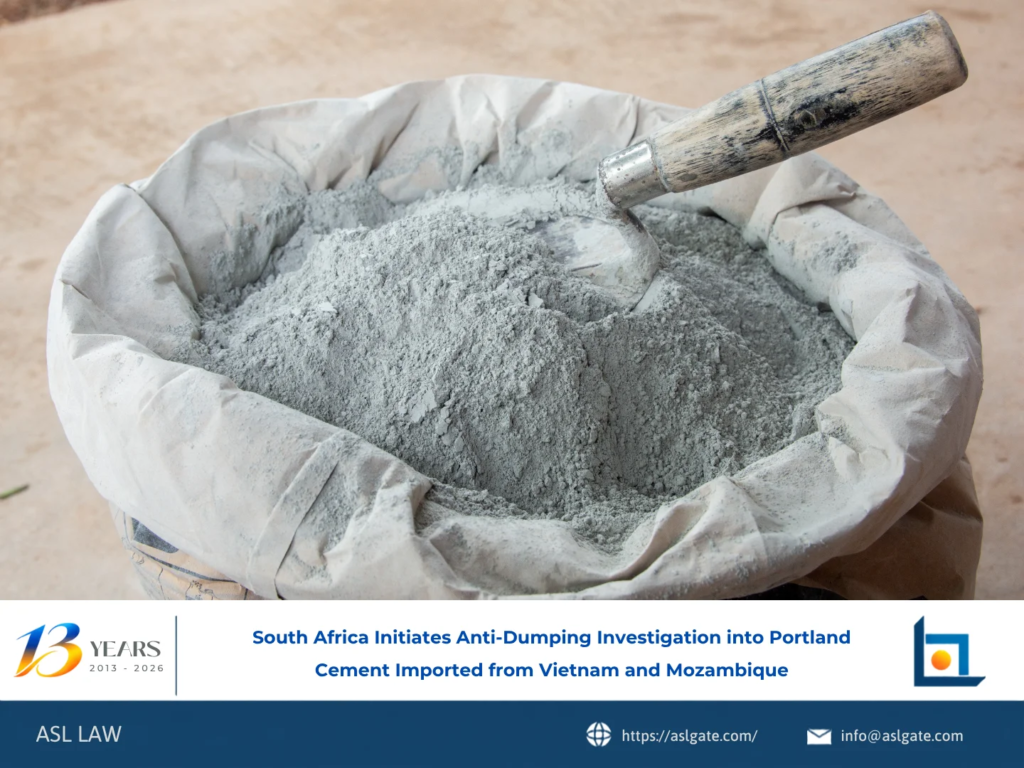
The International Trade Administration Commission of South Africa (ITAC) has initiated an anti-dumping (AD) investigation into Portland cement originating in or imported from Vietnam and Mozambique, following an application filed by Afrimat Industries South Africa Proprietary Limited, Intercement South Africa Proprietary Limited, and Dangote Cement South Africa Proprietary Limited.
The applicants allege that the products from Vietnam and Mozambique are being dumped into the Southern African Customs Union (SACU) market, causing material injury and threatening to cause material injury to the domestic industry.
1. Key Information on the Case
Product under investigation: Portland cement, classified under tariff subheading 2523.29, originating in or imported from Vietnam and Mozambique.
Period of investigation for dumping: January 1, 2025 to December 31, 2025.
Period of investigation for injury: January 1, 2023 to December 31, 2025.
For Vietnam, ITAC determined an alleged dumping margin of 37.04%. The investigating authority found prima facie evidence of dumping based on a comparison between normal value and export price.
Normal value was determined based on domestic cement price data published in construction material price tables by the Department of Construction of Quang Ninh Province. Export prices were determined based on import data from the South African Revenue Service (SARS), after adjusting for inland transportation costs to establish an ex-factory price.
With respect to injury, ITAC decided to assess the cumulative impact of imports from Vietnam and Mozambique. According to the applicants’ allegations, the SACU industry experienced declines in market share, sales volume, production, profitability, capacity utilization, cash flow, and employment, while inventories increased and price suppression and price depression occurred.
The applicants also alleged a threat of material injury due to the possibility that exporters’ production capacity could be redirected to the SACU market, increasing import volumes and affecting domestic prices.
2. Procedures and Deadlines for Businesses to Note
ITAC has sent the public version of the application and investigation questionnaires to known importers, exporters, and associations. Relevant companies should proactively verify whether they have received the complete application and questionnaires.
The deadline for submitting responses is 30 days from the date of publication of the notice or from the date the questionnaire is received. A letter is deemed to have been received seven days after it is sent.
ITAC may grant an extension of up to 14 days where a company has good cause and submits an extension request before the original deadline expires. Merely citing insufficient time may not be accepted as a valid reason.
Companies must simultaneously submit confidential and non-confidential versions of their submissions. The non-confidential version must adequately disclose the information omitted, explain the reasons for confidentiality, and provide a summary sufficient to enable the other parties to reasonably understand the substance of the confidential information.
ITAC may conduct an on-site verification, expected to take place approximately three to five weeks after receipt of the questionnaire responses from exporters. Information that is incomplete, submitted in an improper format, or cannot be verified may be rejected by ITAC and replaced with facts available, generally in a manner adverse to the company.
The parties may also request that ITAC hold a public hearing during the investigation where there are grounds to demonstrate that an oral presentation is necessary.
3. Recommendations for Vietnamese Businesses
Vietnamese producers and exporters of Portland cement to SACU should proactively review the initiation notice, complete the investigation questionnaire responses, and submit them within the prescribed deadline. Companies should also carefully review their production, sales prices, costs, export data, and related transactions to ensure that the information provided to ITAC is complete, accurate, and consistent.
At the same time, companies should prepare for the possibility of an on-site verification and continue to cooperate throughout the subsequent stages of the proceeding. Failure to provide complete information or to cooperate may result in ITAC relying on adverse facts available when determining the dumping margin.
This is a new AD investigation involving Vietnamese-origin goods in South Africa, against the backdrop of other trade remedy proceedings conducted by ITAC involving Vietnamese-origin products in recent years. Vietnamese businesses should therefore closely monitor developments in the case and proactively develop an appropriate response strategy from the early stage of the investigation.
To protect their legitimate interests, manufacturers and exporters should familiarize themselves with the procedure and actively contact Vietnam Antidumping Law Firm specializing in anti-dumping and trade remedy for timely assistance.
ASL Law is a leading full-service and independent Vietnamese law firm made up of experienced and talented lawyers. ASL Law is ranked as the top tier Law Firm in Vietnam by Legal500, Asia Law, WTR, and Asia Business Law Journal. Based in both Hanoi and Ho Chi Minh City in Vietnam, the firm’s main purpose is to provide the most practical, efficient and lawful advice to its domestic and international clients. If we can be of assistance, please email to [email protected].
ASL LAW is the top-tier Vietnam law firm for Anti-dumping & countervailing. If you need any advice, please contact us for further information or collaboration.