Tiếng Việt
 中文 (中国)
 日本語
日本語
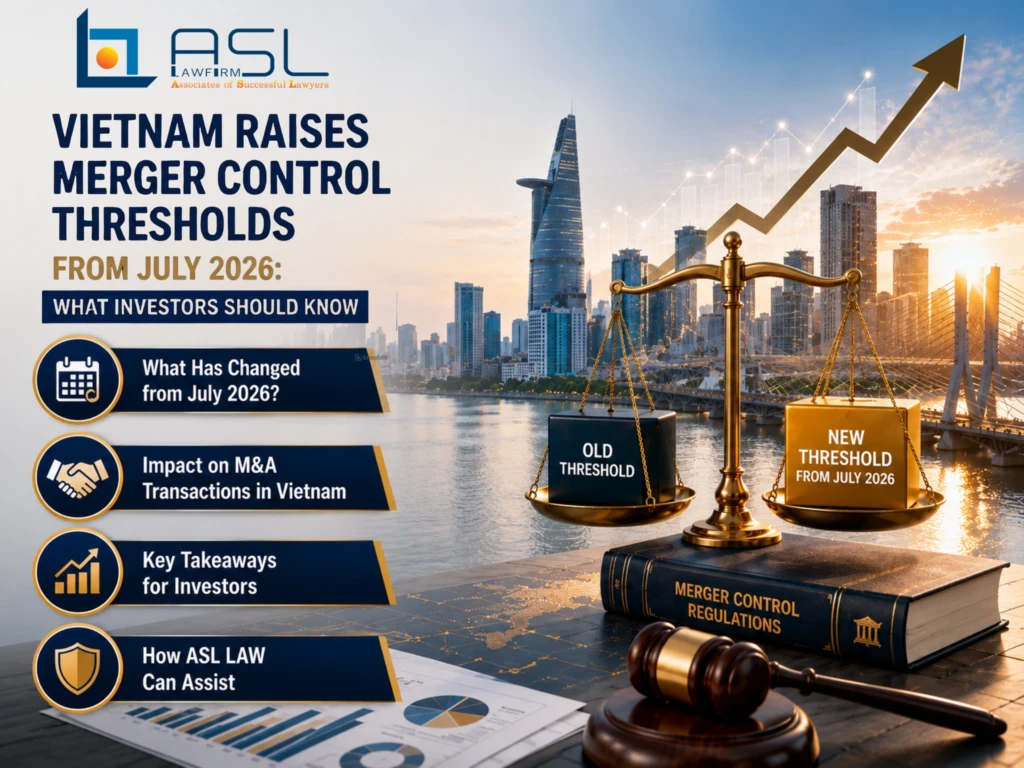
Vietnam will raise several key Vietnam merger control thresholds 2026 from 1 July 2026, marking an important Vietnam Competition Law update 2026 for investors, multinational corporations, private equity funds, strategic buyers, joint venture partners and businesses planning M&A transactions in Vietnam.
The change forms part of Vietnam’s broader efforts to reduce administrative procedures, simplify business conditions and create a more favorable oversea investment environment. For investors, the immediate effect is that certain transactions that would previously have triggered mandatory economic concentration notification may no longer require filing based solely on the old financial thresholds.
However, this does not mean that merger control risk in Vietnam has disappeared. The combined market share threshold remains unchanged at 20%, and transactions in concentrated or strategically important markets may still require careful competition law assessment.
In other words, Vietnam’s new merger control thresholds may reduce filing burdens, but they do not remove the need for early legal review.
1. What Has Changed from July 2026?
Under the new rules, several financial thresholds relevant to economic concentration notification will increase from 1 July 2026.
The key changes are:
| Threshold | Current level | New level from 1 July 2026 |
| Total assets in Vietnam | VND 3,000 billion | VND 6,000 billion |
| Total revenue in Vietnam | VND 3,000 billion | VND 6,000 billion |
| Domestic transaction value | VND 1,000 billion | VND 2,000 billion |
| Combined market share | 20% | 20% |
The most important practical change is that the total assets and total revenue thresholds will double from VND 3,000 billion to VND 6,000 billion, while the domestic transaction value threshold will double from VND 1,000 billion to VND 2,000 billion.
This is a significant development for investors, especially those involved in mid-sized M&A transactions, internal restructurings, domestic acquisitions, joint ventures and corporate reorganizations in Vietnam.
2. Why the New Thresholds Matter for Investors
Vietnam’s merger control regime applies to certain economic concentration transactions, including mergers, consolidations, acquisitions and joint ventures. If a transaction meets the applicable notification thresholds, the parties may be required to notify the Vietnam Competition Commission before implementation.
For investors, the new thresholds matter because they may affect:
- whether a transaction requires merger control filing in Vietnam;
- whether a filing condition should be included in the transaction documents;
- whether closing may be delayed pending regulatory review;
- whether competition law Vietnam due diligence is required;
- whether offshore transactions with Vietnamese market impact should be assessed;
- whether the transaction structure should be revised;
- whether the parties need to prepare market share and revenue data before signing.
The increase in thresholds is likely to reduce the number of filings for transactions that are financially smaller or less likely to affect market competition. This is consistent with Vietnam’s policy direction of cutting unnecessary administrative burdens and simplifying business conditions.
However, investors should not assume that a transaction is safe simply because one financial threshold is not met. Vietnam’s merger control regime still requires a structured assessment of transaction type, financial indicators, market share, relevant market, and potential competitive effects.
3. The 20% Combined Market Share Threshold Remains Important
One of the most important points for investors is that the combined market share threshold remains at 20%.
This means that transactions involving competitors, suppliers, distributors or businesses operating in narrow market segments may still require careful review, even if the revenue, asset or transaction value thresholds are no longer triggered.
The 20% threshold is particularly relevant for:
- acquisitions between competitors;
- joint ventures between market participants;
- transactions in niche markets;
- transactions in sectors with few players;
- vertical integrations involving suppliers and distributors;
- platform or digital market transactions;
- acquisitions of businesses with strong local market positions;
- transactions involving essential inputs, infrastructure, data or customer access.
For example, a transaction may fall below the new financial thresholds but still raise issues if the parties have a combined market share of 20% or more in a relevant Vietnamese market.
This is why investors should continue to conduct market share analysis, especially where the target is a leading player in a specialized sector.
4. Less Administrative Burden, But Not Less Competition Law Risk
The new thresholds should be welcomed by investors because they may reduce unnecessary filings and allow certain transactions to proceed more efficiently.
However, higher thresholds do not mean lower legal risk in all cases.
Merger control in Vietnam is not only a box-ticking exercise. It is part of the broader competition law framework designed to prevent transactions that may substantially restrict competition in Vietnam.
Investors should still consider whether a transaction may:
- create or strengthen market power;
- reduce the number of effective competitors;
- increase barriers to entry;
- limit consumer choice;
- affect pricing or supply conditions;
- restrict market access for competitors;
- create vertical foreclosure risks;
- increase control over data, platforms or distribution channels;
- raise concerns in sensitive or concentrated sectors.
In practice, competition law risk is not always proportional to transaction value. A smaller transaction in a narrow or highly concentrated market may raise more competition concerns than a larger transaction in a fragmented market.
5. Impact on M&A Transactions in Vietnam
For M&A transactions in Vietnam, the new thresholds may affect both legal strategy and transaction documentation.
Investors should review the following issues early in the deal process:
5.1. Filing assessment before signing
Before signing a share purchase agreement, asset purchase agreement, joint venture agreement or offshore investment agreement, investors should assess whether the transaction qualifies as an economic concentration and whether any notification threshold is triggered.
This assessment should be completed before parties agree on closing timelines.
5.2. Conditions precedent
If merger control filing may be required, the transaction documents should include appropriate conditions precedent, cooperation obligations, filing responsibilities, long-stop dates and risk allocation clauses.

5.3. Information collection
Even where filing may not ultimately be required, investors should collect key information early, including revenue, asset value, transaction value, market shares, business lines, competitors, customers and distribution channels.
5.4. Offshore transactions
Foreign investors should also assess offshore transactions if the parties have activities, assets, revenues, customers or market impact in Vietnam. The location of signing or closing is not always decisive.
5.5. Timing risk
Where filing is required, investors should factor merger control review into the transaction timeline. Failure to do so may delay closing or create regulatory risk.
6. Impact on Private Equity and Strategic Investors
Private equity funds and strategic investors should pay particular attention to the new rules.
The increase in financial thresholds may reduce filing obligations for certain mid-market transactions. However, funds and strategic buyers should still conduct competition law screening according to Vietnam Competition Law update 2026 where:
- the buyer already owns portfolio companies in the same or related markets;
- the target is active in a concentrated sector;
- the transaction involves a competitor or potential competitor;
- the investor may acquire control or decisive influence;
- the transaction forms part of a roll-up strategy;
- the offshore investment gives access to data, distribution networks or strategic assets;
- the deal involves healthcare, pharmaceuticals, logistics, energy, consumer goods, technology, e-commerce or digital platform competition law Vietnam.
For private equity funds, the analysis may need to consider not only the acquiring entity, but also relevant affiliates and portfolio companies, depending on the applicable rules and transaction structure.
7. Impact on Joint Ventures
Joint ventures may also be subject to Vietnam merger control rules if they qualify as an economic concentration and meet the relevant thresholds such as joint venture Vietnam competition law.
Investors should review merger control issues before forming a joint venture in Vietnam, particularly where the joint venture partners are competitors, operate in related markets, or contribute assets, customers, technology, data, distribution networks or production capacity.
A joint venture may raise competition law issues if it:
- reduces independent competition between the parties;
- coordinates market behavior;
- creates a stronger combined market position;
- restricts market access for third parties;
- involves exclusivity or non-compete arrangements;
- leads to information exchange between competitors;
- controls key infrastructure, data or distribution channels.
The higher financial thresholds may reduce filing obligations in some cases, but joint venture parties should still conduct a legal assessment before implementation.
8. Impact on Internal Restructuring
Internal restructuring transactions may also require merger control assessment in Vietnam, depending on the transaction structure and the relationship between the entities involved.
Corporate groups often assume that internal transfers, business reorganizations or intra-group acquisitions do not raise competition concerns. In many cases, this may be correct. However, investors should still review whether the transaction technically qualifies as an economic concentration and whether any applicable threshold is triggered.
This is especially important for multinational groups with substantial Vietnamese revenues, assets or operations.
9. What Investors Should Do Now
Investors planning transactions in Vietnam should take the following practical steps:
Step 1: Update merger control screening checklists
Existing internal checklists should be updated to reflect the new thresholds effective from 1 July 2026.
Step 2: Reassess pending transactions
For transactions expected to sign or close around July 2026, investors should reassess whether the old or new thresholds apply and whether the transaction timeline may affect filing strategy.
Step 3: Continue market share analysis
Because the combined market share threshold remains unchanged at 20%, market share analysis should remain part of every serious merger control assessment.
Step 4: Review transaction documents
Transaction documents should include appropriate provisions on merger control filing, cooperation, timing, information sharing and closing conditions.
Step 5: Conduct competition law due diligence
Investors should review not only filing obligations but also broader antitrust compliance risks, including distribution practices, pricing policies, exclusivity, customer allocation, non-compete arrangements, information exchange and abuse of dominance risks.
Step 6: Seek early legal advice
Early advice from Vietnam merger control lawyers can help investors avoid filing mistakes, closing delays, regulatory questions and post-closing compliance issues.
10. Key Takeaways for Investors
The new merger control thresholds are a positive development for investors in Vietnam, but they should be understood correctly.

The key takeaways are:
- Vietnam will raise certain merger control thresholds from 1 July 2026.
- Total assets and total revenue thresholds will double from VND 3,000 billion to VND 6,000 billion.
- The domestic transaction value threshold will double from VND 1,000 billion to VND 2,000 billion.
- The combined market share threshold remains unchanged at 20%.
- Some transactions may no longer require filing based on the old financial thresholds.
- Transactions in concentrated markets may still require careful assessment.
- Offshore transactions may still need Vietnam merger control review if they affect the Vietnamese market.
- Investors should update transaction checklists, due diligence processes and closing conditions.
- Higher thresholds reduce administrative burden, but they do not eliminate antitrust risk.
11. How ASL LAW Can Assist
ASL LAW advises investors, multinational corporations, foreign-invested enterprises, private equity funds, strategic buyers, joint venture partners and Vietnamese businesses on merger control, economic concentration and competition law matters in Vietnam.
Our services include:
- merger control filing assessment;
- economic concentration notification advice;
- transaction structure review;
- market share and relevant market analysis;
- Vietnam M&A Legal Services and competition law due diligence;
- drafting and reviewing merger control clauses;
- preparation of notification dossiers;
- communication with Vietnamese competition authorities;
- antitrust compliance review;
- Vietnam abuse of dominance risk assessment;
- competition law training;
- support for foreign investors and cross-border transactions.
Businesses seeking Competition lawyers in Vietnam, Vietnam Competition lawyers, Antitrust lawyers in Vietnam, Vietnam Antitrust lawyers or Vietnam merger control lawyers may contact ASL LAW for practical and commercially focused legal advice.
ASL LAW also supports clients as an Antitrust and competition law firm in Vietnam, Vietnam competition law firm, Competition law firm in Vietnam, Antitrust law firm in Vietnam and Vietnam Antitrust law firm for broader competition, antitrust, merger control and regulatory compliance matters.
12. Conclusion
Vietnam’s decision to raise merger control thresholds from July 2026 is an important step toward reducing administrative burdens and improving the investment environment.
For investors, the change may simplify certain transactions and reduce unnecessary filings. However, merger control analysis remains essential, particularly where a transaction involves competitors, concentrated markets, strong local players, digital platforms, data-driven business models or potential market power.
The practical message is simple: higher thresholds may reduce filing obligations, but they do not remove the need for competition law review.
Investors planning M&A, joint ventures, restructuring or strategic investments in Vietnam should reassess their merger control strategy early and seek legal advice before signing or closing.
FAQ
From 1 July 2026, Vietnam will increase certain financial thresholds for economic concentration notification in Vietnam. The total assets and total revenue thresholds will increase from VND 3,000 billion to VND 6,000 billion. The domestic transaction value threshold will increase from VND 1,000 billion to VND 2,000 billion. The combined market share threshold remains 20%.
No. A transaction must first qualify as an economic concentration and must meet one or more applicable notification thresholds according to rules on merger notification Vietnam 2026. Investors should assess the transaction type, revenue, assets, transaction value, market share and potential impact on the Vietnamese market.
Yes. The combined market share threshold remains unchanged at 20%. This means transactions in concentrated or niche markets may still require careful review even if the financial thresholds are not met.
Potentially yes. Offshore transactions may require Vietnam merger control regime assessment if they have or may have an impact on the Vietnamese market and the relevant thresholds are triggered.
Investors should conduct Vietnam M&A merger control screening, review the transaction structure, assess market share, check revenue and asset thresholds, consider whether notification is required, and include appropriate merger control clauses in the transaction documents.
Merger control filing mistakes may lead to regulatory delays, penalties, closing risks or post-closing compliance issues. Early legal advice helps investors structure transactions properly and avoid unnecessary regulatory exposure.
ASL Law is a leading full-service and independent Vietnamese law firm made up of experienced and talented lawyers. ASL Law is ranked as the top tier Law Firm in Vietnam by Legal500, Asia Law, WTR, and Asia Business Law Journal. Based in both Hanoi and Ho Chi Minh City in Vietnam, the firm’s main purpose is to provide the most practical, efficient and lawful advice to its domestic and international clients. If we can be of assistance, please email to [email protected].
ASL LAW is the top tier M&A law firm in Vietnam. If you need any advice, please contact us for further information or collaboration.