Tiếng Việt
 中文 (中国)
 日本語
日本語
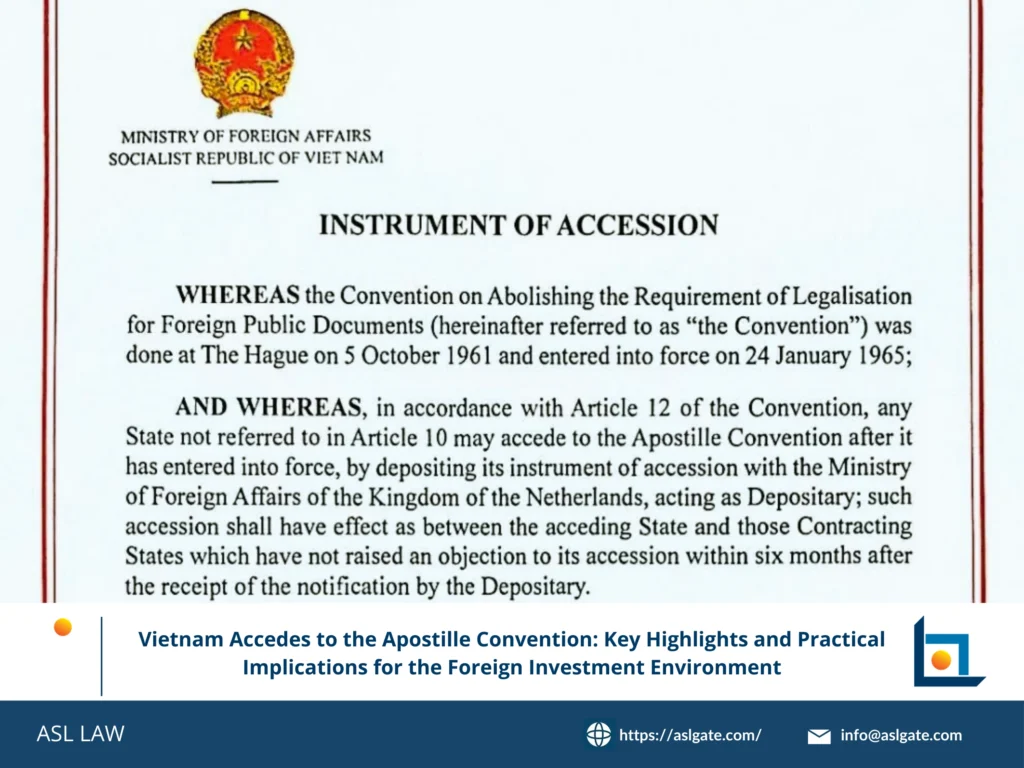
On 13 January 2026, the Ministry of Foreign Affairs of the Kingdom of the Netherlands, in its capacity as depositary, officially notified that Vietnam had deposited its Instrument of Accession to the 1961 Hague Convention Abolishing the Requirement of Legalisation for Foreign Public Documents (the Apostille Convention) on 31 December 2025. In accordance with the Convention’s mechanism, the accession will take effect in relations between Vietnam and those Contracting States that raise no objection as from 11 September 2026.
Vietnam’s accession to the Apostille Convention marks an important milestone in its international legal integration, particularly in the context of ongoing administrative reform, digital transformation, and the strategic priority of attracting oversea investment.
Key notes on Vietnam’s accession to the Apostille Convention
Adopted in 1961, the Apostille Convention aims to simplify the use of public documents among Contracting States. Instead of undergoing multiple stages of consular certification and legalisation in both the issuing and receiving countries, public documents need only be authenticated by a single Apostille certificate issued by a competent authority of the issuing State.
The scope of public documents covered by the Convention is determined by the law of the State of origin and generally includes documents issued by public authorities or judicial bodies, administrative documents, notarised instruments, certified signatures, and official certificates. The Convention does not apply to documents executed by diplomatic or consular agents, nor to administrative documents dealing directly with commercial or customs operations, although in practice some Contracting States still apply Apostilles to certain administrative documents of significance in international trade.
An Apostille certifies only the authenticity of the signature, the capacity in which the person signing the document has acted, and the identity of the seal or stamp affixed to the document. It does not certify the content of the document. This approach ensures formal legal reliability without encroaching on the receiving authority’s competence to assess the substance of the document.
Under the Convention, each Contracting State is required to designate one or more competent authorities to issue Apostilles. Vietnam has designated the Ministry of Foreign Affairs as the competent authority, including the Consular Department in Hanoi and the Ho Chi Minh City Department of Foreign Affairs, and has allowed for the issuance of both paper Apostilles and electronic Apostilles (e-Apostilles) in accordance with international standards.
Enterprises doing business in Vietnam should consider contacting a Vietnam business law firm for legal advice on Corporate services in Vietnam tailored-based to the enterprise’s specific circumstances.
Practical changes once the Apostille Convention takes effect in Vietnam
Once the Apostille Convention officially takes effect, procedures for the use of public documents between Vietnam and other Contracting States will be significantly streamlined. Individuals and businesses will no longer be required to undergo lengthy chains of consular certification and legalisation, which have traditionally entailed substantial time and costs.
For individuals, documents such as diplomas, certificates, birth certificates, marriage certificates, criminal record certificates, and powers of attorney to be used abroad or in Vietnam will become considerably more convenient. This is particularly meaningful for the Vietnamese diaspora, foreign nationals living, studying, and working in Vietnam, as well as families with cross-border elements.
For businesses, the use of public documents related to company establishment, changes in business registration, authorisations, and legal dossiers of foreign investors will become faster and more transparent. Although purely administrative documents directly related to commercial or customs activities do not fall within the mandatory scope of the Convention, Apostilles in practice still provide significant facilitative value in cross-border oversea investment transactions.
At the national level, the implementation of the Apostille Convention contributes to the standardisation of administrative procedures in line with international practice, reduces the burden on state authorities, and facilitates the deployment of digital solutions in the consular and judicial fields.
Accession to the Apostille Convention and its impact on Vietnam’s FDI attractiveness
From a foreign investment perspective, Vietnam’s accession to the Apostille Convention is widely regarded as a positive signal of its readiness for legal integration and its commitment to improving the investment climate. For investors from jurisdictions that rank among Vietnam’s leading sources of FDI—such as Singapore, Korea, Japan, China, Hong Kong, Taiwan, the Netherlands, and the United States—the simplification of public document recognition carries clear practical significance.
First, legal compliance costs during the pre-investment and project implementation phases are reduced, particularly for multinational groups that frequently rely on documents issued in multiple jurisdictions.
Second, the risk of administrative delays caused by consular legalisation requirements is mitigated, thereby helping to shorten the time required to bring projects into operation.
Third, the application of the Apostille regime enhances the predictability and transparency of the legal system, a key factor in long-term oversea investment decisions, especially in high value-added sectors such as technology, advanced manufacturing, finance, and professional services.
More broadly, accession to the Apostille Convention also helps improve Vietnam’s image as an investment destination with a legal framework increasingly aligned with international standards, complementing other ongoing reforms in investment, enterprise, and trade.
Conclusion
Vietnam’s accession to the Apostille Convention is not merely a procedural advancement in consular formalities, but also a strategic step in its broader legal integration and efforts to enhance the investment environment. When the Convention officially takes effect from September 2026, tangible benefits for individuals, businesses, and foreign investors are expected to become increasingly evident, thereby contributing to Vietnam’s national competitiveness and strengthening its position on the global investment map.
ASL Law is a leading full-service and independent Vietnamese law firm made up of experienced and talented lawyers. ASL Law is ranked as the top tier Law Firm in Vietnam by Legal500, Asia Law, WTR, and Asia Business Law Journal. Based in both Hanoi and Ho Chi Minh City in Vietnam, the firm’s main purpose is to provide the most practical, efficient and lawful advice to its domestic and international clients. If we can be of assistance, please email to [email protected].
ASL LAW is the top-tier Vietnam law firm for in-depth legal advice in Vietnam and internationally. If you need any advice, please contact us for further information or collaboration.