Tiếng Việt
 中文 (中国)
 日本語
日本語
For many years, most café and beverage shop owners in Vietnam have routinely played music through YouTube, Spotify, Apple Music, and other online platforms. Some even continue to use old USB drives containing thousands of songs downloaded years ago to create a relaxing atmosphere for customers, rarely questioning whether copyright obligations might arise. The ease of access to music on the Internet has led many business owners to regard it as a “free resource,” provided they do not reproduce or directly commercialize the recordings themselves.
In reality, this perception has never fully reflected the requirements of copyright in Vietnam and related rights framework. However, because the previous royalty collection mechanism was not fully developed and enforcement remained relatively limited, many business establishments did not view music royalties as a mandatory compliance cost.
From 1 July 2026, as Vietnam introduced a clearer framework for collecting royalties on music used in commercial establishments, cafés and beverage shops began facing a new operating expense. Although the amount payable is generally modest when calculated on a monthly basis, the new requirement has raised numerous questions among small business owners, particularly regarding the scope of licensed rights, the calculation of royalty fees, and the transparency of the licensing system.
Music Is No Longer “Free” for Commercial Use
For ordinary consumers, listening to music on digital platforms is generally considered a personal activity. However, once music is used to create an atmosphere for business, attract customers, or enhance the value of services, its legal nature changes.
In other words, music is no longer merely a form of personal entertainment but becomes part of a commercial activity. In many jurisdictions, restaurants, hotels, shopping centres, cafés, and other commercial venues have long been required to pay royalties for copyright in Vietnam through collective management organizations.
In Vietnam, from 1 July 2026, the new regulations formally brought the use of music in business establishments such as cafés and beverage shops under a clearer royalty collection framework.
Under the current mechanism, the annual royalty fee is calculated using the following formula:
Statutory Base Salary × Adjustment Coefficient
The amount payable depends on the size of the business premises. The larger the establishment, the higher the royalty fee. However, the annual royalty payment is capped at VND 20 million.
According to a report by Vietnam Television (VTV), a café with an area of approximately 23 square metres is expected to pay around VND 1.7 million per year, equivalent to roughly VND 140,000 per month. Meanwhile, a café covering approximately 60 square metres may be required to pay about VND 5 million annually under the current calculation formula.
From an operational cost perspective, these amounts may not represent a significant financial burden for many businesses. Nevertheless, the nationwide implementation of this royalty requirement has prompted numerous business owners to review how they use music in their daily operations.
Questions That Many Business Owners Continue to Raise
Although the royalty collection framework has now been implemented, many questions remain within the business community.
One of the most common concerns is whether paying the royalty fee entitles a café to use every song available on the Internet.
Many business owners also wonder whether the royalty covers only Vietnamese musical works or also includes international music; whether additional licences are required when playing music through Spotify, YouTube, or Apple Music; and whether paying the fee once is sufficient to satisfy all copyright obligations.
These questions are entirely reasonable because, in practice, the rights associated with a musical work are often owned by multiple parties.
A single song may simultaneously involve the rights of the composer, performer, producer of the sound recording, and other commercial rights holders. Furthermore, collective management organizations in different jurisdictions generally represent only certain categories of rights and do not necessarily administer the entire catalogue of domestic and international music.
Accordingly, paying a royalty fee does not automatically grant businesses unrestricted rights to use every musical work available in the marketplace.
For this reason, the issue that concerns many business owners today is no longer simply “How much do we have to pay?” but rather “What exactly are we permitted to use after making the payment?” This question is fundamental to both the transparency of the copyright management system and the practical ability of small businesses to achieve legal compliance.
A Lawyer’s Perspective on the Compliance Cost Challenge
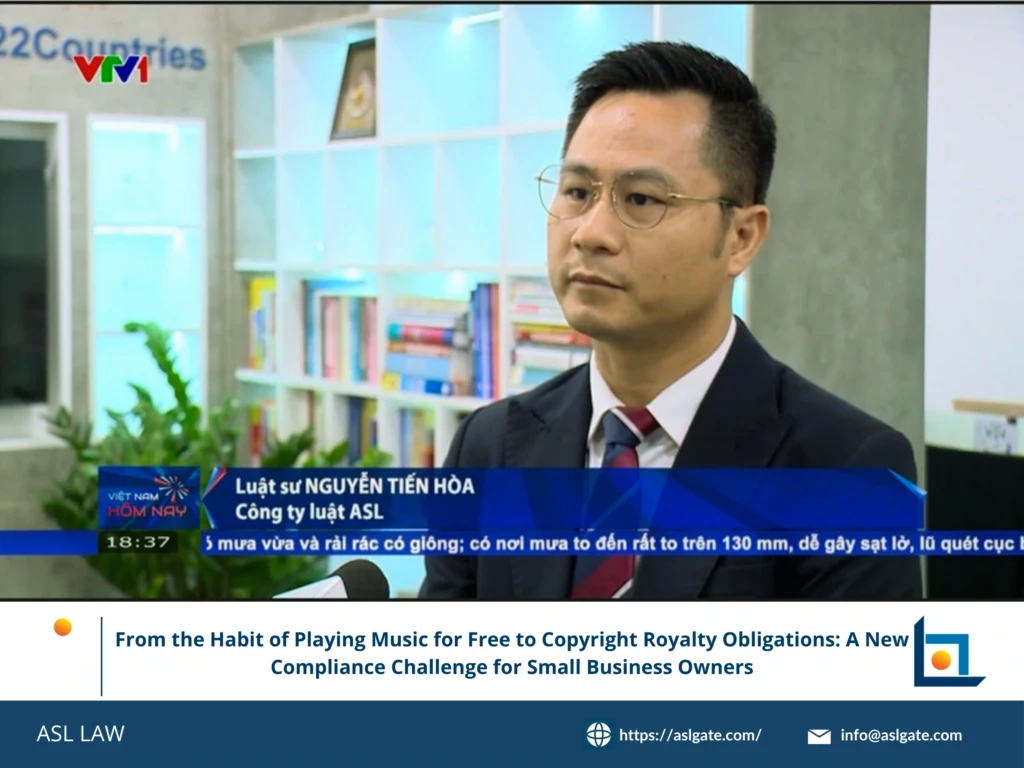
Responding to these concerns raised by the business community, Senior Partner Nguyen Tien Hoa of ASL LAW commented:
“Vietnam has already seen the Vietnam Center for Protection of Music Copyright pioneer the collection of copyright royalties from certain cafés and supermarkets. However, we still lack a transparent, clear, and reasonable mechanism. The question is whether support measures could be introduced to assist small and medium-sized enterprises in stimulating economic growth…”

This observation highlights an important issue in the continuing development of Vietnam’s intellectual property framework: protecting the rights of creators must be balanced against the compliance capacity of the business community, particularly small and micro-sized enterprises.
In principle, royalty collection is consistent with international practice and with the broader objective of protecting intellectual property rights. Ensuring that composers, musicians, and owners of copyright in Vietnam receive appropriate remuneration for the commercial exploitation of their works provides an important incentive for continued creative activity.
However, an effective system should not merely establish payment obligations. It should also ensure that those paying the fees clearly understand the scope of rights they obtain after fulfilling their obligations.
If the scope of licences, the catalogue of managed works, the relationship between domestic and foreign collective management organizations, or the responsibilities of each licensing body are not made sufficiently transparent, businesses may find it difficult to determine whether they have fully complied with applicable legal requirements.
From a policy perspective, consideration may also be given to developing appropriate support mechanisms for small businesses, household businesses, and newly established enterprises. Designing a framework that both safeguards the legitimate interests of copyright owners and avoids imposing unnecessary compliance costs during the early stages of business operations could encourage greater voluntary compliance rather than relying primarily on enforcement measures.
ASL Law is a leading full-service and independent Vietnamese law firm made up of experienced and talented lawyers. ASL Law is ranked as the top tier Law Firm in Vietnam by Legal500, Asia Law, WTR, and Asia Business Law Journal. Based in both Hanoi and Ho Chi Minh City in Vietnam, the firm’s main purpose is to provide the most practical, efficient and lawful advice to its domestic and international clients. If we can be of assistance, please email to [email protected].
ASL LAW is the top-tier Vietnam law firm for Intellectual Property Services. If you need any advice, please contact us for further information or collaboration.