Tiếng Việt
 中文 (中国)
 日本語
日本語
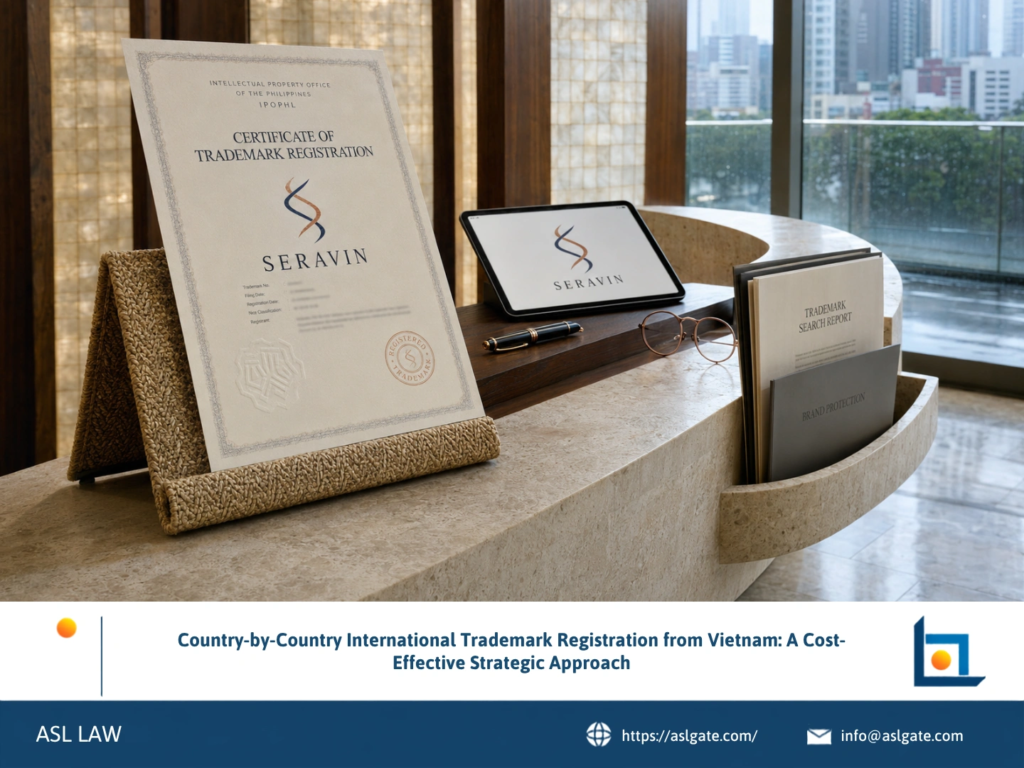
For Vietnamese businesses expanding internationally, Vietnam trademark registration does not necessarily have to cover every possible country from the beginning. A country-by-country approach can allow businesses to prioritize the markets that matter most, allocate their IP budget more efficiently, and adapt trademark protection to actual commercial expansion. Cost-effective country-by-country trademark filing Vietnam businesses undertake can therefore be a practical alternative to pursuing broad international protection without a clear market strategy.
International trademark protection can involve substantial costs, particularly when a business enters multiple jurisdictions with different filing requirements, official fees, local representation rules, translation requirements, and examination procedures. A carefully planned direct filing strategy can help businesses control these expenses while still securing protection in strategically important markets.
Why Country-by-Country Filing Can Be More Cost-Effective
International trademark registration is not necessarily a one-size-fits-all exercise. A Vietnamese company may have immediate commercial activities in three foreign markets but no concrete plans to enter ten other jurisdictions. Filing applications in every potentially relevant country at the same time could therefore tie up resources without producing corresponding commercial value.
A country-by-country strategy drafted by top-tier Vietnam Intellectual Property Law Firm allows the business to connect trademark expenditure with actual commercial priorities.
For example, a company may initially focus on countries where it:
- Already exports products;
- Is negotiating distribution agreements;
- Plans to establish a subsidiary;
- Expects to launch a franchise; or
- Has identified substantial future sales potential.
This approach can make cost-effective country-by-country trademark filing Vietnam businesses pursue more closely aligned with their actual international expansion plans.
The objective is not simply to spend less. It is to ensure that each trademark investment provides meaningful commercial protection.
When Direct National Registration Makes Strategic Sense
Strategic direct national trademark registration from Vietnam can be particularly useful when a business has identified a small number of high-priority markets.
Direct national filing means that the business applies directly under the trademark system of the relevant country rather than relying on a centralized international filing mechanism. This can provide greater flexibility where the business has specific requirements in a particular jurisdiction.
For example, a Vietnamese business may have identified one country as its principal export destination and another as the location for a future subsidiary. Instead of immediately creating a broad international portfolio, the business can prioritize those two markets and assess additional countries as its commercial plans develop.
Direct filing can also be relevant where the business expects a particular country to present substantive trademark issues requiring a highly tailored filing strategy.
The appropriate choice will depend on the countries involved, the business’s expansion plans, the nature of the mark, and the applicable local procedures.
Balancing Filing Costs Against Commercial Priorities
Trademark costs should be evaluated as part of the company’s overall international expansion budget.
Official filing fees are only one component. Businesses may also need to consider professional fees, translation costs, local agent fees, examination responses, publication fees, registration fees, renewal costs, and potential enforcement expenses.
A company that chooses markets solely because the initial filing fee is low may therefore overlook the total cost of maintaining and enforcing the trademark.
Optimizing costs in country-specific trademark registration requires a longer-term perspective. Before filing, businesses should consider not only how much a Vietnam trademark registration application costs today but also whether the market is likely to justify continued protection.
A useful way to prioritize markets is to divide them into different levels:
| Priority | Typical market | Suggested approach |
| High | Current major revenue or immediate expansion market | File promptly |
| Medium | Planned expansion market | Monitor and file according to launch timetable |
| Low | Potential future market with uncertain commercial plans | Reassess before filing |
This type of prioritization can prevent a company from accumulating a large portfolio of registrations that have little commercial relevance.
Using a Phased Filing Strategy
A phased filing strategy can be particularly useful for businesses whose international expansion will occur gradually.
Rather than attempting to protect the brand in every possible jurisdiction simultaneously, a company can begin with the countries that have the highest commercial priority. As sales, investment, distribution, or licensing activities expand, additional trademark applications can then be considered.
This is one of the more budget-friendly international trademark strategies Vietnam businesses can adopt because trademark expenditure can follow actual business development.
For example, a Vietnamese manufacturer may initially export to Japan and Singapore, then expand into Canada and the United States two years later. The trademark strategy can be structured around those stages rather than treating all four markets as equally urgent from the beginning.
However, phased filing requires careful planning. A business should not wait until the last moment before entering a new market. Trademark clearance and filing should ideally take place sufficiently early to identify potential conflicts and address them before commercial launch.
The cheapest filing strategy is not necessarily the most economical strategy if the company discovers a trademark conflict after investing heavily in a foreign market.
How to Control Costs Without Weakening Protection
Economical approaches to global trademark protection should focus on prioritization rather than simply reducing the number of applications.
A company can often improve efficiency by creating a structured trademark portfolio before filing. This means determining which marks are commercially important and which goods and services genuinely need protection in each target country.
Businesses should also consider whether the same mark will be used across multiple markets. Where appropriate, consistent branding can make the international portfolio easier to manage, while country-specific differences may require adjustments.
Another important consideration is avoiding unnecessary filings. Registering every conceivable variation of a brand in every class and country can produce a large portfolio without necessarily creating proportional commercial value.
At the same time, excessive cost-cutting can create serious gaps. A business may save money by failing to protect a product name, local-language version, or key class of goods, only to face significant expenses later when another party registers a similar mark.
The goal of optimizing costs in country-specific trademark registration is therefore to identify the right level of protection for each market.
Country-Specific Filing and the Broader International Strategy
Country-by-country registration does not mean that a business must abandon centralized international filing systems.
In practice, Vietnamese businesses can evaluate direct national applications alongside mechanisms such as the Madrid System. The most suitable approach may differ from one expansion project to another.
A business with operations concentrated in a few strategically important countries may find direct national filing more practical. Another company expecting rapid expansion across numerous Madrid System members may benefit from a centralized international filing strategy.
The two approaches can also complement each other. A company may use direct filings in certain strategically important jurisdictions while relying on an international registration for other markets where the centralized system provides administrative advantages.
This flexibility is particularly valuable when the company’s international expansion is unpredictable.
Trademark strategy should therefore be reviewed periodically rather than treated as a decision made once at the beginning of internationalization.
Building a Cost-Efficient Trademark Portfolio from Vietnam
The most effective cost-effective country-by-country trademark filing Vietnam businesses can implement begins with understanding where the brand actually creates value.
A practical strategy is to review the portfolio whenever there is a significant change in the company’s international business plan. A new distributor, overseas investment project, major export contract, franchise arrangement, or new product launch may justify reassessing trademark priorities.
Before each new filing, the business should consider:
- Whether the mark has been cleared in the target country;
- Whether the goods and services correspond to actual commercial activities;
- Whether the market justifies the cost of registration and long-term maintenance; and
- Whether direct national filing or another international mechanism is more appropriate.
This approach helps transform trademark registration from a purely administrative expense into a planned component of international market development.
For businesses with limited IP budgets, the ability to prioritize can be particularly valuable. Strategic direct national trademark registration from Vietnam allows the company to direct resources toward markets where the risk and commercial value are highest instead of spreading the budget too thinly across numerous jurisdictions.
Ultimately, maximizing the value of an international trademark portfolio is not about obtaining the greatest possible number of registrations. It is about obtaining meaningful protection where the business is most likely to compete, invest, sell, license, or build long-term brand value.
Frequently Asked Questions
1. Is country-by-country trademark filing cheaper than international trademark registration?
Not necessarily. The total cost depends on the number of countries, applicable official fees, professional fees, translations, local representation requirements, and future maintenance. For a business targeting only a few countries, however, direct national filing may provide a cost-efficient solution.
2. When should Vietnamese businesses consider strategic direct national trademark registration from Vietnam?
Direct national filing via Vietnam Intellectual Property Law Firm may be appropriate when a company has identified a limited number of priority markets, requires a country-specific filing strategy, or has particular legal or commercial reasons for applying directly in a jurisdiction.
3. How can businesses implement budget-friendly international trademark strategies Vietnam companies can realistically afford?
Businesses can prioritize markets based on commercial importance, adopt phased filing, conduct clearance searches before entering new markets, and avoid unnecessary registrations while ensuring that strategically important goods, services, and brand variations are adequately protected.
4. What does optimizing costs in country-specific trademark registration involve?
It involves looking beyond the initial filing fee and considering the complete cost of obtaining, maintaining, and enforcing protection. Businesses should compare those costs with the commercial value and infringement risks associated with each target market.
5. Is country-by-country filing still useful if a business may eventually expand worldwide?
Yes. A phased country-by-country strategy can allow a business to protect priority markets first while preserving the flexibility to expand its portfolio later. As the company’s international operations develop, it can reassess whether additional national filings or a centralized international registration strategy would be more efficient.
ASL Law is a leading full-service and independent Vietnamese law firm made up of experienced and talented lawyers. ASL Law is ranked as the top tier Law Firm in Vietnam by Legal500, Asia Law, WTR, and Asia Business Law Journal. Based in both Hanoi and Ho Chi Minh City in Vietnam, the firm’s main purpose is to provide the most practical, efficient and lawful advice to its domestic and international clients. If we can be of assistance, please email to [email protected].
ASL LAW is the top-tier Vietnam law firm for Intellectual Property Services. If you need any advice, please contact us for further information or collaboration.