Tiếng Việt
 中文 (中国)
 日本語
日本語
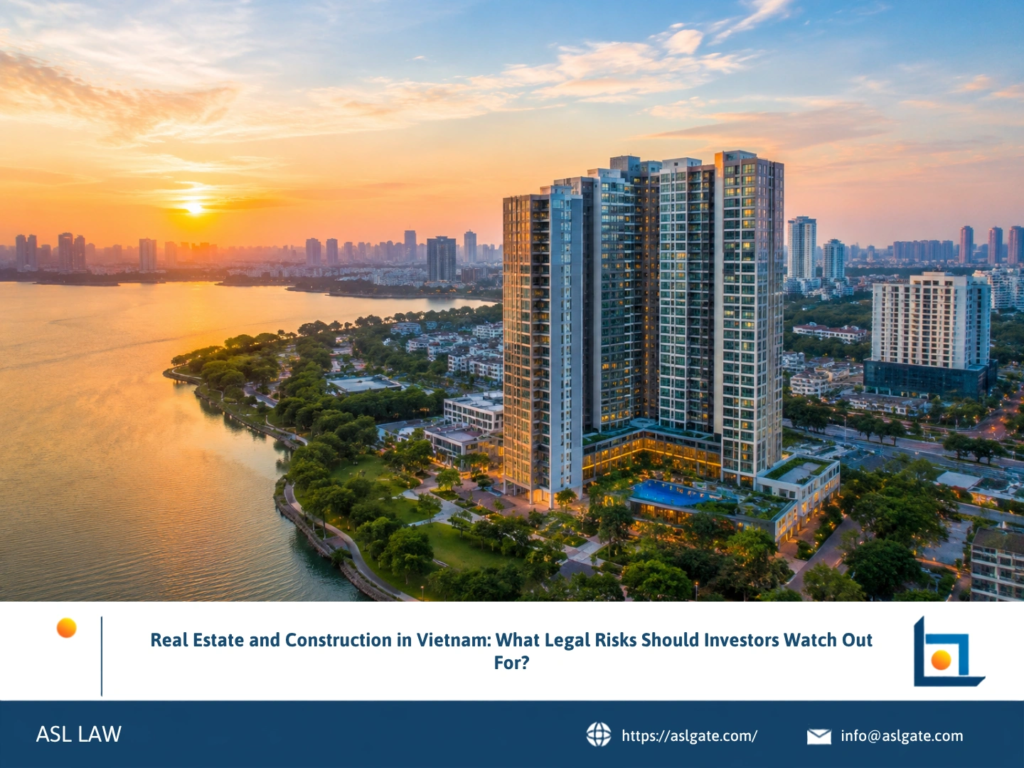
Projects involving real estate and construction in Vietnam can offer substantial opportunities, but investors must navigate a legal framework involving land, investment, planning, housing, real estate business, construction, environmental requirements, and project approvals. In 2026, the regulatory environment has also continued to evolve, making legal review particularly important before investors commit significant capital. Understanding the legal risks in Vietnam real estate investment can help investors identify problems earlier, structure transactions more effectively, and avoid acquiring projects whose legal difficulties may be costly to resolve.
For foreign and domestic investors alike, the most serious risks are often not immediately visible from a project’s commercial presentation. A project may have an attractive location and strong market potential while still facing unresolved land issues, incomplete approvals, planning constraints, construction compliance problems, or limitations on the investor’s ability to develop and transfer the project.
Land Status and Project Legality Should Come First
The first question in any real estate transaction should be whether the project has a legally viable land position.
Investors should not rely solely on a land-use certificate or documents presented by the seller. The legal status of the land needs to be considered together with its land-use purpose, planning status, land allocation or lease arrangements, financial obligations, encumbrances, and the project’s approved oversea investment objectives.
Vietnam’s land framework has also been undergoing significant implementation changes in 2026. For example, Decree No. 49/2026/NĐ-CP provides detailed rules relating to mechanisms for addressing difficulties in implementing the Land Law, while Decree No. 50/2026/NĐ-CP addresses land-use fees and land rents under the relevant framework.
This means investors should be particularly careful when reviewing projects that have experienced delays, historical land disputes, outstanding financial obligations, or changes in their approved development plans.
A land issue can affect much more than ownership. It can influence whether the project can proceed, whether construction approvals can be obtained, whether assets can be transferred, and whether financing can be secured.
For this reason, land due diligence should normally be treated as the starting point rather than one item on a long checklist.
Planning, Investment Approval and Development Conditions
A second major category of legal risks in Vietnam real estate investment concerns the relationship between the project’s investment approval, planning status, land arrangements, and development objectives.
Investors should establish whether the project is consistent with the applicable planning framework and whether the approvals already obtained actually support the development that is being contemplated.
A project may have received one form of approval without having completed every legal step necessary for construction or commercial operation. Confusing these stages can lead investors to assume that a project is further advanced legally than it actually is.
This is particularly important for acquisitions. When purchasing an existing project, an investor should determine which approvals can continue after the transaction and which matters must be amended, re-approved, or otherwise addressed following a change in investor or project structure.
The issue becomes even more important in 2026 because the legal framework governing investment and land continues to develop. The Law amending the Law on Investment, adopted in August 2026, is scheduled to take effect on 1 March 2027. Investors planning transactions that extend into 2027 should therefore consider upcoming regulatory changes rather than assessing the transaction exclusively under today’s rules.
Legal advisors and compliance specialists from Vietnam Real estate law firm can assist investors in interpreting new regulatory requirements and adapting project structures accordingly.
Construction Compliance Can Create Significant Project Risks
Once the land and investment structure have been reviewed, investors need to examine the construction side of the project.
Construction sector legal pitfalls for investors Vietnam projects can encounter include problems relating to construction permits, design documentation, technical requirements, contractor arrangements, project management, construction quality, and acceptance procedures.
Vietnam’s construction framework has undergone a particularly important update in 2026. Law No. 135/2025/QH15 on Construction took effect on 1 July 2026, with certain provisions taking effect earlier. The law establishes the current framework governing construction activities, responsibilities of relevant parties, and state management of construction.
Nghị định No. 217/2026/NĐ-CP, also effective from 1 July 2026, provides detailed rules on construction activity management, including matters concerning construction design and applicable standards.
Investors should therefore avoid assuming that compliance under an earlier regulatory framework automatically means that a project is compliant with the requirements currently applicable to its next stage of development.
Before acquiring or funding a project, the construction review should examine whether the actual project matches the approved documents. Differences between approved designs and construction activities can create significant consequences, particularly where the discrepancy affects safety, planning, project scale, or the ability to complete acceptance and put the project into operation.
Real Estate Business and Property Transaction Risks
Another important area concerns the legal conditions for putting real estate products onto the market.
Real estate developers need to distinguish between owning or developing a project and being legally entitled to sell, lease, transfer, or otherwise commercialize particular real estate products.
This creates key regulatory risks in Vietnam property market transactions where investors rely on commercial assumptions rather than verifying the legal conditions for each transaction.
For example, an investor considering a residential development should examine whether the relevant project and products have satisfied the conditions required for the intended form of commercialization. The timing of sales, contractual arrangements, customer payments, and project documentation can all have legal implications.
The regulatory framework for housing and real estate business has also been updated in 2026. Decree No. 54/2026/NĐ-CP amended and supplemented regulations concerning housing and real estate business, including provisions implementing the Housing Law and Law on Real Estate Business.
Accordingly, investors should verify the current regulatory position rather than relying on transaction structures used in earlier projects.
For an acquisition, this review should also cover existing customer contracts, deposits, sale agreements, obligations to purchasers, disputes, and outstanding commitments. A purchaser of a project may effectively inherit commercial and legal obligations that are not obvious from the project’s headline valuation.
Companies should carefully consider dispute resolution clauses with outsourced legal services provided by top-tier Vietnam law firm when negotiating real estate contracts to ensure that future disputes can be handled efficiently.
Due Diligence Should Cover More Than the Property Itself
Due diligence for investment risks of real estate and construction in Vietnam investors face should extend beyond checking title documents.
A comprehensive review should connect the project’s legal, financial, technical, commercial, and regulatory position. The objective is to understand whether the project can actually deliver the oversea investment return assumed in the transaction.
A practical due diligence process may examine:
- Land documents and land-use status;
- Investment and project approvals;
- Planning and construction documentation;
- Existing financing, security interests, and financial obligations;
- Construction contracts and major supplier arrangements;
- Customer contracts and sales commitments;
- Environmental and other regulatory requirements;
- Existing disputes, complaints, inspections, or administrative violations; and
- The legal consequences of changing the project’s investor or ownership structure.
Historical compliance deserves particular attention. In 2026, the Government issued measures addressing certain longstanding land violations and stalled projects. Nghị quyết No. 29/2026/QH16, effective from 1 May 2026, establishes special mechanisms and policies for handling certain land-law violations arising before the 2024 Land Law took effect and for addressing long-delayed projects.
For investors, this demonstrates why a project’s history matters. A problem that appears to be administrative or historical may still affect the project’s present legal status and future development.
Foreign Investors Should Consider the Investment Structure and Exit Strategy
Foreign investors face an additional layer of legal analysis because real estate investment may involve investment registration, corporate structure, land-use arrangements, business-sector restrictions, and conditions applicable to particular forms of real estate activity.
The investment structure should therefore be assessed before the transaction is finalized.
An investor should understand not only how it will enter the project but also how it will eventually exit. Potential exit routes may include a project transfer, share or capital transfer, restructuring, sale of completed assets, or other transaction structures. Each route can raise different legal, tax, regulatory, and approval considerations.
This is particularly relevant when the investment is structured through acquisition of shares or capital rather than direct acquisition of project assets. A share acquisition may appear commercially efficient, but the investor may also acquire the target company’s historical liabilities and unresolved regulatory problems.
The same principle applies to construction projects. Investors should establish responsibility for existing defects, unfinished works, contractor disputes, regulatory violations, and future compliance obligations before completing the transaction.
Critical legal warnings for Vietnam construction investors should therefore include not only whether construction can legally proceed, but also who will ultimately bear the cost of correcting historical problems.
How Investors Can Reduce Legal Risks Before Committing Capital
The strongest protection against legal risks in Vietnam real estate investment is not simply obtaining more documents. It is identifying which legal issues could materially affect the investment decision and addressing those issues before signing binding transaction documents.
Investors should distinguish between problems that can be corrected, problems that require additional approvals, and problems that fundamentally undermine the project’s viability.
Where material issues are identified, the transaction documents can potentially address them through conditions precedent, representations and warranties, indemnities, escrow arrangements, price adjustments, completion conditions, or termination rights, depending on the transaction structure.
Investors should also avoid treating legal due diligence as a one-time exercise completed immediately before signing. Major projects can remain under development for years, during which land regulations, construction requirements, planning decisions, and administrative procedures may change.
The 2026 regulatory developments demonstrate this clearly. New rules concerning land implementation, real estate business, and construction have continued to reshape the legal environment.
A sound investment strategy therefore combines legal due diligence with continuous regulatory monitoring throughout the project’s lifecycle.
Frequently Asked Questions
1. What are the main legal risks in Vietnam real estate investment?
The main risks may involve land-use rights, planning, investment approvals, project development conditions, construction compliance, real estate commercialization, financing, contractual obligations, environmental requirements, and historical administrative violations. The significance of each risk depends on the specific project and transaction structure.
2. What are the major construction sector legal pitfalls for investors Vietnam projects may face?
Common issues include discrepancies between approved and actual construction, incomplete permits or approvals, defective or incomplete design documentation, contractor disputes, failure to satisfy applicable technical requirements, and difficulties completing acceptance or putting the project into operation.
3. How should investors conduct due diligence for real estate investment risks Vietnam projects present?
Due diligence should review the project’s land, investment, planning, construction, financing, contractual, commercial, environmental, and dispute history. Investors should also examine whether the approvals and documents remain appropriate for the project’s intended development and transaction structure.
4. What are the key regulatory risks in Vietnam property market transactions in 2026?
Investors should pay particular attention to continuing implementation changes in land law, updated regulations on housing and real estate business, and the new construction framework effective from July 2026. Projects with historical land or regulatory problems also require careful review in light of the mechanisms introduced in 2026 for certain stalled or problematic projects.
5. What are the most important critical legal warnings for Vietnam construction investors?
Investors should not assume that land ownership or project approval automatically means that construction and commercialization can proceed without further requirements. They should verify the project’s current approvals, construction compliance, contractual liabilities, historical violations, and the allocation of responsibility for correcting existing problems before committing substantial capital.
ASL Law is a leading full-service and independent Vietnamese law firm made up of experienced and talented lawyers. ASL Law is ranked as the top tier Law Firm in Vietnam by Legal500, Asia Law, WTR, and Asia Business Law Journal. Based in both Hanoi and Ho Chi Minh City in Vietnam, the firm’s main purpose is to provide the most practical, efficient and lawful advice to its domestic and international clients. If we can be of assistance, please email to [email protected].
ASL LAW is the top tier Real Estate law firm in Vietnam. If you need any advice, please contact us for further information or collaboration.