Tiếng Việt
 中文 (中国)
 日本語


A trademark application in Vietnam may be refused because the proposed mark lacks distinctiveness, conflicts with an earlier trademark, falls within a category of signs prohibited by law, or does not satisfy other statutory requirements. Under Article 117 of Vietnam’s Law on Intellectual Property, an application may also be refused where the applicant lacks the…

17
Oct
Oct
Businesses that discover a trademark application in Vietnam that is identical or confusingly similar to their existing brand may oppose its registration before the Intellectual Property Office of Vietnam (IPVN). For trademark applications published from April 1, 2026, the statutory opposition period is three months from publication. The opponent must submit a written objection in…

19
Oct
Oct
The trademark registration timeline Vietnam businesses should plan for depends on the application’s filing date, examination stages, and any issues that arise during processing. For trademark applications published from April 1, 2026, the revised legal framework provides for publication within one month after an application is deemed valid and substantive examination within five months from…

21
Oct
Oct
The trademark registration cost Vietnam businesses should budget for consists of government fees and, where applicable, professional service fees charged by a trademark representative or lawyer. For a standard application covering one class and up to six goods or services, the currently published basic official charges total approximately VND 1,325,000 before any eligible VNeID exemption,…

22
Oct
Oct
To conduct a trademark search in Vietnam before registration, businesses should search for the proposed brand name and its variations in official trademark databases, examine similar marks covering related goods and services, and assess potential conflicts with earlier rights. A reliable trademark search Vietnam strategy should consider spelling, pronunciation, visual similarities, relevant goods and services,…

19
Oct
Oct
To complete trademark registration in Vietnam, applicants must identify a distinctive mark, determine the goods and services to be protected, prepare the required documents, and file an application with the Intellectual Property Office of Vietnam (IPVN). The application then proceeds through formal examination, publication, substantive examination, and a decision on whether protection can be granted….
14
Sep
Sep
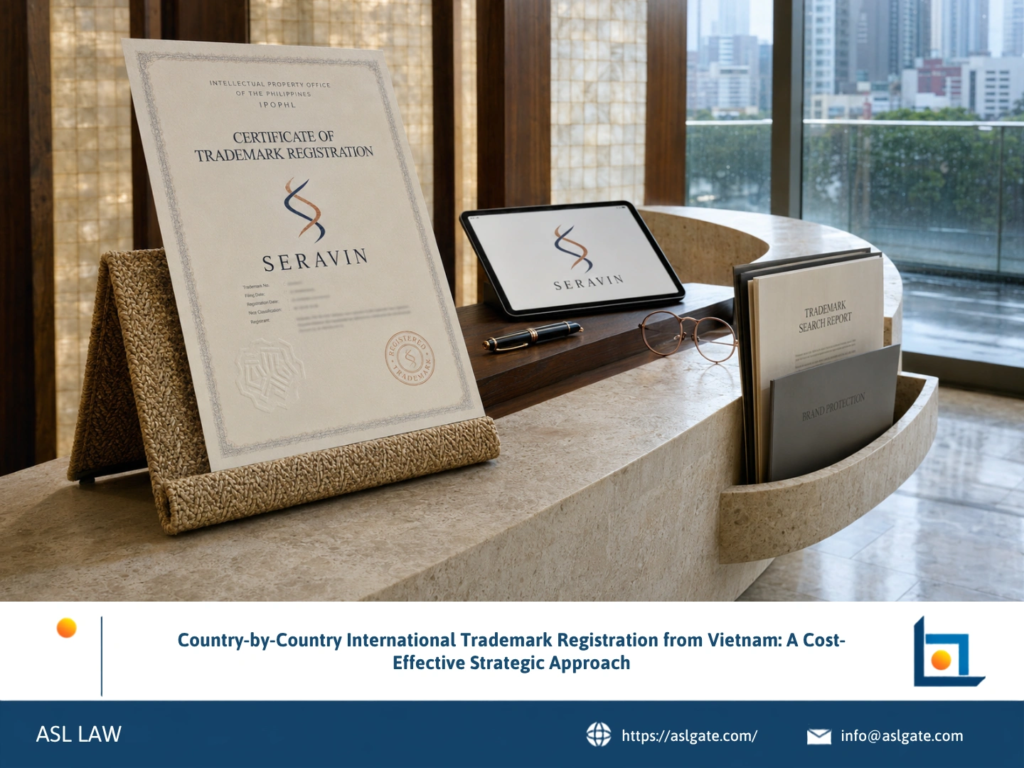
For Vietnamese businesses expanding internationally, Vietnam trademark registration does not necessarily have to cover every possible country from the beginning. A country-by-country approach can allow businesses to prioritize the markets that matter most, allocate their IP budget more efficiently, and adapt trademark protection to actual commercial expansion. Cost-effective country-by-country trademark filing Vietnam businesses undertake can…

15
Sep
Sep
For Vietnamese businesses expanding beyond the domestic market, Vietnam trademark registration should ideally move at the same pace as international business development. A brand that enters a foreign market without adequate trademark protection may face registration conflicts, infringement, counterfeiting, or even attempts by third parties to register the brand first. The Madrid System offers Vietnamese…

17
Sep
Sep
Preventing trademark theft in Vietnam has become increasingly important as Vietnamese businesses expand into e-commerce, international markets, franchising, licensing, and digital platforms. A brand that has been built over years can become vulnerable when another party registers a similar or identical trademark first, copies important brand elements, or deliberately targets the reputation that a business…

21
Jul
Jul
According to the latest announcement by Managing IP, the internationally recognized organization specializing in the assessment and ranking of law firms and lawyers in the field of intellectual property services, Managing Partner Pham Duy Khuong and Senior Partner Do Ba Thich of ASL LAW have once again been recognized as Trade mark Stars in IP…
- 1
- 2