Tiếng Việt
 中文 (中国)
 日本語
日本語
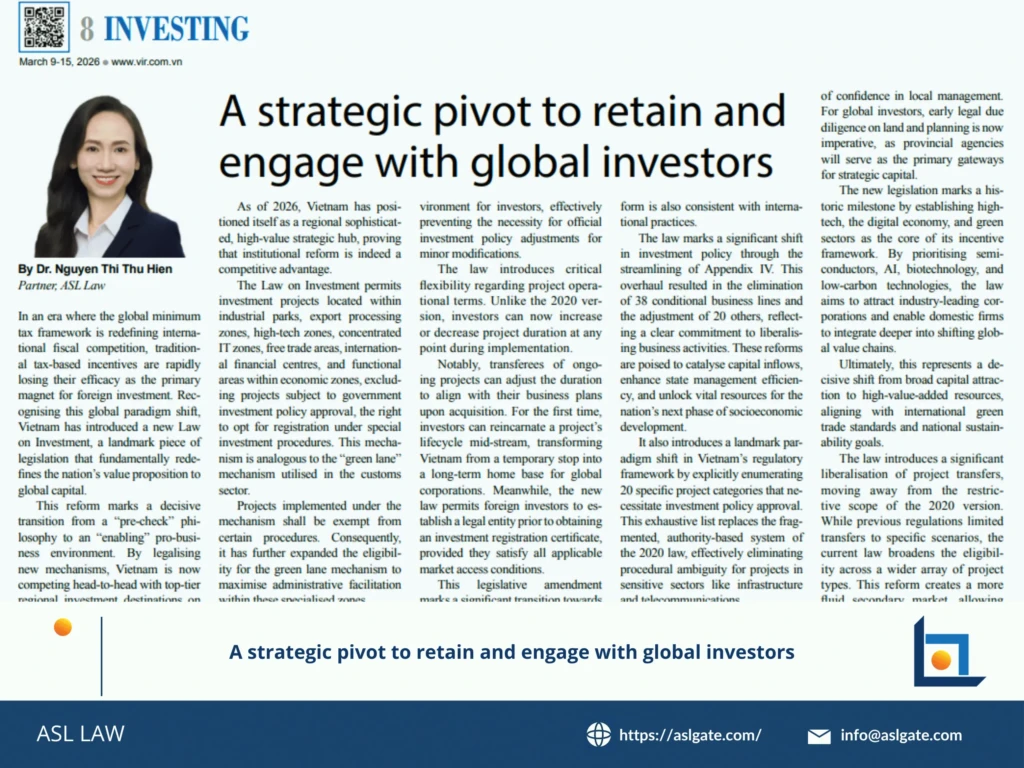
(Written By Dr. Nguyen Thi Thu Hien, Partner, ASL Law – Published on Vietnam Investment Review) In an era where the global minimum tax framework is redefining international fiscal competition, traditional tax-based incentives are rapidly losing their efficacy as the primary magnet for foreign investment. Recognising this global paradigm shift, Vietnam has introduced a new Law on Investment, a landmark piece of legislation that fundamentally redefines the nation’s value proposition to global capital.
This reform marks a decisive transition from a “pre-check” philosophy to an “enabling” pro-business environment. By legalising new mechanisms, Vietnam is now competing head-to-head with top-tier regional investment destinations on the most critical currency in modern business: execution speed.
Beyond mere deregulation, the new law introduces pivotal novelties designed to future-proof the investment climate. This framework does not just aim to attract new eagle investors, it provides existing global corporations with the legal flexibility to expand and anchor their strategic operations in Vietnam for the long term. As of 2026, Vietnam has positioned itself as a regional sophisticated, high-value strategic hub, proving that institutional reform is indeed a competitive advantage.
The Law on Investment permits investment projects located within industrial parks, export processing zones, high-tech zones, concentrated IT zones, free trade areas, international financial centres, and functional areas within economic zones, excluding projects subject to government investment policy approval, the right to opt for registration under special investment procedures. This mechanism is analogous to the “green lane” mechanism utilised in the customs sector.
Projects implemented under the mechanism shall be exempt from certain procedures. Consequently, it has further expanded the eligibility for the green lane mechanism to maximise administrative facilitation within these specialised zones.
The law has abolished the requirement for project adjustment in two specific cases: removing the need for policy adjustment when capital changes by less than 20 per cent, or technology is upgraded. The current law retains only five instances where enterprises are mandated to adjust their investment policy. This new regulation significantly simplifies administrative procedures and facilitates a more favourable environment for investors, effectively preventing the necessity for official investment policy adjustments for minor modifications.
The law introduces critical flexibility regarding project operational terms. Unlike the 2020 version, investors can now increase or decrease project duration at any point during implementation. Notably, transferees of ongoing projects can adjust the duration to align with their business plans upon acquisition. For the first time, investors can reincarnate a project’s lifecycle mid-stream, transforming Vietnam from a temporary stop into a long-term home base for global corporations.
Meanwhile, the new law permits foreign investors to establish a legal entity prior to obtaining an offshore investment registration certificate, provided they satisfy all applicable market access conditions. This legislative amendment marks a significant transition towards a more liberalised investment environment compared to its 2020 predecessor. This reform significantly bolsters foreign funding attraction and ensures a level playing field between domestic and foreign investors.
By establishing an early legal presence, companies can initiate recruitment and formalise contracting ahead of schedule, ensuring that their projects can hit the ground running immediately upon approval. This reform is also consistent with international practices.
Enterprises doing business in Vietnam should consider contacting a Vietnam business law firm for legal advice on Corporate services in Vietnam tailored-based to the enterprise’s specific circumstances.
The law marks a significant shift in investment policy through the streamlining of Appendix IV. This overhaul resulted in the elimination of 38 conditional business lines and the adjustment of 20 others, reflecting a clear commitment to liberalising business activities. These reforms are poised to catalyse capital inflows, enhance state management efficiency, and unlock vital resources for the nation’s next phase of socioeconomic development.
It also introduces a landmark paradigm shift in Vietnam’s regulatory framework by explicitly enumerating 20 specific project categories that necessitate investment policy approval. This exhaustive list replaces the fragmented, authority-based system of the 2020 law, effectively eliminating procedural ambiguity for projects in sensitive sectors like infrastructure and telecommunications. By exempting non-critical sectors, such as industrial clusters and specific mineral projects, the current law significantly deregulates the offshore investment environment to facilitate high-velocity strategic capital.
In addition, it decentralises authority from central to local levels, replacing quantitative thresholds with qualitative impact assessments. This shift serves to dissolve central-level bottlenecks and signals a high degree of confidence in local management. For global investors, early legal due diligence on land and planning is now imperative, as provincial agencies will serve as the primary gateways for strategic capital.
The new legislation marks a historic milestone by establishing high-tech, the digital economy, and green sectors as the core of its incentive framework. By prioritising semiconductors, AI, biotechnology, and low-carbon technologies, the law aims to attract industry-leading corporations and enable domestic firms to integrate deeper into shifting global value chains. Ultimately, this represents a decisive shift from broad capital attraction to high-value-added resources, aligning with international green trade standards and national sustainability goals.
The law introduces a significant liberalisation of project transfers, moving away from the restrictive scope of the 2020 version. While previous regulations limited transfers to specific scenarios, the current law broadens the eligibility across a wider array of project types. This reform creates a more fluid secondary market, allowing investors to exit or restructure their portfolios with greater ease. By removing these rigid barriers, Vietnam is fostering a dynamic investment environment where capital and assets can be reallocated more efficiently to capable operators. This shift not only enhances asset liquidity but also reinforces investor confidence by providing a clear, flexible pathway for long-term capital mobility.
ASL Law is a leading full-service and independent Vietnamese law firm made up of experienced and talented lawyers. ASL Law is ranked as the top tier Law Firm in Vietnamby Legal500, Asia Law, WTR, and Asia Business Law Journal. Based in both Hanoi and Ho Chi Minh City in Vietnam, the firm’s main purpose is to provide the most practical, efficient and lawful advice to its domestic and international clients. If we can be of assistance, please email to [email protected].
ASL LAW is the top-tier Vietnam law firm for Investment Services. If you need any advice, please contact us for further information or collaboration.