Tiếng Việt
 中文 (中国)
 日本語

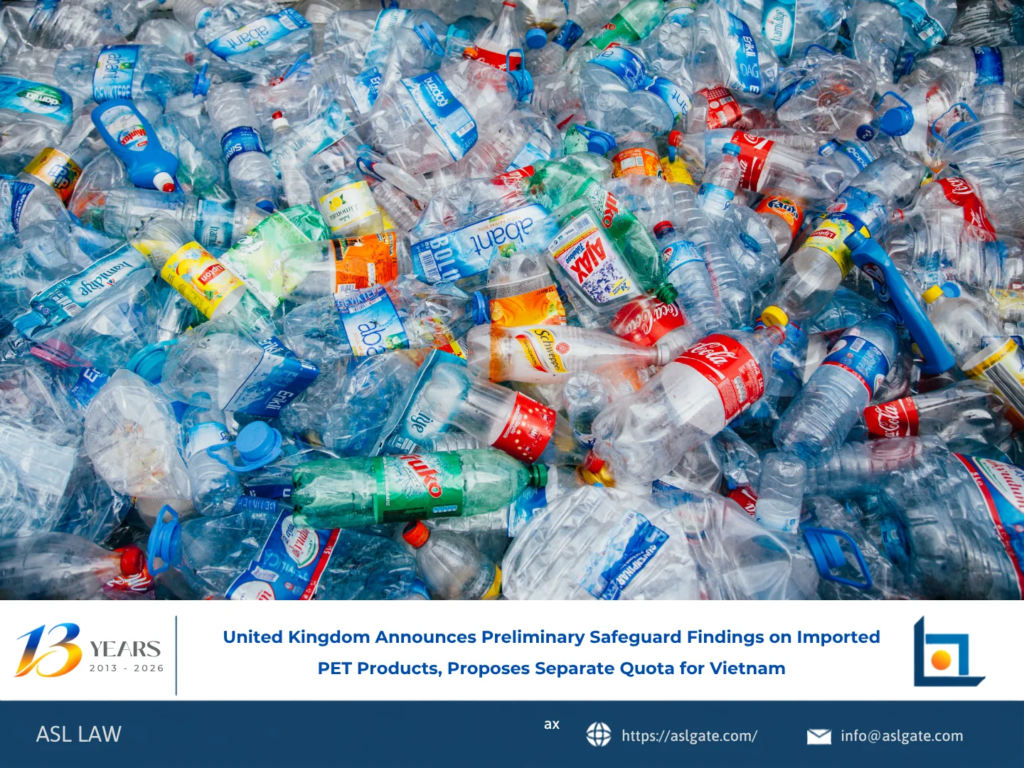
On 23 October 2026, the United Kingdom Trade Remedies Authority (TRA) published its preliminary findings confirming that increased imports of polyethylene terephthalate (PET) had caused serious injury to the domestic industry. The TRA proposed imposing a provisional safeguard measure in the form of a tariff-rate quota (TRQ), under which Vietnam would receive a separate quota totalling 2,983.33 tonnes for the period from 1 December 2026 to 31 May 2027.
Background and Scope of the Investigation
On 5 August 2026, the TRA initiated a safeguard investigation into imported PET products following an application filed by ALPEK Polyester Limited. The company alleged that increased PET imports had caused serious injury to domestic UK producers.
The investigation period covered 1 January 2021 to 31 December 2025. The products under investigation included virgin PET (vPET) and recycled PET (rPET) with an intrinsic viscosity of 74 ml/g or higher. These products are currently classified under commodity codes 3907 6100 and 3907 6900.
Key Findings of the Preliminary Investigation
According to UK customs data used by the TRA, PET imports increased by 68% between 2021 and 2025. Following a decline in 2023, imports continued to rise over the subsequent two years, reaching their highest level in 2025. In contrast, the output of the UK PET manufacturing industry declined continuously over the same period.
Regarding prices, the TRA found that domestic selling prices of UK producers came under downward pressure towards the end of the investigation period. Although declining production costs also contributed to lower selling prices, the TRA considered that this factor alone could not fully explain market developments. Increased import volumes, combined with falling import prices, contributed to downward pressure on domestic prices.
The TRA identified global PET overcapacity, particularly in Asia, amid demand that had not increased correspondingly, as one of the factors driving imports into the UK. China was identified as a significant contributor to the increase in global supply, accounting for an estimated 35–45% of total global PET trade in 2025, up from approximately 23% in 2020.
In addition, trade defence measures imposed in several major markets, including the European Union, Canada and the United States, together with changes in trade flows and access to low-cost input materials, were also considered by the TRA to be contributing factors behind the increase in PET imports into the UK.
Based on its assessment of these factors, the TRA preliminarily concluded that the significant increase in PET imports had caused serious injury to the domestic industry. Accordingly, it proposed imposing a provisional safeguard measure in the form of a tariff-rate quota from 1 December 2026.
Proposed Tariff-Rate Quotas and Safeguard Duty Rates
Under the TRQ mechanism, imports within the allocated quota would be subject only to the ordinary customs duties, if any, and would not be subject to the additional safeguard duty. The proposed total provisional quota for the period from 1 December 2026 to 31 May 2027 is 192,963.17 tonnes, allocated among import sources as follows:
- European Union: 77.6%;
- Mexico: 5.4%;
- Indonesia: 3.7%;
- Vietnam: 3.1%;
- Other sources subject to the measure: 10.2%.
For imports exceeding the allocated quotas, the TRA proposed an additional safeguard duty of 65%. The provisional measure is expected to remain in force for a maximum of 200 days, calculated from the day following publication of the notice, or until the definitive measure takes effect, whichever occurs first.
The TRA stated that the quota allocation is intended to maintain traditional trading relationships, ensure adequate supplies to the UK market and minimise unnecessary disruption to businesses using PET as an input material.
Implications for Vietnamese Businesses and Recommendations
Vietnam is among the countries allocated a separate quota under the proposed provisional safeguard measure. Specifically, Vietnam’s allocated quota is divided into two periods:
- Period 1 (1 December 2026–28 February 2027): 1,475.27 tonnes;
- Period 2 (1 March 2027–31 May 2027): 1,508.06 tonnes.
The total quota allocated to Vietnam for both periods is 2,983.33 tonnes. According to TRA data, Vietnam is among the sources that recorded a significant increase in PET imports into the UK market.
Notably, the TRA determined that Vietnam does not qualify for an exemption from the safeguard measure under the special treatment for developing countries provided for in Article 9.1 of the WTO Agreement on Safeguards, as imports from Vietnam exceeded the 3% market share threshold applied in the assessment.
In light of these developments, the Vietnam Plastics Association (VPAS) and businesses manufacturing and exporting PET to the UK should take note of the following recommendations:
– Submit comments on the preliminary findings: Businesses and industry associations should submit their comments to the TRA no later than 22 November 2026 for consideration during the preparation of the final findings.
– Review export plans: Closely monitor the progress of the investigation, assess actual export volumes to the UK, review customer structures and consider adjusting delivery schedules in line with the proposed quotas.
– Study the quota allocation mechanism: Proactively examine the proposed quota allocation methodology and consider requesting direct consultations with the TRA before it issues its final findings, with a view to maintaining access to the UK market.
– Coordinate response efforts: Proactively coordinate with the Trade Remedies Authority of Vietnam to review export conditions, assess potential impacts and develop appropriate response strategies in light of developments in the investigation.
To protect their legitimate interests, manufacturers and exporters should familiarize themselves with the procedure and actively contact Vietnam Antidumping Law Firm specializing in anti-dumping and trade remedy for timely assistance.
ASL Law is a leading full-service and independent Vietnamese law firm made up of experienced and talented lawyers. ASL Law is ranked as the top tier Law Firm in Vietnam by Legal500, Asia Law, WTR, and Asia Business Law Journal. Based in both Hanoi and Ho Chi Minh City in Vietnam, the firm’s main purpose is to provide the most practical, efficient and lawful advice to its domestic and international clients. If we can be of assistance, please email to [email protected].
ASL LAW is the top-tier Vietnam law firm for Anti-dumping & countervailing. If you need any advice, please contact us for further information or collaboration.