Tiếng Việt
 中文 (中国)
 日本語
日本語
Outsourced legal services Vietnam are becoming a strategic choice for businesses that aim to reduce costs while maintaining high-quality legal support. As companies grow and expand in competitive markets, the demand for flexible, reliable, and efficient legal outsourcing Vietnam continues to rise. In today’s dynamic business environment, legal services are no longer limited to in-house…

08
Oct
Oct
ASL LAW has recently published an in-depth article in Business Forum Magazine on the topic “Commercialization of Intellectual Property Rights – A Driver of R&D Investment,” contributed by Lawyer Pham Duy Khuong, Managing Partner of ASL LAW. The article analyzes the pivotal role of monetizing intellectual property (IP) assets in fostering innovation, enhancing competitiveness, and…
26
Sep
Sep
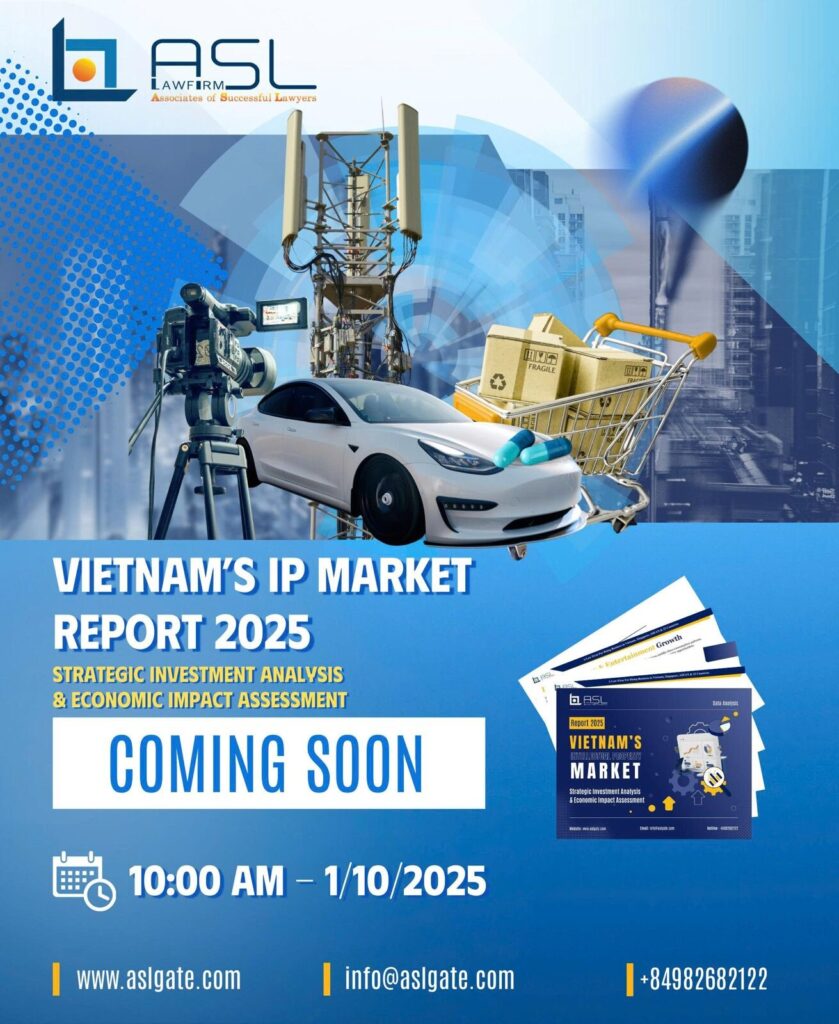
ASL LAW is pleased to announce the upcoming release of the Vietnam IP Market Report 2025 (Strategic investment Analysis & Economic Impact Assessment). This is the first and only comprehensive report ever conducted on Vietnam providing in-depth insights into: ✨ Vietnam’s IP market is booming: 📊 This report is designed for: 🌍 The report will…

08
Jul
Jul
Vietnam is an increasingly attractive market for foreign companies looking to expand their regional presence. Many business with oversea investment initiative begins by opening representative office in Vietnam, which allows them to explore opportunities, conduct research, and build connections before committing to a full-scale business. A representative office is one of the simplest forms of…
30
Jun
Jun
Vietnam is one of the most attractive markets in Southeast Asia for foreign investors doing business in Vietnam due to its strong economic growth and increasing integration into global trade. However, choosing the right type of enterprise is a crucial step that determines how efficiently the investment in ASEAN turns out. Each legal structure has…

08
Jul
Jul
Expanding operations abroad is an important milestone for enterprises doing business in Vietnam seeking growth, access to new markets, and global competitiveness. Establishing a company in a foreign jurisdiction, however, is not just about opportunity—it also involves navigating a complex framework of domestic and international laws. Foreign investors who prepare carefully from the start can…

12
Sep
Sep
As Vietnam positions itself as a preferred destination for high-tech oversea investment and cross-border technology transfer, ensuring legal safeguards for confidential information and trade secrets becomes paramount. Particularly for foreign-invested enterprises (FIEs), robust mechanisms like Non-Disclosure Agreements (NDAs) and Non-Compete Agreements (NCAs) are not just compliance tools but strategic necessities. These agreements play a critical…

12
Sep
Sep
In the context of a knowledge-based economy and innovation-driven growth, the protection and exploitation of intellectual property (IP) have become vital for enterprises. Resolution No. 68-NQ/TW of the Politburo emphasizes the task of “institutionalizing innovation and protecting intangible assets” as a cornerstone of the national development strategy. This sets an urgent requirement for innovative enterprises…

10
Sep
Sep
Resolution No. 05/2025/NQ-CP (“Resolution 05”) of the Vietnamese Government marks a significant step in piloting a tokenized assets market to promote secure and controlled digital financial innovation. The resolution focuses on establishing a pilot legal framework, prioritizing the protection of stakeholders’ rights, legal compliance, and risk mitigation. The following article summarizes the key points of…
10
Sep
Sep
Vietnam has emerged as one of the most dynamic economies in Asia, attracting foreign investors, tech entrepreneurs, and legal professionals alike. However, doing business in Vietnam also requires navigating a unique legal, cultural, and regulatory landscape. Many investors repeat the same mistakes, which can result in wasted time, financial loss, or compliance risks. This article…