Tiếng Việt
 中文 (中国)
 日本語
日本語
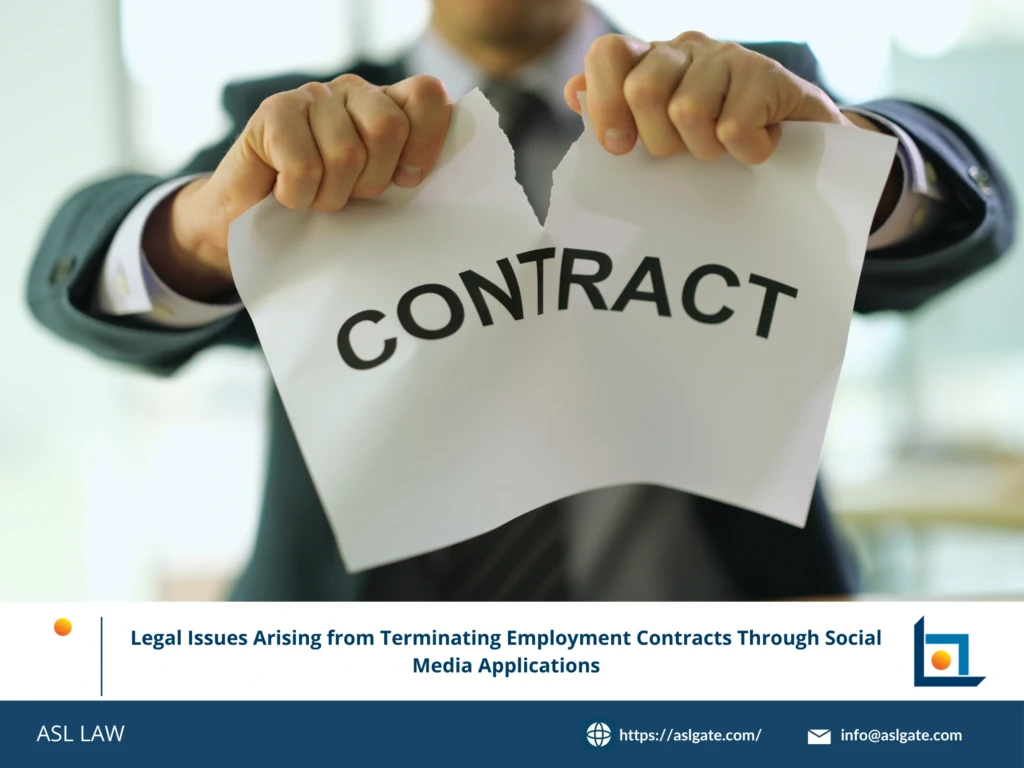
The rapid development of information technology and social media platforms in recent years has significantly transformed communication methods in employment relationships. Whereas communication between employers and employees was previously conducted primarily through paper documents, emails, or other formal notification methods, social media applications such as Zalo, Facebook, Messenger, Telegram, and other online messaging platforms have now become common communication tools in business management and operations.
Work-related notifications, task assignments, work schedule adjustments, leave approvals, and even personnel-related decisions may all be communicated through these platforms.
In practice, many enterprises doing business in Vietnam have used social media messages to notify employees that they will no longer continue working, to request that employees resign, or to inform them of the termination of their employment contracts.
From the employee’s perspective, receiving a termination notice via a social media message is often understood as an official decision from the employer, particularly where the message is sent by a manager or an individual holding a leadership position within the company. As a result, employees may immediately stop working upon receiving such messages without requesting any formal written notice, thereby giving rise to disputes when issues relating to salary, social insurance, compensation, or the legal obligations of the parties are not clearly resolved.
The legal issue arising from this practice is whether messages sent through social media applications can be regarded as notices of employment contract termination, and if so, how their legal validity should be determined. This issue concerns not only evidentiary matters but also the legal nature of the act of terminating an employment contract, since termination constitutes a significant legal act that ends the rights and obligations of the parties in an employment relationship. If the termination of an employment contract is determined solely based on a social media message, the requirements of transparency, formality, and legality of the termination decision may be substantially affected.
Furthermore, although current Vietnamese law contains provisions relating to data messages and electronic evidence, it does not provide specific guidance on the use of social media applications for terminating employment contracts. The Labor Code imposes notification obligations upon termination of employment contracts, while electronic transaction laws recognize that data messages may serve as written documents if they satisfy the prescribed legal requirements. However, the application of these provisions in judicial practice remains inconsistent, particularly because social media messages simultaneously possess the characteristics of personal communications while also potentially serving as legal evidence.
Accordingly, studying the legal issues arising from the termination of employment contracts through social media applications is necessary to clarify the legal value of electronic messages in employment relationships, define the boundary between workplace communication and legally binding decisions, and contribute to improving the legal framework for resolving labor disputes in the context of an increasingly digitalized society.
Legal Framework Governing Employment Contract Termination and Data Messages
Assessing the legality of terminating employment contracts through social media applications must be considered within the broader legal framework of labor law and electronic transaction law. These two groups of legal provisions are closely interconnected because labor law governs the conditions and procedures for employment contract termination, while electronic transaction law regulates the legal validity of data messages, including messages sent through social media platforms.
First, from the perspective of labor law and contract consultancy, the termination of an employment contract is a significant legal event that ends the employment relationship between the employer and the employee and therefore must strictly comply with the provisions of the Labor Code. Under labor law, employment contracts may only be terminated based on legally prescribed grounds and must follow the required procedures, particularly the obligation to notify the employee.
A notice of employment contract termination carries important legal significance because it establishes the effective date of termination, determines the compensation liabilities and obligations of the parties, and ensures the employee’s right to be informed and protected. By its nature, a termination notice is not merely an ordinary communication but a legal decision expressing the employer’s official intention to terminate the employment relationship.
Foreign investors conducting business in Vietnam should consider consulting ASL LAW for tailored Legal Advice on Business oversea that addresses their specific commercial and operational requirements.
Ordinarily, a notice of employment contract termination must contain essential elements, including the identity of the issuing party, the employee whose employment is being terminated, the relevant employment contract, the effective termination date, and the content of the termination decision. The notice must be official, clear, and capable of verification in the event of a dispute. This reflects the principles of transparency and stability in employment relationships while preventing arbitrary or ambiguous contract terminations.
In addition to labor law, electronic transaction law also plays an important role in determining the legal value of social media messages. Under electronic transaction law, data messages created, transmitted, received, and stored by electronic means may be admitted as evidence in legal proceedings if they satisfy the requirements of reliability, integrity, and the ability to identify the originator. This demonstrates that the law does not reject the evidentiary value of electronic data; rather, it recognizes that data messages may, in certain circumstances, possess legal value equivalent to written documents.
However, the fact that a data message may be admissible as evidence does not automatically mean that every social media message constitutes a legal decision or a notice of employment contract termination. Electronic transaction law requires that the method of creating, transmitting, and storing the data message be reliable, that the integrity of its contents be preserved, and that the sender be accurately identifiable. At the same time, civil procedure law requires evidence to be evaluated objectively, comprehensively, and thoroughly, meaning that an electronic message can only be assessed within the context of all available evidence and the surrounding circumstances of the dispute.
Accordingly, although the current legal framework provides an initial basis for evaluating the legal value of social media messages in employment relationships, it still lacks specific regulations governing the use of social media applications to notify employees of employment contract termination.
The interaction between labor law and electronic transaction law therefore requires a cautious approach that both accommodates the flexibility of electronic communications in practice and safeguards the legal certainty and procedural integrity of employment contract termination decisions. This also forms the basis for further analysis of the legal issues arising from the use of social media messages as a tool for terminating employment relationships in practice.
Legal Issues Associated with Using Social Media Messages to Terminate Employment Contracts
The use of messages sent through social media applications to terminate employment contracts raises numerous legal issues, particularly regarding evidentiary value and whether such messages may constitute notices of employment contract termination. In principle, electronic messages may be admitted as evidence if they satisfy the requirements relating to integrity and the ability to identify the sender. However, this does not automatically mean that such messages constitute legally effective employment termination decisions.
The greatest challenge concerns the integrity and reliability of electronic data. Social media messages may be edited, deleted, or transmitted incompletely, making it difficult to determine the employer’s actual legal intention. Where a party relies solely on screenshots or printed copies of messages without producing the original electronic data, the risk of evidentiary inaccuracies becomes substantial.
In addition, identifying the sender of the message presents another significant legal issue. A social media account may be accessed by multiple individuals or may not belong to a person authorized to decide on employment contract termination. Accordingly, unless it can be established that the sender possessed the authority to act on behalf of the business operating in Vietnam, the contents of the message are unlikely to constitute a legally valid notice of employment contract termination.
Furthermore, the distinction between workplace communication and legally binding decisions is often unclear in social media environments. Many messages merely constitute informal discussions or temporary instructions but may nevertheless be interpreted as decisions to terminate employment. Accordingly, social media messages should generally be regarded only as supporting evidence, and whether an employment contract has been terminated should be determined based on a comprehensive assessment of all documentary evidence and the overall context of the employment relationship.
Judicial Practice and Legal Debates
In labor dispute resolution practice, the use of social media messages as evidence of employment contract termination has generated considerable legal debate. In certain cases, electronic messages have been accepted as evidence demonstrating that an employer instructed an employee to stop working, particularly where the content of the message clearly expresses the employer’s intention not to continue the employment relationship. According to contract consultancy, this approach is often adopted to protect employees in the context of the increasingly widespread use of electronic communications.
However, treating social media messages as notices of employment contract termination also raises concerns regarding legal certainty. If every message relating to an employee’s resignation or dismissal could be regarded as a termination decision, the requirement for formal notification would be substantially weakened, creating risks for both employers and employees. This could blur the distinction between ordinary workplace communications and legally binding acts, thereby affecting the stability of employment relationships.
Current judicial practice also demonstrates inconsistency in the evaluation of electronic messages across different cases. In some instances, courts require formal written documents, whereas in others, social media messages have been accepted as important evidence. These differing approaches reflect a legislative gap regarding the regulation of data messages in employment relationships and highlight the need for more specific guidance to ensure consistent application in judicial practice.
Overall, social media messages may assist in clarifying the development of an employment relationship, but they should not be regarded as the sole basis for determining whether an employment contract has been terminated. Such assessments should be conducted cautiously, striking an appropriate balance between protecting employees and ensuring legal certainty.
Directions for Legal Reform and Practical Recommendations
Based on the legal issues and judicial practice discussed above, it is evident that terminating employment contracts through social media applications has become an inevitable phenomenon in the era of digital transformation, while the current legal framework has yet to keep pace with practical developments. This necessitates further legal reforms to ensure greater clarity, consistency, and legal certainty in employment relationships.
First, labor legislation or implementing regulations should clarify the permissible forms of employment contract termination notices in electronic environments. The law may recognize data messages as a lawful form of notification, provided that specific conditions are satisfied, including the identification of an authorized sender, preservation of the integrity of the message, and the existence of mechanisms for storing and verifying the information. Clearly defining these requirements would help reduce disputes and promote consistency in the application of the law.
Furthermore, specific guidance should be issued regarding the evaluation of social media messages as a source of evidence in labor disputes. Courts and dispute resolution authorities should assess such messages together with all other relevant evidence, including employment contracts, internal regulations, work-related emails, and other supporting documents, rather than treating social media messages as the sole basis for determining whether an employment contract has been been terminated. Such an approach would uphold the principle of comprehensive evidence assessment while reducing the risk of inferring legal intent solely from ordinary communications.
From the employer’s perspective, enterprises doing business in Vietnam should establish clear communication procedures and standardized processes for issuing employment contract termination decisions, distinguishing between routine workplace communications conducted through social media and official notices issued in writing or through internal electronic systems. Standardizing these procedures would not only reduce legal risks but also enhance transparency in human resource management. At the same time, employees should improve their legal awareness to avoid mistakenly treating ordinary workplace messages as official termination decisions in the absence of formal notification.
Overall, the use of social media applications in employment relationships is an irreversible trend. Nevertheless, to preserve the stability of the legal system, it is necessary to establish a clear and consistent legal framework governing the legal effect of data messages in the context of employment contract termination. Such a framework would help balance the flexibility of electronic communications with the procedural certainty required under labor law in the development of the digital economy.
ASL Law is a leading full-service and independent Vietnamese law firm made up of experienced and talented lawyers. ASL Law is ranked as the top tier Law Firm in Vietnam by Legal500, Asia Law, WTR, and Asia Business Law Journal. Based in both Hanoi and Ho Chi Minh City in Vietnam, the firm’s main purpose is to provide the most practical, efficient and lawful advice to its domestic and international clients. If we can be of assistance, please email to [email protected].
ASL LAW is the top-tier Vietnam law firm for Employment and Labor Law. If you need any advice, please contact us for further information or collaboration.