Tiếng Việt
 中文 (中国)
 日本語
日本語
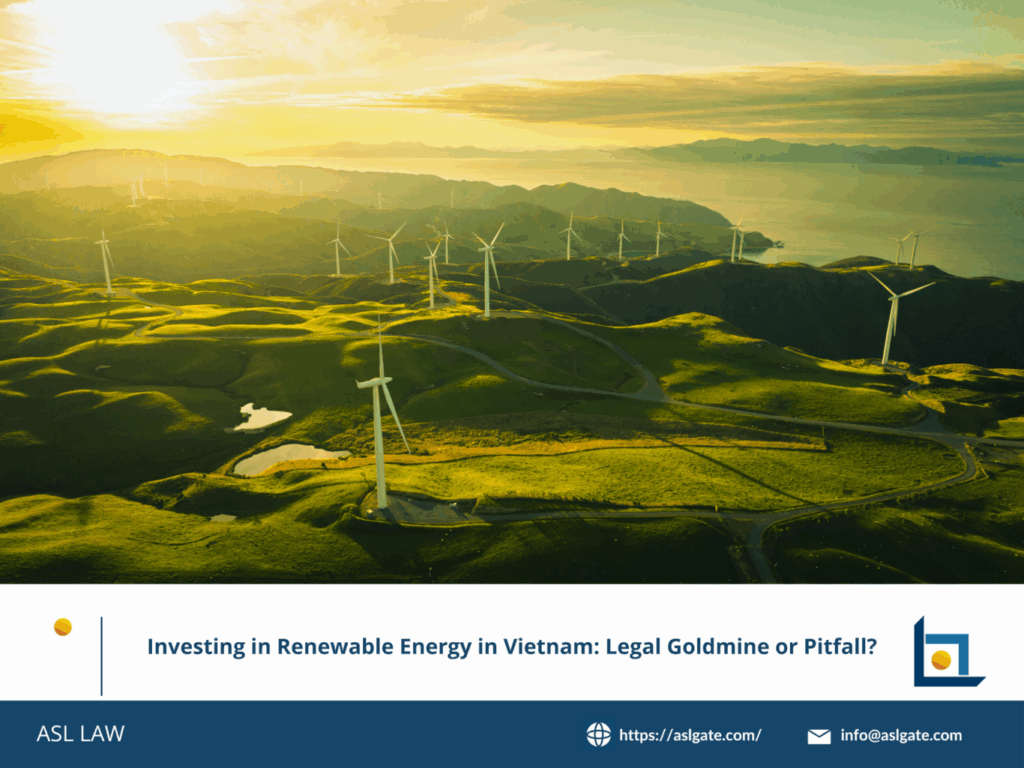
Amidst the global energy transition and commitments to reduce greenhouse gas emissions, Vietnam has emerged as an attractive destination for investors in the renewable energy sector. However, despite its strong development potential, investing in renewable energy in Vietnam remains entangled with various legal hurdles and policy uncertainties. This article explores the opportunities while highlighting key legal challenges that investors need to consider.
Vietnam’s Renewable Energy Potential
Vietnam is blessed with abundant renewable resources, including over 3,000 km of coastline, high solar radiation levels, and consistent wind speeds across many regions. Under Power Development Plan VIII (PDP8), renewable energy is prioritized as a key component of the national power mix, with a target of approximately 47% of installed capacity coming from renewable sources by 2030.
Key areas attracting strong oversea investment include rooftop solar, offshore wind, biomass, and waste-to-energy projects. Interest from foreign investors is also growing, particularly as FDI enterprises increasingly seek clean energy solutions.
Key Investment Opportunities
- Policy Commitments to Green Energy
Vietnam has made numerous international commitments such as COP26 and the Just Energy Transition Partnership (JETP), signaling a strong resolve toward clean energy. These commitments lay the foundation for mid- and long-term incentives and support mechanisms for renewable energy investment. - Rising Market Demand
Rapid industrialization and emission-reduction requirements from multinational corporations are driving robust demand for green energy, opening doors for both large-scale and distributed renewable projects. - International Cooperation and Technology Transfer
The Vietnamese government encourages projects with advanced, environmentally friendly technology and international partners, creating favorable conditions for strategic investors to access the market.
Legal Challenges to Be Aware Of
- Unstable Feed-in Tariff (FIT) Policy
The FIT mechanism previously drove a wave of oversea investment but has now expired, with no clear replacement in place. Delays in implementing new auction or bidding schemes create investor concerns about policy stability and capital recovery. - Incomplete Legal Framework for Offshore Wind
Despite vast potential, offshore wind projects face licensing difficulties, marine spatial planning issues, and lack of coordination among ministries. The absence of clear regulations on sea use rights and transmission infrastructure hinders project implementation. - Grid Connection and Transmission Bottlenecks
Many completed renewable projects cannot connect to the grid or face curtailment due to transmission overload. The current lack of a defined risk-sharing mechanism between developers and EVN adds to the uncertainty. - Lengthy and Complex Investment Procedures
Investors must navigate numerous regulatory steps involving land, environment, construction, and grid connection—often subject to prolonged timelines and inconsistent practices across provinces. - Absence of a Competitive Electricity Market
Without a fully competitive power market, investors cannot directly sell electricity to end-users via mechanisms such as Direct Power Purchase Agreements (DPPA), limiting project profitability and operational flexibility.
Strategic Recommendations for Investors
- Closely monitor the rollout of new pricing policies and financial support mechanisms.
- Conduct legal due diligence during pre-feasibility stages, including risk assessments for planning, transmission, and contractual issues.
- Partner with experienced local entities to streamline administrative procedures and local engagement.
- Consider phased oversea investments and incorporate on-site consumption or storage solutions to reduce grid dependency.
- Leverage international initiatives like JETP or green investment funds to access preferential capital sources.
Conclusion
Vietnam offers tremendous potential for renewable energy investment, but a more mature legal framework is essential to build investor confidence. Identifying the right risks and adopting a robust legal strategy will help businesses transform opportunity into long-term, sustainable value amid the global energy transition.
ASL Law is a leading full-service and independent Vietnamese law firm made up of experienced and talented lawyers. ASL Law is ranked as the top tier Law Firm in Vietnam by Legal500, Asia Law, WTR, and Asia Business Law Journal. Based in both Hanoi and Ho Chi Minh City in Vietnam, the firm’s main purpose is to provide the most practical, efficient and lawful advice to its domestic and international clients. If we can be of assistance, please email to [email protected].
ASL LAW is the top-tier Vietnam law firm for Investment Services. If you need any advice, please contact us for further information or collaboration.