Tiếng Việt
 中文 (中国)
 日本語

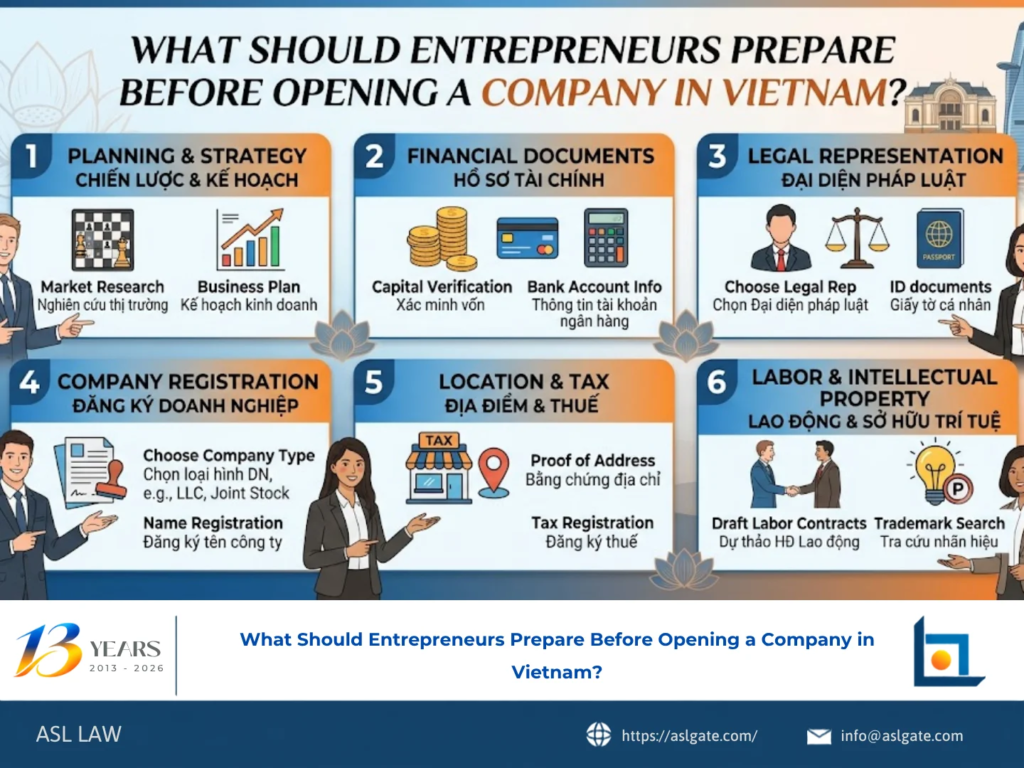
Understanding what to prepare before opening a company Vietnam is essential for entrepreneurs seeking to enter the market efficiently and avoid preventable legal or financial problems. Beyond registering a business name, founders must assess market-entry conditions, select an appropriate corporate structure, prepare investment capital, organize documentation, and identify ongoing compliance obligations. Careful preparation helps entrepreneurs establish a company that is legally compliant and commercially ready to operate.
Define the Business Model and Check Market-Entry Conditions
The first step is to clarify the proposed business activities, target customers, operating locations, and expected sources of revenue. These decisions influence the company’s legal structure, licensing requirements, staffing needs, and initial investment.
Foreign entrepreneurs should also confirm whether their intended activities are open to foreign investment and whether any market-access conditions apply. Certain sectors may require additional approvals, specific qualifications, or compliance with foreign ownership restrictions.
Before deciding to open company in Vietnam, entrepreneurs should determine whether ordinary enterprise registration is sufficient or whether investment registration and sector-specific licenses may also be required. This preliminary assessment can prevent delays caused by choosing an unsuitable business model or submitting incomplete applications.
Choose the Right Corporate Structure
An entrepreneur checklist for company setup Vietnam should include selecting an appropriate legal entity. Depending on the circumstances, entrepreneurs may consider a limited liability company, a joint-stock company, or another structure permitted under Vietnamese law.
The decision should reflect ownership arrangements, management responsibilities, funding plans, liability considerations, and future expansion. Entrepreneurs establishing a business with partners should clarify each party’s capital contribution, voting rights, management authority, and exit arrangements.
For foreign investors, forming company in Vietnam may involve additional investment procedures compared with establishing a purely domestic enterprise. The applicable requirements depend on the investor’s circumstances, intended activities, and relevant investment regulations.
Founders should also prepare a suitable company name, registered office address, proposed business lines, and details of the legal representative.
Prepare Capital and a Realistic Financial Plan
Financial planning is among the essential preparations for starting a business Vietnam. Entrepreneurs should estimate initial setup expenses, operating costs, employee salaries, rent, taxes, professional fees, and working capital requirements.
Vietnamese law does not impose a universal minimum charter capital for every business. However, certain regulated sectors have specific capital requirements or other financial conditions. The proposed capital should therefore be assessed against both legal requirements and actual business needs.
Foreign investors should pay particular attention to capital contribution deadlines, funding arrangements, and applicable foreign exchange procedures. They should also consider how the company will fund operations before generating stable revenue.
A realistic budget should include a contingency reserve for unexpected expenses and possible delays in obtaining licenses or commencing operations.
Organize Documents and Registration Requirements
Legal and financial prep before company formation includes preparing accurate identification documents, ownership information, corporate details, and investment-related materials where required.
Foreign documents may need consular legalization, notarized translations, or other formalities depending on the document type and applicable rules. Preparing these materials early can reduce the risk of application delays or requests for supplementary documents.
Entrepreneurs should confirm the registered office address, business lines, charter capital, ownership structure, and legal representative details before filing. Inconsistencies between documents may complicate the registration process.
A Law firm in Vietnam can help entrepreneurs assess applicable procedures, prepare registration documents, and identify additional approvals required for their intended activities.
Plan for Tax, Employment, and Operational Compliance
Company registration is only the beginning of the compliance process. Entrepreneurs should identify their expected tax obligations, accounting requirements, invoicing procedures, and reporting deadlines before operations commence.
If the business intends to recruit employees, its preparations should also cover employment contracts, payroll administration, compulsory insurance obligations, workplace policies, and work permits where applicable.
Businesses operating in regulated sectors may need additional permits or professional qualifications. Entrepreneurs should verify these requirements before signing long-term leases, hiring staff, or committing substantial funds.
The pre-launch checklist for entrepreneurs in Vietnam should also include opening appropriate bank accounts, establishing accounting systems, arranging internal document storage, and assigning responsibility for compliance deadlines.
Complete a Pre-Launch Review
Before commencing operations, entrepreneurs should confirm that the company has obtained the registrations and licenses required for its actual activities. They should review capital contribution arrangements, contractual templates, supplier agreements, and procedures for handling customer information and intellectual property.
Those planning to set up a company in Vietnam should also establish a calendar for tax filings, reporting obligations, license renewals, and other recurring compliance tasks. Early preparation makes it easier to identify responsibilities and avoid missed deadlines.
A final review of legal, financial, and operational readiness helps founders move from company formation to commercial activity with fewer uncertainties.
FAQ
1. What should entrepreneurs prepare before opening a company in Vietnam?
They should define their business activities, check market-entry conditions, select a corporate structure, prepare capital and documents, confirm licensing requirements, and plan for tax, accounting, and employment compliance.
2. Is there a minimum capital requirement for establishing a company in Vietnam?
There is no universal minimum charter capital for every business. However, certain sectors have specific capital requirements or financial conditions, and the proposed capital should be sufficient for the company’s planned operations.
3. Do foreign entrepreneurs need additional registration procedures?
Depending on their circumstances and intended activities, foreign investors may need investment registration in addition to enterprise registration. Sector-specific approvals may also apply.
4. What documents should entrepreneurs prepare for company registration?
Common materials include identification documents, company name and address details, business activities, ownership information, charter capital details, and information about the legal representative. Foreign documents may require additional formalities.
5. When should entrepreneurs seek legal advice?
Ideally, before committing substantial capital or submitting registration applications. Early advice can help clarify market-entry conditions, identify licensing requirements, and reduce the risk of costly procedural mistakes.
ASL Law is a leading full-service and independent Vietnamese law firm made up of experienced and talented lawyers. ASL Law is ranked as the top tier Law Firm in Vietnam by Legal500, Asia Law, WTR, and Asia Business Law Journal. Based in both Hanoi and Ho Chi Minh City in Vietnam, the firm’s main purpose is to provide the most practical, efficient and lawful advice to its domestic and international clients. If we can be of assistance, please email to [email protected].
ASL LAW is the top-tier Vietnam law firm for doing business in Vietnam. If you need any advice, please contact us for further information or collaboration.