Tiếng Việt
 中文 (中国)
 日本語

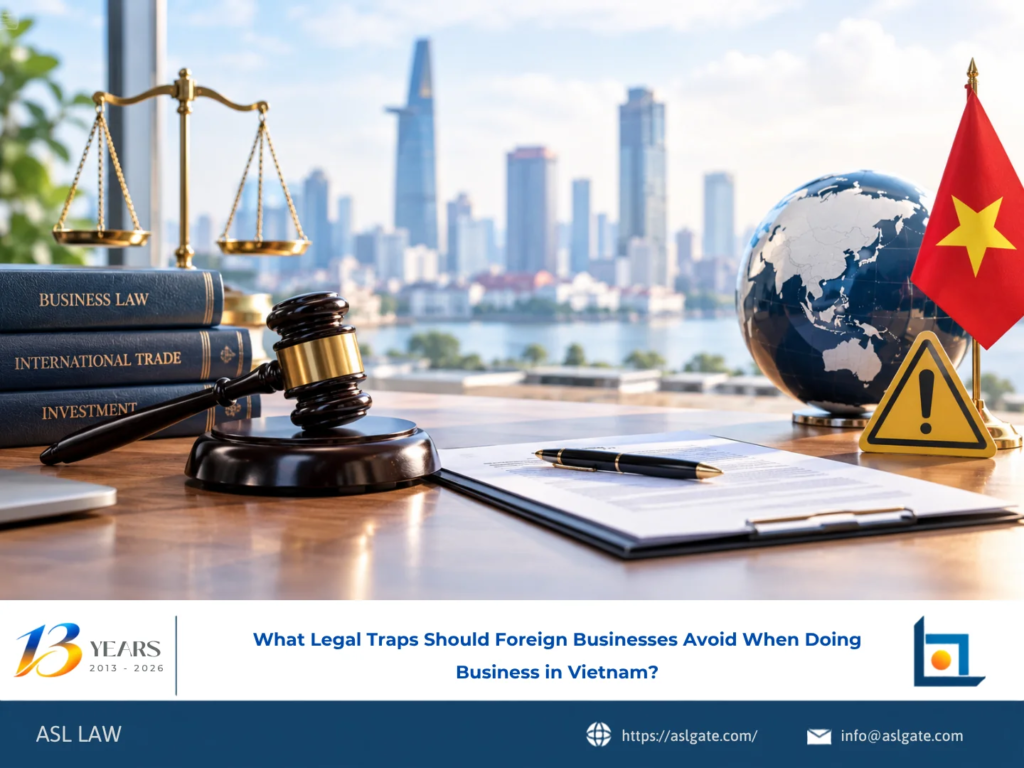
Legal traps for foreign businesses in Vietnam can arise at every stage of market entry, from choosing an investment structure and obtaining licenses to signing commercial contracts, managing employees, and complying with tax obligations. Foreign investors who overlook local legal requirements may face financial losses, administrative penalties, contractual disputes, or restrictions on business operations. Identifying these risks early helps companies establish a compliant presence and build a more secure foundation for long-term growth.
Misunderstanding Market-Entry and Investment Conditions
One of the most significant legal traps for foreign businesses in Vietnam is assuming that foreign investors can enter every sector under the same conditions as domestic companies. Vietnam permits foreign investment across many industries, but certain sectors remain subject to market-access restrictions, ownership limits, licensing requirements, or specific operational conditions.
Before deciding to open company in Vietnam, investors should verify whether their proposed business activities are permitted and whether any restrictions apply to foreign ownership or the scope of operations. The appropriate investment structure may differ depending on the sector, the investor’s nationality, and the intended business model.
Investors should also distinguish between investment registration, enterprise registration, and any additional sector-specific approvals. Completing one procedure does not necessarily authorize a company to conduct every activity listed in its business plan.
Choosing the Wrong Corporate Structure
Another common legal pitfall for foreign investors Vietnam involves selecting a corporate structure without considering liability, governance, capital requirements, and future expansion.
Foreign investors may establish a wholly foreign-owned company, participate in a joint venture, or consider other legally available structures. Each option involves different implications for ownership, decision-making authority, regulatory compliance, and commercial flexibility.
When forming company in Vietnam, investors should carefully define shareholder rights, capital contribution obligations, management powers, and procedures for resolving internal disputes. Inadequate governance arrangements can create serious problems when business partners disagree, capital contributions are delayed, or an investor seeks to exit.
Investors should also ensure that registered business activities accurately reflect their intended operations and that capital contribution deadlines are monitored.
Overlooking Contractual and Commercial Risks
Avoiding legal traps when entering Vietnam market requires careful attention to commercial agreements. Foreign businesses sometimes rely on overseas contract templates without adapting them to Vietnamese law or the practical realities of local transactions.
Important contractual issues include payment terms, delivery obligations, product quality, warranties, intellectual property ownership, confidentiality, termination rights, and dispute resolution. Ambiguous provisions may create uncertainty when a counterparty fails to perform.
Businesses should also verify the authority of the individuals signing contracts and conduct appropriate due diligence on suppliers, distributors, customers, and potential joint-venture partners.
For cross-border transactions, the governing law and dispute resolution mechanism deserve particular attention. A clause that appears suitable in one jurisdiction may not provide the expected protection when the parties, assets, and enforcement proceedings involve different countries.
Ignoring Tax, Employment, and Operational Compliance
Foreign business legal traps to watch out for extend beyond company registration. Once operations begin, companies must comply with applicable tax rules, accounting obligations, labor legislation, and statutory insurance requirements.
Common problems include incorrect tax declarations, inadequate supporting documentation, improper employment contracts, failures to meet insurance obligations, and non-compliance with work permit or other immigration requirements where applicable.
Businesses should establish internal compliance procedures before commercial operations become complex. This includes maintaining accurate accounting records, monitoring filing deadlines, reviewing employment arrangements, and checking whether additional licenses are required for specific activities.
Companies planning to set up a company in Vietnam should also account for ongoing compliance costs rather than focusing exclusively on initial registration expenses. A Law firm in Vietnam can help assess licensing requirements, review contractual arrangements, and identify legal risks associated with the proposed business model.
Protecting Intellectual Property and Managing Disputes
Intellectual property is another important consideration for foreign companies entering Vietnam. A foreign trademark registration or an established international brand does not automatically eliminate the need to assess protection under Vietnam’s intellectual property framework.
Businesses should review trademark availability, consider appropriate registration strategies, and ensure that ownership of relevant intellectual property is clearly documented. Companies transferring technology, licensing brands, or working with local manufacturers should also define permitted uses, confidentiality obligations, and ownership of newly developed materials.
Dispute prevention is equally important. Foreign investors should maintain clear records of transactions, payments, communications, and contractual performance. They should also evaluate the practical enforceability of dispute resolution clauses before signing major agreements.
A proactive legal review can help businesses identify key legal risks for foreign companies in Vietnam before those risks develop into costly disputes or regulatory problems.
Establishing a Reliable Legal Compliance Strategy
Foreign investors can reduce legal exposure by treating compliance as an ongoing business function rather than a one-time registration exercise. Before entering the market, companies should conduct legal due diligence, confirm market-access conditions, select an appropriate corporate structure, and prepare contracts suited to their operations.
After establishment, periodic reviews should cover licensing, tax, employment, intellectual property, and contractual obligations. Businesses should also monitor regulatory changes that may affect their sector.
A structured approach to compliance allows foreign companies to make informed decisions, allocate resources effectively, and respond to legal issues before they threaten business continuity.
FAQ
1. What are the main legal traps for foreign businesses in Vietnam?
Major risks include misunderstanding foreign investment restrictions, choosing an unsuitable corporate structure, using poorly drafted contracts, failing to meet tax and employment obligations, and neglecting intellectual property protection.
2. Can foreign investors establish a wholly foreign-owned company in Vietnam?
Yes, in many sectors. However, market-access conditions, foreign ownership restrictions, and licensing requirements may apply depending on the proposed business activities and applicable law.
3. Is enterprise registration sufficient to begin all business activities?
Not necessarily. Certain activities require additional licenses, approvals, or satisfaction of specific business conditions before operations can lawfully commence.
4. How can foreign companies reduce contractual risks in Vietnam?
They should conduct counterparty due diligence, clearly define contractual obligations, verify signing authority, and select appropriate governing-law and dispute-resolution provisions.
5. When should foreign investors seek legal advice?
Ideally, before committing capital or signing binding agreements. Early legal advice can help investors assess market-entry conditions, choose an appropriate structure, identify licensing requirements, and prevent avoidable compliance problems.
ASL Law is a leading full-service and independent Vietnamese law firm made up of experienced and talented lawyers. ASL Law is ranked as the top tier Law Firm in Vietnam by Legal500, Asia Law, WTR, and Asia Business Law Journal. Based in both Hanoi and Ho Chi Minh City in Vietnam, the firm’s main purpose is to provide the most practical, efficient and lawful advice to its domestic and international clients. If we can be of assistance, please email to [email protected].
ASL LAW is the top-tier Vietnam law firm for doing business in Vietnam. If you need any advice, please contact us for further information or collaboration.