Tiếng Việt
 中文 (中国)
 日本語

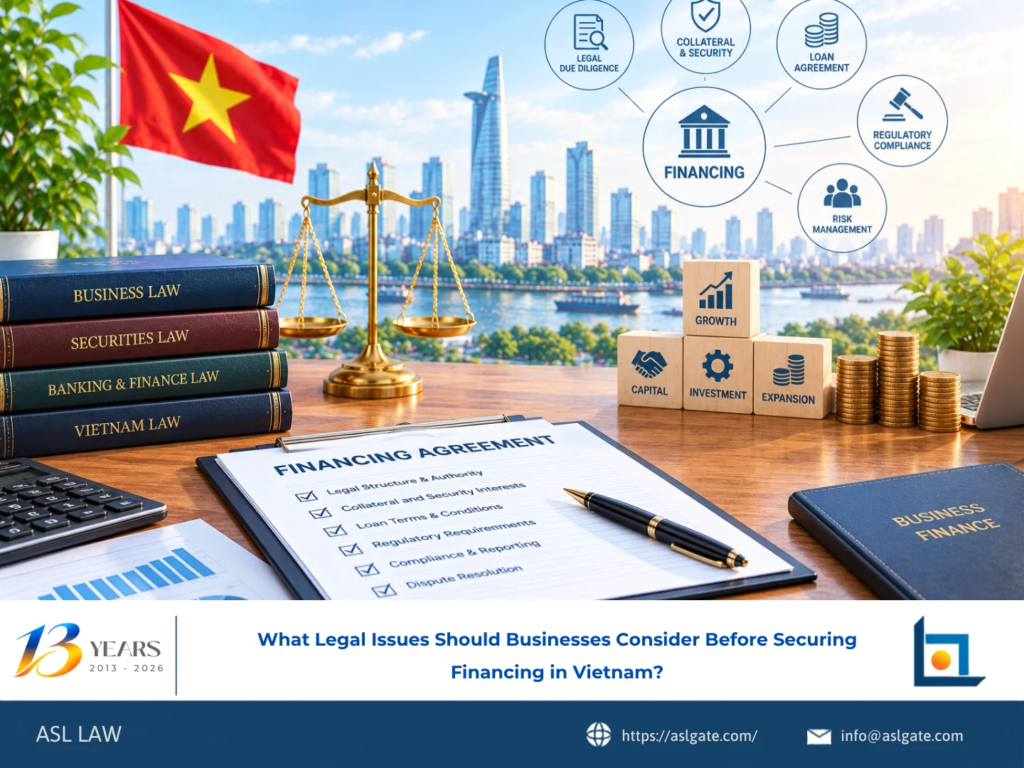
Legal considerations before securing financing Vietnam businesses must address include loan terms, collateral arrangements, corporate approval requirements, interest rates, repayment obligations, and regulatory compliance. Whether a company borrows from a domestic bank, obtains funding from a foreign lender, or raises capital from investors, overlooking these issues can create unexpected liabilities and restrict future business operations. A thorough legal review helps businesses understand their obligations, negotiate appropriate protections, and secure financing on terms that support sustainable growth.
Assess the Financing Structure and Applicable Legal Requirements
The first step in evaluating key legal issues for business financing in Vietnam is identifying the appropriate funding structure. Common options include bank loans, shareholder loans, foreign loans, credit facilities, and equity investment. Each arrangement carries different legal, financial, and governance implications.
Businesses should determine whether the proposed financing is subject to specific licensing, registration, reporting, or foreign exchange requirements. For example, foreign loans obtained by Vietnamese borrowers may be subject to conditions under Vietnam’s foreign borrowing and repayment regulations, including registration requirements for certain loans.
Companies should also confirm that the proposed funding arrangement is consistent with their registered activities, corporate structure, and applicable laws. The legal requirements can vary depending on the lender, the borrower, the loan term, and the transaction structure.
Review Loan Terms, Interest Rates, and Repayment Obligations
A legal checklist before obtaining loans in Vietnam should begin with a careful review of the financing agreement. Businesses should understand the principal amount, interest calculation, repayment schedule, fees, default interest, and circumstances in which the lender may demand early repayment.
Borrowers should pay particular attention to financial covenants, reporting duties, restrictions on additional borrowing, and requirements to maintain specified financial ratios. These provisions can limit a company’s operational flexibility even when it continues to make scheduled payments.
Interest rates and related charges should be assessed under the legal framework applicable to the particular financing arrangement. Different rules may apply depending on whether the transaction involves a bank, another domestic lender, a foreign lender, or a shareholder.
Businesses should model their expected cash flow against the proposed repayment schedule and clarify how payment defaults, grace periods, and restructuring requests will be handled.
Examine Collateral and Personal Guarantees
Financing legal risks for Vietnamese businesses often arise from security arrangements that borrowers do not fully understand.
A lender may require a mortgage over real estate, a pledge over shares or other assets, a security interest in receivables, or a guarantee from a parent company or individual. Before agreeing, the borrower should verify asset ownership, existing encumbrances, valuation, registration requirements, and the legal authority to provide the security.
Businesses should also understand the circumstances in which the lender can enforce collateral. A broad security arrangement may expose assets essential to the company’s daily operations, while a personal guarantee may create significant financial exposure for an individual guarantor.
The financing documents should clearly identify the secured obligations, the assets covered, the conditions for enforcement, and the circumstances in which the security will be released. Borrowers should avoid granting broader security than necessary without understanding the consequences.
Confirm Corporate Approvals and Contractual Restrictions
Companies must ensure that financing decisions are properly authorized under their charter, internal governance rules, and applicable legislation. Depending on the company’s legal form and the transaction, approval may be required from the board, members’ council, shareholders, or another competent body.
Businesses should also review existing loan agreements, investment agreements, shareholder arrangements, and major commercial contracts. These documents may restrict additional borrowing, the creation of new security interests, asset disposals, or changes in ownership.
What to consider legally before financing Vietnam transactions also includes the authority of the persons signing the documents and the consistency of the financing terms with existing obligations.
A failure to obtain the necessary approvals or comply with contractual restrictions may trigger disputes, breaches of existing agreements, or challenges to the transaction’s validity.
Plan for Default, Disputes, and Debt Recovery
Before accepting financing, businesses should assess the legal consequences of missed payments and other defaults. The agreement should explain default events, notice requirements, opportunities to remedy breaches, acceleration rights, and available dispute resolution procedures.
Borrowers should also understand whether disputes will be resolved through Vietnamese courts or arbitration, where appropriate, and how judgments or arbitral awards may be enforced against relevant assets.
Where a company already faces repayment difficulties, early communication with creditors may create opportunities to negotiate revised payment schedules or restructuring arrangements before the situation deteriorates. Businesses should maintain accurate financial records and preserve relevant correspondence throughout the financing relationship.
A Debt recovery law firm in Vietnam or a Debt collection law firm in Vietnam may assist creditors with evaluating recovery options when repayment disputes arise. For borrowers, early legal advice can help assess contractual exposure and potential restructuring strategies.
Obtain Legal Review Before Signing
Legal considerations before securing financing Vietnam companies face should be assessed before the agreement becomes binding. A comprehensive review can identify unclear provisions, excessive security requirements, unfavorable default clauses, and regulatory obligations that may affect the transaction.
Businesses should prepare a complete set of financing documents, verify corporate approvals, and ensure that all negotiated terms are accurately reflected in the final agreement. Professional service of contract consultancy can support the review of financing documents and related commercial arrangements.
A Vietnam Hanoi law firm or a Comprehensive law firm in Vietnam may help businesses evaluate loan terms, collateral, corporate authorization, and compliance obligations in the context of the proposed financing.
The objective is not simply to obtain funding, but to ensure that the financing arrangement is legally sound, financially manageable, and compatible with the company’s long-term business plans.
FAQ
1. What are the main legal considerations before securing financing in Vietnam?
Businesses should review the financing structure, interest and repayment terms, collateral, corporate approvals, regulatory requirements, default provisions, and dispute resolution mechanisms.
2. Are foreign loans to Vietnamese businesses subject to registration requirements?
Certain foreign loans are subject to registration with the competent authority, depending on factors such as the loan term and applicable regulations. Borrowers should verify the requirements before drawing down the loan.
3. What should a business check before pledging assets as collateral?
It should verify ownership, existing security interests, valuation, required approvals, registration formalities, and the lender’s enforcement rights if a default occurs.
4. Can a financing agreement restrict a company’s future business decisions?
Yes. Financial covenants and contractual restrictions may limit additional borrowing, asset disposals, dividend payments, or other activities. Borrowers should understand these restrictions before signing.
5. When should a business obtain legal advice for financing?
Ideally, before signing the financing agreement or providing collateral. Early review can help identify regulatory requirements, clarify repayment obligations, and negotiate protections against avoidable legal and financial risks.
ASL Law is a leading full-service and independent Vietnamese law firm made up of experienced and talented lawyers. ASL Law is ranked as the top tier Law Firm in Vietnam by Legal500, Asia Law, WTR, and Asia Business Law Journal. Based in both Hanoi and Ho Chi Minh City in Vietnam, the firm’s main purpose is to provide the most practical, efficient and lawful advice to its domestic and international clients. If we can be of assistance, please email to [email protected].
ASL LAW is the top-tier Vietnam law firm for Banking & Financial Services. If you need any advice, please contact us for further information or collaboration.