Tiếng Việt
 中文 (中国)
 日本語
日本語
As the Vietnamese market continues to expand, franchising has become a strategic tool for businesses seeking rapid market penetration. However, the legal distinction between franchising and trademark licensing often creates confusion for investors, leading to unnecessary compliance risks. Working with an experienced Vietnam franchise and license law firm such as ASL LAW is essential to ensure that every transaction is legally compliant, commercially sustainable, and strategically structured under Vietnamese law.
Use up and down arrow keys to resize the meta box pane.
Understanding Franchising and Trademark Licensing under Vietnamese Law
To develop a successful market entry strategy, businesses must clearly distinguish between these two common models from the perspective of Vietnamese law.
1. Legal Nature of Franchising
Under Article 284 of the 2005 Commercial Law of Vietnam, franchising is a commercial activity whereby the franchisor permits and requires the franchisee to conduct the sale of goods or provision of services under a standardized business model.
The key characteristic of franchising is that the business must operate according to the organizational system prescribed by the franchisor and be associated with trademarks, trade names, business know-how, symbols, and advertising systems.
In this model, the franchisor has the right to supervise and support the franchisee’s business operations in order to maintain consistency throughout the franchise network. A professional franchise law firm in Vietnam can help businesses structure these relationships in compliance with local regulations.
2. Legal Nature of Trademark Licensing
Unlike franchising, trademark licensing is primarily based on intellectual property rights. Pursuant to Article 141 of the 2005 Intellectual Property Law, trademark licensing allows the trademark owner to authorize another organization or individual to use the trademark within the scope of the owner’s rights.
The defining feature of trademark licensing is that the licensor is generally not permitted to control or interfere with the licensee’s business operations or management system. The transaction focuses solely on the right to use intellectual property assets. A qualified Vietnam franchise and license law firm can assist businesses in preparing legally enforceable licensing arrangements while minimizing regulatory risks.
Detailed Comparison: Why Businesses Need Franchise and Licensing Legal Advice
A reputable Vietnam franchise and license law firm can help businesses evaluate the most suitable model based on commercial objectives and legal compliance requirements.
| Criteria | Franchising | Trademark Licensing |
| Legal Basis | Commercial Law, Decree 35/2006/ND-CP | Intellectual Property Law, Decree 65/2023/ND-CP |
| Operational Conditions | Business system must operate for at least 1 year | No minimum operation period, but trademark must be protected in Vietnam |
| Registration Requirement | Mandatory registration with the Ministry of Industry and Trade for foreign-to-Vietnam franchising | Registration is optional but recommended for enforceability against third parties |
| Level of Control | Strict control over operations, store design, and training | No control or interference in the licensee’s business operations |
| Contract Duration | Subject to parties’ agreement | Cannot exceed the trademark protection term |
1. Differences in Legal Framework and Operational Conditions
Franchising is governed by the Commercial Law and Decree 35/2006/ND-CP, requiring the franchise system to have operated for at least one year before franchising activities commence.
By contrast, trademark licensing falls under the Intellectual Property Law and does not require any minimum operational history. However, the trademark in Vietnam must already be registered and protected in Vietnam. A reliable license law firm in Vietnam can assist foreign companies in ensuring trademark validity before licensing activities begin.
2. Degree of Commercial Control and Support
In franchising arrangements, the franchisor may conduct regular or ad hoc inspections, provide initial training, and deliver ongoing technical support.
On the other hand, in trademark licensing arrangements, deep intervention in the licensee’s business system is restricted in order to avoid the arrangement being recharacterized as an unregistered franchise. This distinction is one of the most important issues handled by a Vietnam franchise law firm.
3. Registration Procedures with Government Authorities
For foreign-to-Vietnam franchising activities, registration with the Ministry of Industry and Trade is mandatory before implementation.
For trademark licensing, recordal with the intellectual property authority is voluntary but highly recommended to strengthen enforceability against third parties. A Vietnam license law firm can support businesses throughout these procedures.
Franchise Legal Services: Registration Procedures and Required Documents
An experienced franchise law firm in Vietnam can help businesses overcome administrative barriers through accurate legal procedures.
1. Preparing the Franchise Registration Dossier
The registration dossier generally includes:
- Franchise registration application form;
- Franchise Disclosure Document (FDD);
- Documents proving the legal status of the franchisor;
- Evidence of industrial property protection.
All foreign documents must be legalized and notarized, with certified Vietnamese translations prepared in accordance with Vietnamese regulations.
2. Processing Time and Practical Considerations
Although the statutory processing period is officially five working days, in practice the process may take between 10 and 20 days or longer depending on dossier complexity and requests for clarification from authorities.
Working with a Vietnam franchise law firm significantly reduces delays and legal risks during the registration process.
Risks of Confusing Franchising with Trademark Licensing
Many businesses intentionally use licensing agreements to avoid franchise registration procedures. However, this strategy carries substantial legal risks under Vietnam franchise law.
1. Substance over Form Principle
Vietnamese authorities assess the actual substance of a transaction rather than merely relying on contract titles.
If a trademark licensing agreement contains operational manuals, service quality control mechanisms, or uniform store design requirements, authorities may characterize the arrangement as franchising. A franchise law firm in Vietnam can help businesses avoid such recharacterization risks.
2. Administrative Penalties and Legal Liability
If an arrangement is deemed to constitute unregistered franchising, businesses may face administrative fines ranging from VND 5,000,000 to VND 10,000,000 under Decree 98/2020/ND-CP.
More importantly, businesses may be required to disgorge all unlawful profits obtained from the violation.
3. Risk of Contract Invalidity
Under Article 144 of the Intellectual Property Law, clauses that improperly restrict the licensee’s rights beyond legitimate intellectual property protection may be declared invalid.
An invalid contract loses binding force, requiring parties to return benefits received, potentially causing serious commercial losses. A Vietnam franchise and license law firm can help businesses draft enforceable agreements that withstand regulatory scrutiny.
Importance of Trademark Protection Before Transactions
Ensuring intellectual property protection is the foundation of every successful franchising or licensing transaction.
1. For Licensing Models
A trademark in Vietnam must be registered and protected in Vietnam before it can legally serve as the subject matter of a trademark licensing agreement.
If the trademark is not yet protected, the agreement may be vulnerable to invalidation because the licensed rights do not legally exist. A Vietnam license law firm can conduct trademark audits and registration procedures before licensing activities commence.
2. For Franchising Models
Vietnam franchise law does not strictly require a registered trademark before franchising activities begin because franchising may also involve business know-how or trade names.
However, operating without trademark protection exposes the system to significant infringement risks. Competitors may imitate the business model without fear of legal consequences.
3. Risks under the First-to-File Principle
If a business fails to file a trademark application promptly, third parties — or even franchise partners — may register the trademark first in Vietnam and obtain ownership rights.
As a result, the genuine brand owner may lose the ability to operate under its own brand within the Vietnamese market. This issue is frequently handled by a Vietnam franchise law firm with expertise in intellectual property protection.
Converting from Trademark Licensing to Franchising
Transitioning from licensing to franchising is possible but requires careful legal planning.
1. Feasibility and Conditions for Conversion
Businesses may initially use licensing arrangements to test the Vietnamese market before transitioning to franchising once the one-year operational requirement is satisfied.
However, if the original licensing arrangement already possesses the characteristics of franchising, the business may still face penalties before the conversion process is completed.
2. Safe Conversion Procedures
The conversion process generally includes:
- Terminating the previous licensing agreement;
- Preparing a complete franchising dossier, including the FDD and franchise agreement;
- Registering franchising activities with the Ministry of Industry and Trade.
If the original licensing agreement was recorded with the intellectual property authority, businesses should complete cancellation procedures before proceeding further. A Vietnam franchise and license law firm can manage the entire transition process efficiently.
Why Choose ASL LAW for Franchise Legal Services in Vietnam?
ASL LAW is not merely a Vietnam franchise law firm but also a strategic legal partner helping businesses optimize long-term commercial operations.
1. Multidisciplinary Legal Expertise
Our legal team combines extensive experience in Commercial Law, Investment Law, and Intellectual Property Law to deliver comprehensive legal solutions tailored to each client.
2. Extensive Practical Experience
ASL LAW has successfully supported numerous multinational corporations in registering franchising activities in Vietnam, handling complex dossiers, and resolving operational disputes.
3. Confidential and Dedicated Services
We are committed to maintaining strict client confidentiality and supporting businesses throughout every stage of expansion, from initial system establishment to nationwide growth.
Frequently Asked Questions about Franchise Legal Advice in Vietnam
The one-year operational requirement applies to the franchise system itself, not necessarily to operations conducted within Vietnam. The business system may have operated overseas or in other jurisdictions as long as actual operational history can be demonstrated.
Yes. Franchise agreements may be drafted in English based on mutual agreement between the parties. However, for registration with Vietnamese authorities or dispute resolution proceedings, notarized Vietnamese translations are mandatory.
Legally speaking, a trademark licensing agreement is safest and most enforceable after the trademark registration certificate has been granted. Signing agreements during the application stage carries substantial invalidity risks if the trademark application is ultimately rejected.
Administrative fines currently range from VND 5,000,000 to VND 10,000,000. However, the most significant consequence is often the suspension of operations and the obligation to return all profits generated from unlawful franchising activities.
Contact ASL LAW for Franchise and Licensing Legal Services
If your business requires legal advice regarding franchising in Vietnam, trademark licensing, franchise registration with the Ministry of Industry and Trade, Franchise Disclosure Document (FDD) preparation, or conversion from licensing to franchising models, ASL LAW can assist with:
- Recharacterization risk assessment;
- Contract review and drafting;
- Registration dossier preparation;
- Communication with competent authorities.
As a leading Vietnam franchise law firm and Vietnam license law firm, ASL LAW supports businesses in managing legal risks, protecting intellectual property rights, expanding business systems lawfully, and ensuring full compliance with Vietnamese disclosure and operational requirements.
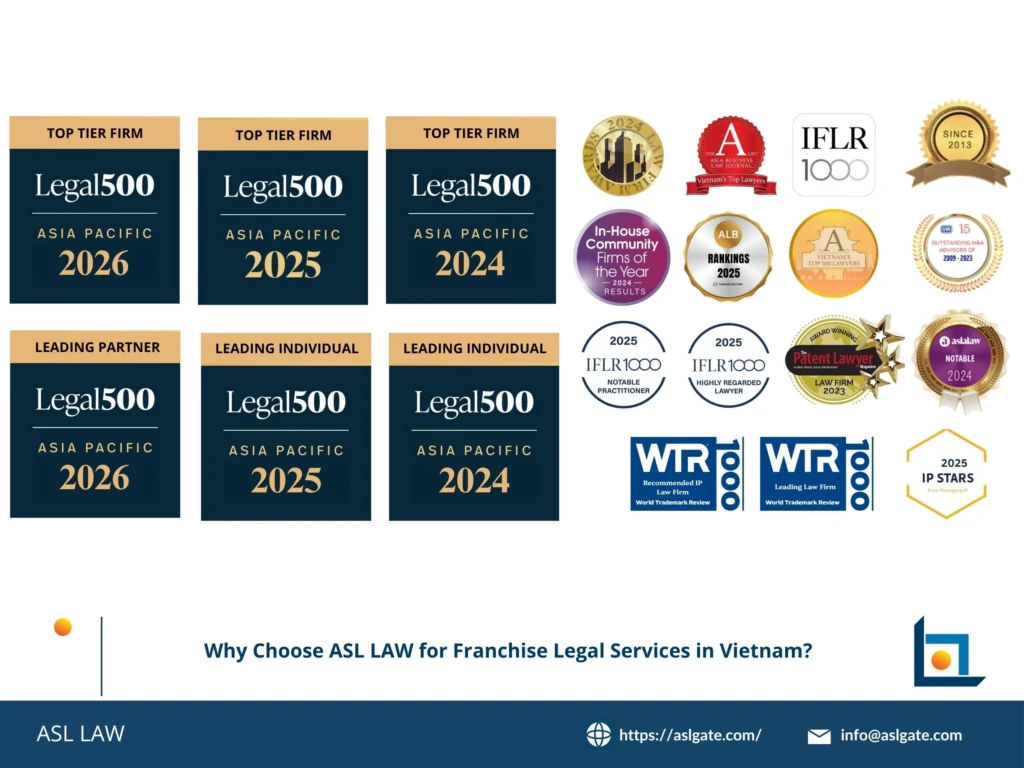
ASL Law is a leading full-service and independent Vietnamese law firm made up of experienced and talented lawyers. ASL Law is ranked as the top tier Law Firm in Vietnam by Legal500, Asia Law, WTR, and Asia Business Law Journal. Based in both Hanoi and Ho Chi Minh City in Vietnam, the firm’s main purpose is to provide the most practical, efficient and lawful advice to its domestic and international clients. If we can be of assistance, please email to [email protected].
ASL LAW is the top tier Franchise law firm in Vietnam. If you need any advice, please contact us for further information or collaboration.