Tiếng Việt
 中文 (中国)
 日本語
日本語
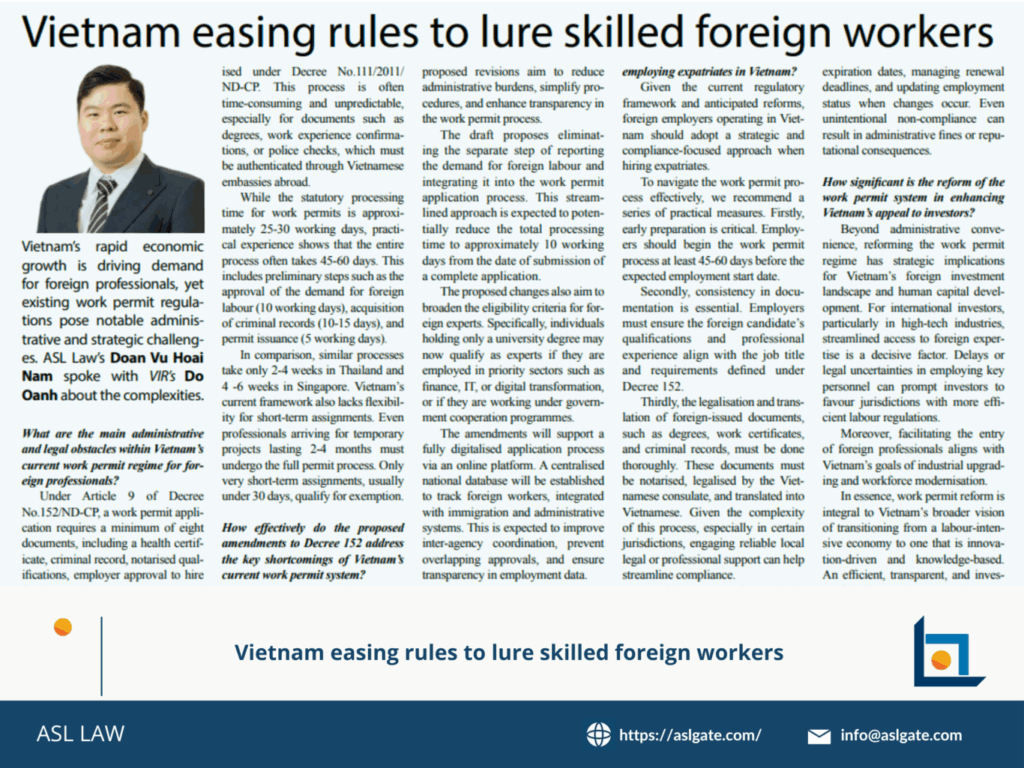
(Published on VIR) Vietnam’s rapid economic growth is driving demand for foreign professionals, yet existing work permit regulations pose notable administrative and strategic challenges. ASL Law’s Doan Vu Hoai Nam spoke with VIR’s Do Oanh about the complexities.
What are the main administrative and legal obstacles within Vietnam’s current work permit regime for foreign professionals?
Under Article 9 of Decree No.152/ND-CP, a work permit application requires a minimum of eight documents, including a health certificate, criminal record, notarised qualifications, employer approval to hire foreign workers, passport copy, and other relevant papers. Importantly, any foreign-issued documents must be consularly legalised under Decree No.111/2011/ ND-CP.
This process is often time-consuming and unpredictable, especially for documents such as degrees, work experience confirmations, or police checks, which must be authenticated through Vietnamese embassies abroad. While the statutory processing time for work permits is approximately 25-30 working days according to the labour law in Vietnam, practical experience shows that the entire process often takes 45-60 days.
This includes preliminary steps such as the approval of the demand for foreign labour (10 working days), acquisition of criminal records (10-15 days), and permit issuance (5 working days). In comparison, similar processes take only 2-4 weeks in Thailand and 4 -6 weeks in Singapore. Vietnam’s current framework also lacks Àexibility for short-term assignments.
Even professionals arriving for temporary projects lasting 2-4 months must undergo the full permit process. Only very short-term assignments, usually under 30 days, qualify for exemption.
How effectively do the proposed amendments to Decree 152 address the key shortcomings of Vietnam’s current work permit system?
In response to persistent concerns, the Ministry of Home Affairs has circulated a draft amendment to Decree 152 for public feedback. The proposed revisions aim to reduce administrative burdens, simplify procedures, and enhance transparency in the work permit process.
The draft proposes eliminating the separate step of reporting the demand for foreign labour and integrating it into the work permit application process. This streamlined approach is expected to potentially reduce the total processing time to approximately 10 working days from the date of submission of a complete application. The proposed changes also aim to broaden the eligibility criteria for foreign experts.
Specifically, individuals holding only a university degree may now qualify as experts if they are employed in priority sectors such as finance, IT, or digital transformation, or if they are working under government cooperation programmes. The amendments will support a fully digitalised application process via an online platform.
A centralised national database will be established to track foreign workers, integrated with immigration and administrative systems. This is expected to improve inter-agency coordination, prevent overlapping approvals, and ensure transparency in employment data.
What recommendations does ASL Law offer to help foreign businesses and investors better prepare when employing expatriates in Vietnam?
Given the current regulatory framework and anticipated reforms, foreign employers operating in Vietnam should adopt a strategic and compliance-focused approach when hiring expatriates. To navigate the work permit process effectively, we recommend a series of practical measures. Firstly, early preparation is critical. Employers should begin the work permit process at least 45-60 days before the expected employment start date.
Secondly, consistency in documentation is essential. Employers must ensure the foreign candidate’s qualifications and professional experience align with the job title and requirements defined under Decree 152. Thirdly, the legalisation and translation of foreign-issued documents, such as degrees, work certificates, and criminal records, must be done thoroughly.
These documents must be notarised, legalised by the Vietnamese consulate, and translated into Vietnamese according to labour law in Vietnam. Given the complexity of this process, especially in certain jurisdictions, engaging reliable local legal or professional support can help streamline compliance. Fourthly, companies should implement robust internal systems to monitor key compliance milestones.
These include tracking work permit expiration dates, managing renewal deadlines, and updating employment status when changes occur. Even unintentional non-compliance can result in administrative fines or reputational consequences.
How significant is the reform of the work permit system in enhancing Vietnam’s appeal to investors?
As part of our official series of advising labour law in Vietnam, beyond administrative convenience, reforming the work permit regime has strategic implications for Vietnam’s foreign investment landscape and human capital development. For international investors, particularly in high-tech industries, streamlined access to foreign expertise is a decisive factor. Delays or legal uncertainties in employing key personnel can prompt investors to favour jurisdictions with more efficient labour regulations.
Moreover, facilitating the entry of foreign professionals aligns with Vietnam’s goals of industrial upgrading and workforce modernisation. In essence, work permit reform is integral to Vietnam’s broader vision of transitioning from a labour-intensive economy to one that is innovation-driven and knowledge-based.
An efficient, transparent, and investor-friendly regulatory environment for foreign talent will strengthen Vietnam’s position as a regional hub for value-added investment.
ASL Law is a leading full-service and independent Vietnamese law firm made up of experienced and talented lawyers. ASL Law is ranked as the top tier Law Firm in Vietnam by Legal500, Asia Law, WTR, and Asia Business Law Journal. Based in both Hanoi and Ho Chi Minh City in Vietnam, the firm’s main purpose is to provide the most practical, efficient and lawful advice to its domestic and international clients. If we can be of assistance, please email to [email protected].
ASL LAW is the top-tier Vietnam law firm for Employment and Labor Law. If you need any advice, please contact us for further information or collaboration.