Tiếng Việt
 中文 (中国)
 日本語
日本語
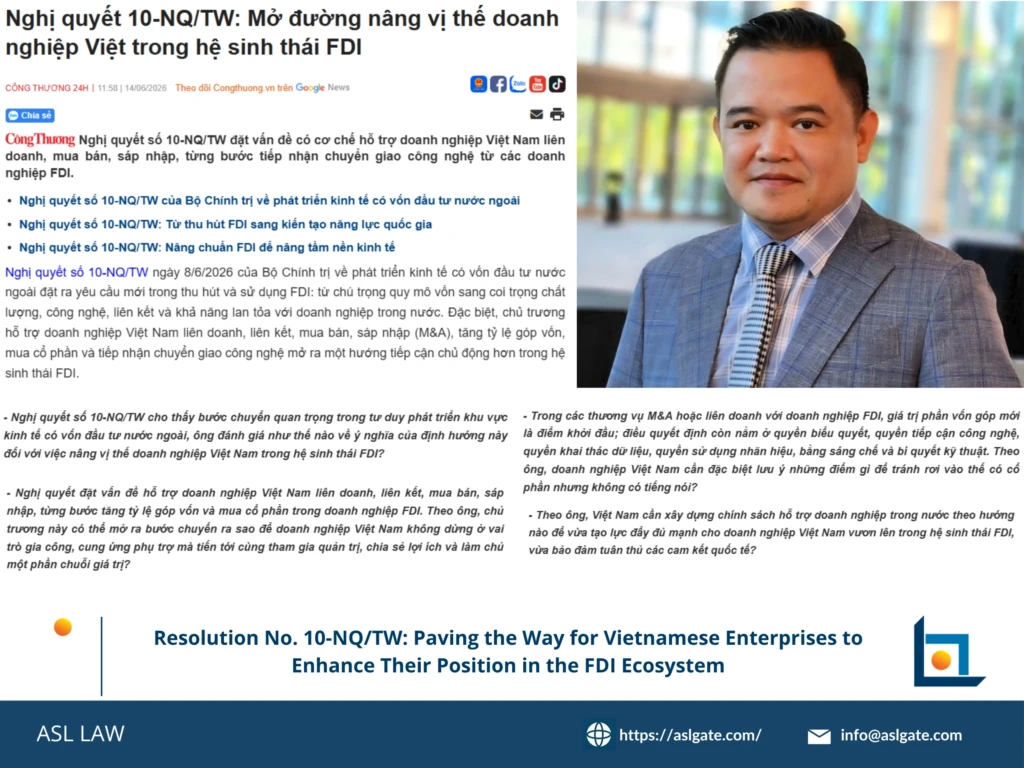
(Published in Newspaper of Industry and Trade) Resolution No. 10-NQ/TW introduces mechanisms to support Vietnamese enterprises in joint ventures, mergers and acquisitions, and the gradual absorption of technology transferred from foreign-invested enterprises.
Resolution No. 10-NQ/TW, issued by the Politburo on June 8, 2026, concerning the development of the foreign-invested sector, sets out a new approach to attracting and utilizing foreign direct investment (FDI): shifting the focus from capital scale to quality, technology, linkages, and spillover effects on domestic enterprises. In particular, the policy of supporting Vietnamese enterprises in joint ventures, partnerships, mergers and acquisitions (M&A), increasing equity participation, acquiring shares, and receiving technology transfer in Vietnam opens a more proactive path within the FDI ecosystem.
In an interview with Industry and Trade Newspaper, Lawyer Pham Duy Khuong, Managing Partner of ASL LAW and an expert in international trade and M&A, analyzed the legal issues that need to be addressed to enable Vietnamese enterprises to participate more deeply in global value chains.
Co-Creating Value within the FDI Supply Chain
Resolution No. 10-NQ/TW reflects a significant shift in thinking regarding the development of the foreign-invested sector. How do you assess the significance of this orientation in enhancing the position of Vietnamese enterprises within the FDI ecosystem?
Lawyer Pham Duy Khuong: Previously, when discussing foreign investment attraction, many localities focused primarily on capital size, the number of projects, land use, or export turnover. Such an approach was appropriate during the period when Vietnam needed capital, employment, and integration into global production chains. However, as the economy moves toward growth driven by science, technology, innovation, digital transformation, and green transition, the criteria for evaluating FDI must also evolve.
The Resolution emphasizes quality, efficiency, technology, linkages with domestic enterprises, the development of Vietnamese suppliers, and the transfer of managerial knowledge. This is particularly important because Vietnamese enterprises cannot elevate their position if they remain outside the value chain in the role of simple suppliers. To move up the value chain, they must be connected with the standards, processes, technologies, and markets of offshore investment corporations.
From a legal perspective, this policy orientation should be institutionalized through project selection criteria, incentive conditions, post-investment monitoring mechanisms, and obligations for investors to fulfill their commitments. Investment incentives should not be granted solely based on capital scale or geographical location, but rather linked to tangible outcomes such as localization rates, training of Vietnamese personnel, technology transfer, development of domestic suppliers, and contributions to innovation. Once legal criteria are clearly established, the State will have a basis for supervision, FDI enterprises will make substantive commitments, and Vietnamese enterprises will have opportunities to grow through their own capabilities.
The Resolution calls for supporting Vietnamese enterprises in joint ventures, partnerships, mergers and acquisitions, gradually increasing their capital contributions and shareholding in FDI enterprises. How could this policy enable Vietnamese enterprises to move beyond contract manufacturing and auxiliary supply roles toward participating in governance, sharing benefits, and controlling parts of the value chain?
Lawyer Pham Duy Khuong: For many years, most Vietnamese enterprises have participated in the FDI ecosystem as suppliers, subcontractors, or service providers. While this role has provided orders, employment, and opportunities to learn international standards, remaining in such a position for too long could lock enterprises into low-value segments, making them dependent on orders and excluding them from key decisions within the production chain.
Joint ventures, strategic partnerships, and M&A transactions provide an alternative path. Through participation in capital structures, governance structures, or shareholder rights within FDI enterprises, Vietnamese businesses can gain deeper access to operational processes, technical standards, customer systems, distribution networks, and technologies. This marks a transition from a purely commercial relationship to one based on shared interests. However, equity ownership does not automatically translate into governance rights. Therefore, the value of a transaction lies in its post-deal legal structure, including voting rights, nomination rights, access to information, participation in investment decisions, and entitlement to technological benefits.
To ensure that this policy is effective, the State should establish a professional transaction support ecosystem. Vietnamese enterprises should receive assistance in legal advisory services, business valuation, technology due diligence, auditing, finance, post-M&A governance, and shareholder protection mechanisms.
This does not mean the State should conduct transactions on behalf of enterprises, but rather create favorable conditions for businesses to engage in complex transactions with stronger bargaining power. On the corporate side, companies wishing to become true partners of FDI enterprises must ensure financial transparency, improve governance standards, and develop clear technological strategies. Without such preparation, a joint venture may merely become an attractive façade, while the core benefits remain beyond reach.
Enhancing the Position of Vietnamese Enterprises
In M&A transactions or joint ventures with FDI enterprises, the value of capital contribution is merely the starting point. What truly matters are voting rights, access to technology, data exploitation rights, and rights relating to trademarks, patents, and technical know-how. What should Vietnamese enterprises pay particular attention to in order to avoid becoming shareholders without a voice?
Lawyer Pham Duy Khuong: In M&A transactions or joint ventures with FDI enterprises, the first thing Vietnamese enterprises must understand is that ownership percentage does not always equate to control. There are cases in which a company holds a significant stake but still has no say in strategic decisions, no access to operational data, no control over intellectual property assets, and no involvement in technology upgrading processes. Therefore, the value of capital contribution is only the beginning of the transaction.
From a legal perspective of a Vietnam M&A Legal Consultant, companies should carefully review the charter, shareholders’ agreements, joint venture agreements, contracts of technology transfer in Vietnam, confidentiality agreements, and dispute resolution mechanisms. Important rights must be clearly stipulated, including voting rights, veto rights over major decisions, rights to nominate management personnel, rights to access financial reports, production data, customer data, business plans, and technical documents. Regarding intellectual property, parties should clarify rights relating to trademarks, patents, software, databases, technical know-how, technological improvements, and the use of improvement results after technology transfer.
Another crucial aspect is ensuring that technology transfer agreements are substantive. The scope of transfer, duration, territorial limitations, personnel training, technical support, warranty obligations, remedies for technical defects, and liability for failure to meet commitments must all be specifically regulated. The 2025 revised Law on Technology Transfer, which came into effect on April 1, 2026, establishes a legal framework governing the assignment and licensing of technologies and allows the scope of transfer to be determined by agreement between the parties. This provides an important foundation for enterprises to design more robust contracts.
If these provisions are neglected, Vietnamese enterprises may end up with capital but no rights, technology agreements without the capacity to absorb technology, and joint ventures while remaining excluded from core value creation. These are very real legal risks in cross-border transactions.
In your view, how should Vietnam design support policies for domestic enterprises in a manner that both provides sufficient impetus for Vietnamese companies to advance within the FDI ecosystem and ensures compliance with international commitments?
Lawyer Pham Duy Khuong: Support policies for domestic enterprises must be designed on the basis of transparency, clear criteria, capability development objectives, and accountability under international commitments. This is especially important because Vietnam has entered into numerous new-generation free trade agreements containing commitments relating to investment, trade in services, competition, policy transparency, national treatment, and most-favored-nation treatment.
The appropriate approach is not to favor pre-selected groups of enterprises but to provide support based on capabilities, objectives, and measurable outcomes. For example, enterprises engaged in technological innovation, human resource development, governance enhancement, domestic supplier development, green transition, digital transformation, technology assessment, or M&A activities in strategic technology sectors could access support based on transparent criteria. Such an approach provides momentum for Vietnamese enterprises while minimizing the risk of being viewed as discriminatory or as granting trade-distorting subsidies.
Support instruments should focus on building fundamental capabilities. The State may provide assistance in training legal and M&A management personnel, offering intellectual property consultancy, supporting technology assessment, establishing innovation funds, implementing supplier upgrading programs, connecting Vietnamese enterprises with offshore investment corporations, and expanding access to credit under transparent conditions. In complex transactions, Vietnamese enterprises particularly need the capability to interpret contracts, value technologies, identify data-related risks, and manage disputes.
Most importantly, support should go hand in hand with supervision. Enterprises receiving support from a Vietnam M&A Legal Consultant should be able to demonstrate concrete results through improved technological capabilities, increased numbers of trained workers, enhanced governance standards, greater participation in supply chains, or expanded domestic value-added. Proper support is not subsidy. Proper support means creating an institutional springboard that enables Vietnamese enterprises to grow through genuine competitiveness and enter the FDI ecosystem as equal partners.
ASL Law is a leading full-service and independent Vietnamese law firm made up of experienced and talented lawyers. ASL Law is ranked as the top tier Law Firm in Vietnam by Legal500, Asia Law, WTR, and Asia Business Law Journal. Based in both Hanoi and Ho Chi Minh City in Vietnam, the firm’s main purpose is to provide the most practical, efficient and lawful advice to its domestic and international clients. If we can be of assistance, please email to [email protected].
ASL LAW is the top-tier Vietnam law firm for Investment Services. If you need any advice, please contact us for further information or collaboration.