Tiếng Việt
 中文 (中国)
 日本語
日本語
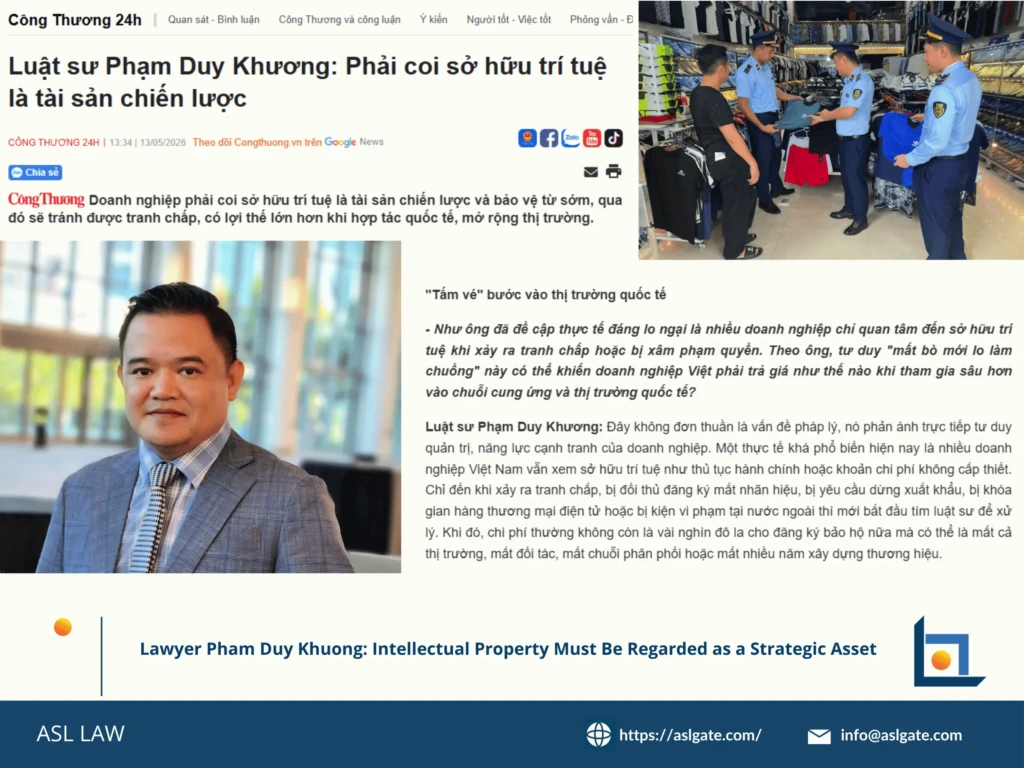
(Published in Industry and Trade Newspaper) Enterprises must regard intellectual property as a strategic asset and protect it from an early stage. By doing so, they can avoid disputes, gain greater advantages in international cooperation, and expand into new markets.
On May 5, 2026, Deputy Prime Minister Ho Quoc Dung signed Official Dispatch No. 38/CĐ-TTg on combating, preventing, and handling acts infringing intellectual property rights, launching a nationwide large-scale enforcement campaign. This move demonstrates Vietnam’s determination to protect intellectual assets, establish a transparent digital economic ecosystem, and create a “safe passport” for Vietnamese enterprises to confidently expand into global markets.
Regarding this issue, a reporter from Industry and Trade Newspaper had a discussion with Lawyer Pham Duy Khuong, Managing Partner of a Vietnam Intellectual Property Law Firm, ASL LAW and an expert in intellectual property and international trade.

Shifting the Mindset on Intellectual Property
– Sir, how do you assess the current state of intellectual property in Vietnam?
Lawyer Pham Duy Khuong: The current state of intellectual property in Vietnam is undergoing a positive and noticeable transformation. The legal framework has become more comprehensive and increasingly aligned with international commitments, especially following recent amendments to the Intellectual Property Law aimed at simplifying procedures, strengthening the exploitation of rights, and expanding protection capabilities in the digital environment.
The number of trademark, patent, and industrial design applications has been increasing, demonstrating improved awareness among businesses and society regarding the value of intellectual assets. Many enterprises have shifted from a procedural approach to a strategic mindset, recognizing intellectual property as an important tool for market expansion and protection of competitive advantages.
However, the main bottleneck remains enforcement, as infringements in both traditional markets and digital platforms continue to be complicated. The gap between legal regulations and practical enforcement effectiveness is still significant, particularly in proving damages and seeking compensation. Many rights holders face difficulties in proving specific levels of damage, making rights protection less effective than expected.
Contact with ASL LAW, a Vietnam Intellectual Property Law Firm with renowned Intellectual Property Service to receive consultation on your specific Intellectual Property business.
In reality, Vietnam still faces three major challenges. First, intellectual property infringements remain highly complicated, especially in the digital environment. Counterfeit goods, imitation products, content copying, software copyright violations, and brand impersonation are rapidly shifting from traditional markets to social media and online platforms with increasingly sophisticated methods.
Second, many Vietnamese enterprises still do not regard intellectual property as a strategic asset. Quite a number of businesses only seek protection registration after disputes arise or before export activities begin, while in international markets, intellectual property forms an integral part of competitiveness and risk management.
Third, the legal framework is having to move very quickly to keep pace with emerging technologies such as artificial intelligence, digital data, and digital content. This is not only Vietnam’s challenge but also a global issue.
On the positive side, Vietnam has started introducing legal reforms toward digitalization and adaptation to the new creative economy, gradually shifting from the mindset of “registration and infringement handling” to “management, exploitation, and commercialization of intellectual assets.” This is a very important transition in the context of rapid growth in the digital economy, artificial intelligence, and cross-border trade.

– What significance does Official Dispatch No. 38 and the nationwide campaign against intellectual property infringement hold for the development of a creative economy, and what message does it send to domestic businesses and international investors?
Lawyer Pham Duy Khuong: The Official Dispatch demonstrates the Government’s strong determination to improve law enforcement effectiveness. This contributes to creating a transparent business environment, promoting innovation, and supporting the development of an economy driven by intellectual assets. It also sends a clear message to domestic businesses and international investors that Vietnam is serious about protecting intellectual property rights and considers them a key factor for sustainable economic growth and international integration.
Following this Official Dispatch, the enforcement of intellectual property protection in Vietnam will certainly enter a more decisive and expansive phase, while awareness among enterprises and relevant stakeholders will significantly improve.
A “Ticket” to Enter International Markets
– As you mentioned, a concerning reality is that many enterprises only pay attention to intellectual property after disputes or infringements occur. In your opinion, how could this “closing the stable door after the horse has bolted” mindset cost Vietnamese businesses as they integrate more deeply into global supply chains and international markets?
Lawyer Pham Duy Khuong: This is not merely a legal issue; it directly reflects corporate governance thinking and competitive capability. A fairly common reality today is that many enterprises doing business in Vietnam still view intellectual property as an administrative procedure or a non-essential expense. Only when disputes arise, trademarks are registered first by competitors, exports are suspended, e-commerce stores are shut down, or lawsuits are filed abroad do they begin seeking legal assistance. By then, the cost is no longer just a few thousand dollars for registration, but potentially the loss of entire markets, partners, distribution chains, or years of brand-building efforts.
In the current context, the core value of many enterprises is shifting away from tangible assets such as factories and machinery toward intangible assets, including brands, customer data, product designs, technologies, trade secrets, distribution systems, and digital reputation.
Without early protection, enterprises may end up effectively working for their own brands. In fact, many Vietnamese exporters have already encountered situations where partners or third parties registered their trademarks abroad first, preventing them from continuing to sell products under their own brand names.
Within global supply chains, international partners assess not only product quality but also intellectual property compliance capabilities: whether trademarks are protected, whether designs pose infringement risks, whether software licenses are legitimate, and whether digital data and content have lawful origins. Enterprises lacking early preparation are easily classified as high-risk partners.
Therefore, Vietnamese businesses need to change their mindset and regard intellectual property as a strategic asset. They should proactively conduct registration of trademark as well as patents, and industrial designs in target markets; review risks before export activities; manage contracts with employees, suppliers, designers, and technology partners; and monitor infringement activities in the marketplace.
Prevention in intellectual property is always less costly than dealing with consequences. Enterprises that know how to protect intellectual assets early will avoid disputes and gain greater advantages in fundraising, international cooperation, market expansion, and deeper participation in global value chains.
A “Lever” for the Digital Creative Industry
– The world is entering a stage of increasingly complex disputes regarding copyright in Vietnam involving generative AI, training data, and ownership of digital content. In your opinion, what legal foundations and governance capabilities should Vietnam prepare to protect intellectual property rights while facilitating digital economic development?
Lawyer Pham Duy Khuong: The biggest issue today is that humanity is entering an era in which data, content, and knowledge have become the core inputs of the AI economy. If we approach this issue too rigidly through the lens of traditional copyright thinking, we may protect certain immediate interests but slow down the development of domestic AI ecosystems and long-term national competitiveness.
Countries are choosing different approaches: the United States prioritizes innovation and allows the market and case law to shape operational frameworks; the European Union emphasizes data owners’ rights and transparency requirements; China pursues a model combining data and AI control while simultaneously supporting technology enterprises in accelerating development.
In my opinion, Vietnam needs to prepare several important foundations. First, shift from protecting individual works toward governing data ecosystems and exploitation rights. In the AI era, value lies in training data; therefore, legal mechanisms are needed for licensing, sharing, and exploiting data to both protect rights holders and facilitate the development of AI enterprises.
Second, establish reasonable liability exemption mechanisms for AI development activities within safe limits, clearly distinguishing between model training and commercial exploitation of infringing products, thereby avoiding excessive legal risks during research stages.
Third, create a transparent market for data and copyright licensing where parties can negotiate and share benefits. The focus should be on building a legal framework for the licensing economy rather than solely handling infringements.
Fourth, improve enforcement capabilities in the digital environment. Regulatory authorities and the judicial system must keep pace with technology and understand how data is collected, processed, and used in order to effectively handle new forms of disputes.
Fifth, clearly define a national strategy. If Vietnam aims to develop globally competitive AI enterprises, policies must create experimental spaces for innovation; overly early restrictions could result in missed opportunities to develop domestic technological capabilities.
Thank you very much for your insights!
ASL Law is a leading full-service and independent Vietnamese law firm made up of experienced and talented lawyers. ASL Law is ranked as the top tier Law Firm in Vietnam by Legal500, Asia Law, WTR, and Asia Business Law Journal. Based in both Hanoi and Ho Chi Minh City in Vietnam, the firm’s main purpose is to provide the most practical, efficient and lawful advice to its domestic and international clients. If we can be of assistance, please email to [email protected].
ASL LAW is the top-tier Vietnam law firm for Intellectual Property Services. If you need any advice, please contact us for further information or collaboration.