Tiếng Việt
 中文 (中国)
 日本語

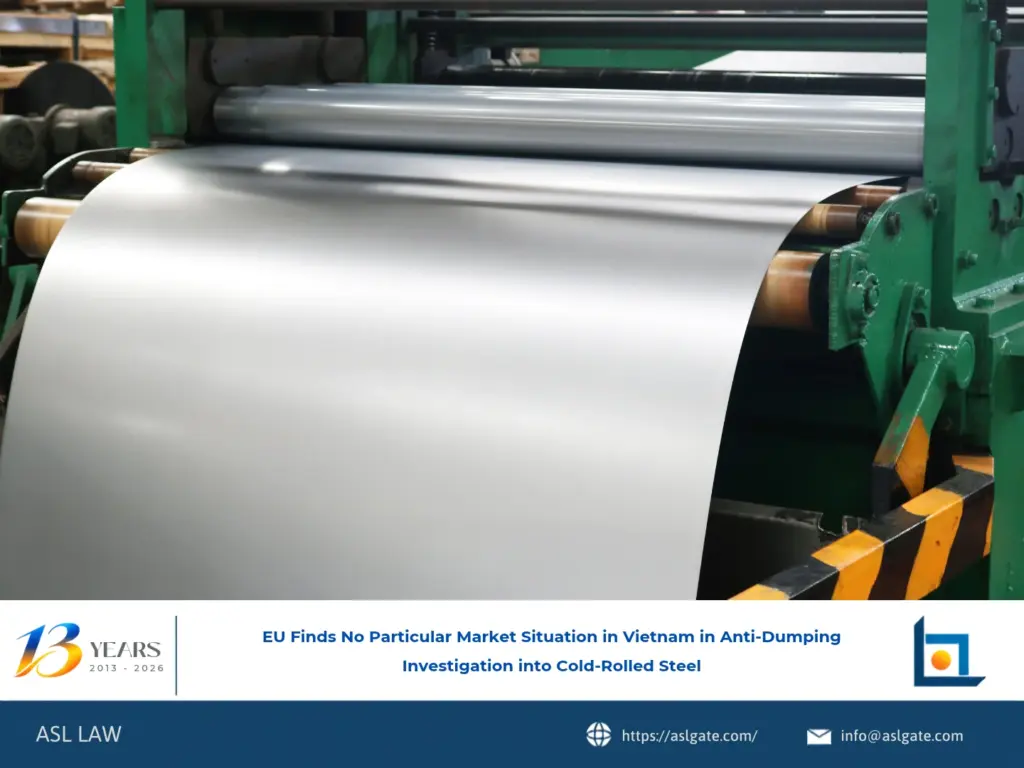
On November 16, 2026, the European Commission (EC) issued Implementing Regulation (EU) 2026/2547, officially imposing anti-dumping duties on certain cold-rolled steel products imported from Vietnam and four other markets. Notably, although the EC determined a dumping margin of 16% for Vietnamese cold-rolled steel, it rejected allegations of a Particular Market Situation (PMS) in Vietnam. This outcome creates additional tax pressure on Vietnamese exporters while also establishing a significant precedent for defending the methodology used to determine the normal value of Vietnamese goods in similar trade remedy proceedings.
Scope of the Investigation and Countries Concerned
The investigation was initiated by the EC on September 18, 2025, following a complaint filed by the European Steel Association (EUROFER). The products under investigation were certain flat-rolled cold-rolled steel products (CRF) originating in India, Japan, Taiwan (China), Türkiye, and Vietnam.
The products fall primarily under CN codes in headings 7209, 7211, 7225, and 7226. However, not all steel products classified under these headings are covered by the measures. The EC excluded certain products, including electrical steel, blackplate with a thickness of less than 0.35 mm, and certain specialized alloy steel products.
The dumping investigation period ran from July 1, 2024, to June 30, 2025. The injury investigation period covered January 1, 2022, to June 30, 2025.
Official Anti-Dumping Duty Rates on Vietnamese Cold-Rolled Steel
In its definitive findings, the EC established a dumping margin of 16.0% for cold-rolled steel imported from Vietnam. The definitive anti-dumping duty rate was also set at 16.0%, uniformly applicable to all three categories of enterprises:
- POSCO VIETNAM CO., LTD: 16.0%.
- Other cooperating companies: 16.0%.
- All other exporting companies: 16.0%.
Accordingly, in this investigation, whether or not an enterprise cooperated with the EC does not affect the final duty rate applicable to Vietnamese-origin goods. For non-cooperating enterprises, the EC relied on facts available to determine the dumping margin. The EC stated that the cooperation level of Vietnamese exporters in the investigation accounted for more than 80% of total imports from Vietnam during the investigation period.
Implementing Regulation (EU) 2026/2547 entered into force on November 17, 2026, the day following its publication in the Official Journal of the European Union.
Businesses should note that the 16% anti-dumping duty is an additional charge on top of ordinary import duties. Correctly identifying product codes, country of origin, and manufacturer information in commercial documentation is therefore essential when completing import procedures into the EU.
EC Rejects Allegations of a Particular Market Situation in Vietnam
One of the most notable aspects of the definitive findings is that the EC did not apply the Particular Market Situation (PMS) provisions to Vietnam.
During the investigation, EUROFER argued that certain factors in Vietnam could distort the production costs and selling prices of cold-rolled steel. The issues examined included the impact of steel imports from China, export restrictions on iron ore, steel scrap, and coal, the degree of vertical integration among manufacturers, and the use of Chinese-origin hot-rolled steel as an input material.
The EC assessed the arguments and information submitted by the parties, including comments from the competent Vietnamese authorities and relevant enterprises. Based on its assessment of these factors, the EC concluded that there were insufficient grounds to apply the PMS provisions to Vietnam in this investigation.
This finding is significant because, if a PMS is established, the investigating authority may consider adjusting the methodology for determining normal value where domestic selling prices do not permit an appropriate comparison with export prices. The decision not to apply PMS helps reduce the risk of normal value being determined using an alternative methodology that could be disadvantageous to Vietnamese enterprises.
However, an important distinction must be made: the finding that no PMS exists does not mean that the EC concluded that Vietnamese enterprises were not dumping. In this investigation, the EC still determined a dumping margin of 16% and imposed the corresponding anti-dumping duty. PMS and dumping are separate issues assessed during the investigation process.
Significance of the Findings for Vietnam’s Steel Industry
The EC’s rejection of the PMS allegations represents a favorable outcome for Vietnam’s steel industry from a legal and evidentiary perspective. The findings demonstrate that Vietnamese enterprises and competent authorities can defend their positions against allegations concerning market mechanisms, raw material costs, and domestic regulatory policies.
The decision may also serve as a useful reference in future trade remedy proceedings, particularly when foreign investigating authorities examine whether policy factors or developments in imports from third countries distort prices and production costs in Vietnam.
Nevertheless, the EC’s findings in the cold-rolled steel investigation do not automatically bind investigating authorities in other proceedings. Enterprises must still prepare their own data and arguments based on the specific characteristics of the products, industries, and investigation periods involved in each case.
Conversely, the definitive 16% anti-dumping duty may increase the import costs of Vietnamese steel in the EU, affecting price competitiveness and the ability to maintain export contracts. Enterprises should reassess their quotations, delivery terms, profit margins, and capacity to allocate additional tax costs throughout the supply chain.
Recommendations for Exporting Enterprises
Vietnamese manufacturers and exporters of cold-rolled steel to the EU should promptly review their product portfolios, CN codes, and technical specifications to determine accurately whether their goods fall within the scope of the measures. Relying solely on general HS code classifications may lead to incorrect assessments, as the EU Regulation defines the product scope based on both product descriptions and specific CN codes.
In addition, enterprises should:
- Review export prices and assess the impact of the 16% anti-dumping duty on existing contracts and future export plans.
- Maintain comprehensive records of domestic selling prices, export prices, raw material costs, production costs, and relevant adjustments to support any future verification requests.
- Maintain accounting and data-traceability systems that allow reconciliation between accounting records, raw material purchase documents, production records, and sales transactions.
- Monitor any subsequent EU reviews or investigations to promptly assess the possibility of changes to the measures.
The outcome of this case demonstrates the importance of transparent data preparation and full cooperation in protecting business interests. In particular, the finding that no PMS exists in Vietnam provides a positive reference for future proceedings. However, enterprises must remain proactive in demonstrating market conditions and the reasonableness of their cost data in each specific investigation.
To protect their legitimate interests, manufacturers and exporters should familiarize themselves with the procedure and actively contact Vietnam Antidumping Law Firm specializing in anti-dumping and trade remedy for timely assistance.
ASL Law is a leading full-service and independent Vietnamese law firm made up of experienced and talented lawyers. ASL Law is ranked as the top tier Law Firm in Vietnam by Legal500, Asia Law, WTR, and Asia Business Law Journal. Based in both Hanoi and Ho Chi Minh City in Vietnam, the firm’s main purpose is to provide the most practical, efficient and lawful advice to its domestic and international clients. If we can be of assistance, please email to [email protected].
ASL LAW is the top-tier Vietnam law firm for Anti-dumping & countervailing. If you need any advice, please contact us for further information or collaboration.
s