Tiếng Việt
 中文 (中国)
 日本語

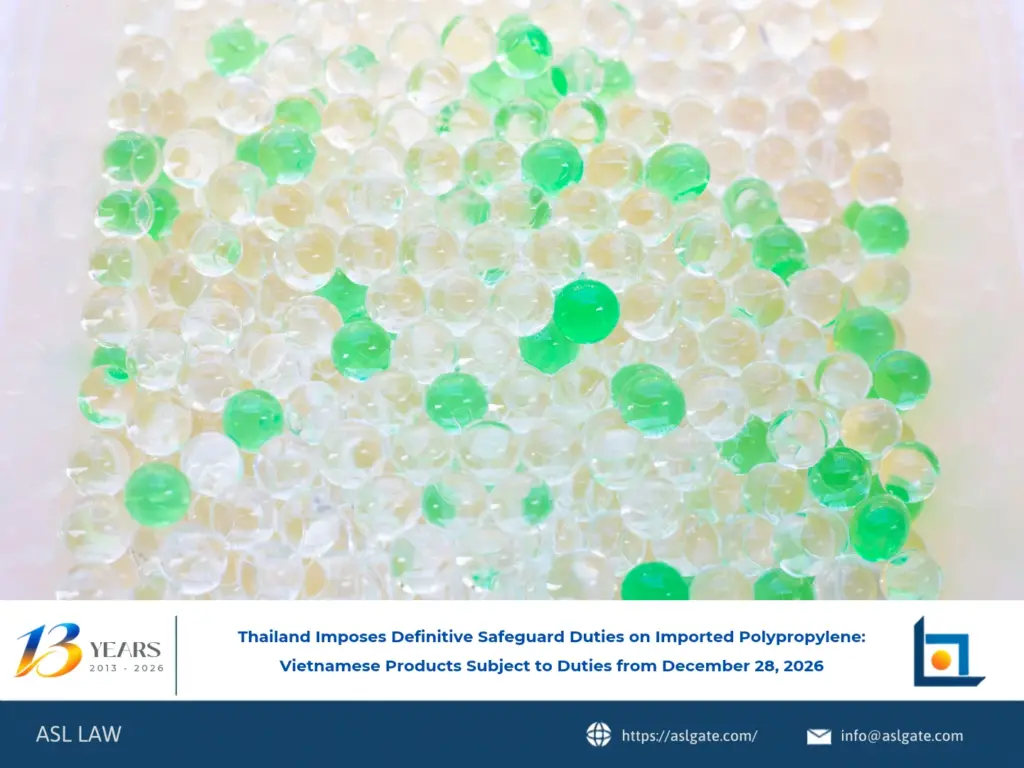
On November 10, 2026, the Department of Foreign Trade (DFT) under Thailand’s Ministry of Commerce issued its final determination and decided to impose definitive safeguard measures on imported polypropylene (PP) products from 40 countries and territories, including Vietnam. The measures will remain in force for three years, with duties decreasing annually from an initial rate of 7.73% of the CIF value. Although the decision takes effect on September 28, 2026, the collection of duties will be postponed until December 28, 2026, giving exporters and importers time to review their contracts, selling prices, and eligibility for exemptions.
Background and Scope of Thailand’s Safeguard Investigation
On September 3, 2025, the DFT initiated a safeguard investigation into imported polypropylene products following an application submitted by three Thai manufacturers: HMC Polymer, Thai Polyethylene, and IRPC Public.
According to data published by the investigating authority, PP imports increased from 228,365 tonnes in 2020 to 390,583 tonnes in 2023, representing a rise of 71.03%. During the first three quarters of 2025, imports continued to increase by 18.09% compared with the same period in 2024. The applicants argued that this increase in imports had caused or threatened to cause serious injury to Thailand’s domestic PP industry.
The products subject to the measures are polypropylene products classified under the following HS codes:
- 3902.10.30.001 and 3902.10.30.090;
- 3902.10.40.001 and 3902.10.40.090;
- 3902.10.90.001 and 3902.10.90.090;
- 3902.30.30.001 and 3902.30.30.090;
- 3902.30.90.001 and 3902.30.90.090;
- 3902.90.90.000.
The measures apply to goods imported from 40 countries and territories that export at least one tonne of the products to Thailand, including Vietnam. Accordingly, Vietnamese PP manufacturers and exporters should carefully verify their product codes and characteristics before shipping goods to the Thai market.
Safeguard Duty Rates and Implementation Schedule
Under the DFT’s decision, definitive safeguard measures will be imposed for three years, from September 28, 2026, to September 27, 2029. The duties are calculated as a percentage of the CIF value and will decrease annually as follows:
| Period | Safeguard duty rate |
| September 28, 2026 – December 27, 2026 | 0% |
| December 28, 2026 – September 27, 2027 | 7.73% |
| September 28, 2027 – September 27, 2028 | 7.68% |
| September 28, 2028 – September 27, 2029 | 7.63% |
Notably, Thailand has postponed the collection of safeguard duties for three months under an emergency provision to support the domestic market against the effects of the conflict in the Middle East. Therefore, although the measures take effect on September 28, 2026, goods imported between September 28 and December 27, 2026, will be subject to a 0% duty rate.
Businesses should distinguish between the effective date of the measures and the date on which duty collection begins. The postponement of duty collection does not mean that Vietnamese-origin goods are exempt from the safeguard measures throughout the entire period of application.
Exemptions and Exclusions from the Measures
Under the exemption list for developing countries, Thailand excludes goods originating in 175 countries and territories. However, Vietnam is not included in this list. Consequently, Vietnamese-origin PP products are subject to the safeguard measures if they fall within the product description and HS codes covered by the investigation.
In addition to origin-based exemptions, Thailand’s decision provides for the exclusion of certain specific PP products or their application at a 0% duty rate, including:
- PP used in drinking water systems: Products must comply with NSF/ANSI 61 or DVGW W 270 certification requirements.
- PP terpolymer used in film production: Grades containing anti-block and slip additives must have a sealing initiation temperature (SIT) of no more than 115°C; grades without these additives must have an SIT of no more than 105°C.
- PP block copolymer used in retort food packaging: Products must meet technical requirements concerning haze, melt flow rate (MFR), and documentation demonstrating compliance with food-contact standards.
- PP random copolymer: Products with an MFR of 70 g/10 minutes or higher qualify for exclusion.
- PP imported for the production of goods for export in Thailand: Certain cases may qualify for duty exemptions under Thailand’s laws on industrial estates, investment promotion, or customs.
In addition, information available on the DFT’s trade remedies database records an exclusion for virgin PP resin with a plastomer or elastomer structure. Businesses should directly compare their products with the descriptions in the decision and its relevant annexes to determine whether they qualify for exclusion.
Meeting the relevant technical specifications in practice does not automatically guarantee exemption from duties. Businesses should prepare certificates, technical documents, evidence of intended use, and other supporting documents as required by Thai customs authorities.
Impact on Vietnamese PP Exporters
Vietnam’s absence from the list of developing countries eligible for exemption means that Vietnamese PP exporters must factor safeguard duties into their business plans for the Thai market.
The initial duty rate of 7.73% may increase import prices and affect the competitiveness of Vietnamese PP compared with products from other sources. The actual impact will depend on CIF prices, product composition, contractual terms, and the ability to pass some of the additional duty costs on to importers or customers.
For businesses supplying specialized products for the medical, food, or export-manufacturing sectors in Thailand, the product exclusions may offer opportunities to maintain trade without incurring the standard safeguard duties. However, eligibility depends on full compliance with the applicable technical requirements and supporting documentation procedures.
Furthermore, the application of measures across 40 countries and territories may change the competitive dynamics among PP suppliers in the Thai market. Vietnamese businesses should monitor import trends, duty policies, and the responses of importers to adjust their export strategies accordingly.
Recommendations for Vietnamese Businesses
Vietnamese PP manufacturers and exporters to Thailand should proactively take the following steps:
- Review HS codes and product scope: Compare the HS codes, composition, polymer structure, and technical characteristics of each product against the list of goods subject to the duties.
- Assess eligibility for product exclusions: If products are intended for drinking water systems, food packaging, film production, or have specialized polymer characteristics, businesses should verify the applicable technical requirements and prepare supporting documentation.
- Adjust contracts and pricing strategies: Calculate the impact of the 7.73%, 7.68%, and 7.63% duty rates across the respective periods. Clearly allocate responsibility for duty payments in sales contracts and specify the applicable delivery terms.
- Prepare origin and technical documentation: Maintain records concerning raw material sources, manufacturing processes, product composition, test results, and quality certifications to support the determination of whether the measures apply.
- Monitor DFT announcements: Keep up to date with implementation guidance, exemption procedures, and any changes relating to the safeguard measures.
Businesses should not rely solely on commercial product names or declared HS codes to determine whether their products are subject to duties. A comprehensive assessment of product codes, technical descriptions, origin, and intended use will help minimize the risks of additional duties, customs clearance delays, or disputes with importers when Thailand’s safeguard measures are implemented.
To protect their legitimate interests, manufacturers and exporters should familiarize themselves with the procedure and actively contact Vietnam Antidumping Law Firm specializing in anti-dumping and trade remedy for timely assistance.
ASL Law is a leading full-service and independent Vietnamese law firm made up of experienced and talented lawyers. ASL Law is ranked as the top tier Law Firm in Vietnam by Legal500, Asia Law, WTR, and Asia Business Law Journal. Based in both Hanoi and Ho Chi Minh City in Vietnam, the firm’s main purpose is to provide the most practical, efficient and lawful advice to its domestic and international clients. If we can be of assistance, please email to [email protected].
ASL LAW is the top-tier Vietnam law firm for Anti-dumping & countervailing. If you need any advice, please contact us for further information or collaboration.