Tiếng Việt
 中文 (中国)
 日本語
日本語
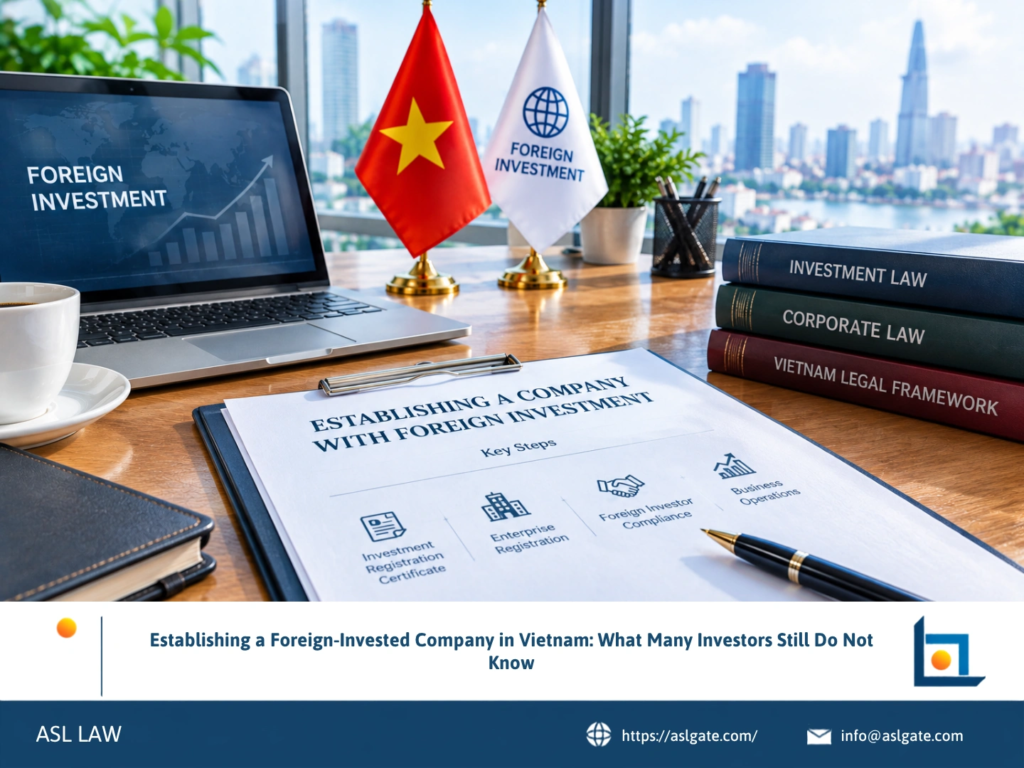
Vietnam remains an attractive destination for foreign investors, but establishing a foreign-invested company involves more than registering a legal entity and transferring capital. The most important decisions often have to be made before incorporation, including market access, investment structure, ownership, licensing, capital arrangements, and the company’s intended activities. Understanding the little-known facts about FDI company establishment in Vietnam can help investors avoid problems that may become expensive once operations have already begun.
Vietnam’s offshore investment framework has changed significantly in recent years. The new Law on Investment No. 143/2025/QH15 took effect on March 1, 2026, while amendments to the Law on Enterprises took effect from July 1, 2025. Decree No. 168/2025/NĐ-CP on enterprise registration also took effect on July 1, 2025, replacing the previous enterprise-registration framework.
These changes make it particularly important for foreign investors to reassess assumptions based on older market-entry procedures. Some of the little-known facts about FDI company establishment in Vietnam concern not the registration certificate itself, but the legal conditions surrounding the investment project and the company’s subsequent operations.
Foreign Investment Starts with Market Access, Not Company Registration
One of the first things investors doing business in Vietnam should understand is that establishing a company and determining whether a foreign investor may conduct a particular business activity are two different legal questions.
Under Vietnam’s investment framework, foreign investors are generally entitled to market access on conditions applicable to domestic investors unless the relevant business sector falls within the categories subject to foreign-investor market-access restrictions. Those restrictions may concern matters such as foreign ownership ratios, forms of investment, scope of investment activities, investor capacity, or other statutory conditions.
This is one of the most important things investors overlook when setting up FDI in Vietnam. An investor may have a commercially attractive business plan but discover that the proposed activity is subject to a foreign ownership limitation, a required Vietnamese partner, a specific investment form, or another market-access condition.
The practical consequence is significant. Investors should determine the legal status of the proposed business activities before deciding how the company will be structured.
For example, the appropriate structure may differ depending on whether the investor intends to:
- establish a wholly foreign-owned company;
- establish a company with a Vietnamese partner;
- acquire an existing Vietnamese enterprise;
- contribute capital to an existing company; or
- use another permitted investment structure.
Accordingly, one of the key little-known facts about FDI company establishment in Vietnam is that the corporate structure should normally follow the investment and market-access analysis, rather than the other way around.
Looking for a trusted Vietnam law firm in Hanoi for legal consulting services in Vietnam, guidance on how to set up a company in Vietnam, or reliable Vietnam legal outsourcing? Choose Vietnam full Service law firm ASL LAW as your strategic legal partner.
An Investment Project Can Be More Important Than the Company Itself
Foreign investors sometimes approach company formation as though the company were the primary legal object. In reality, the investment project can be equally important.
The investment framework regulates offshore investment projects separately from the corporate entity. Depending on the circumstances, investors may need to establish and register an investment project before or as part of establishing the economic organization.
This is particularly relevant to foreign investors establishing a new enterprise to carry out a business project in Vietnam. The investment-registration stage and enterprise-registration stage should therefore be planned together rather than treated as completely independent administrative procedures.
The current investment law has been effective since March 1, 2026, making it important for investors relying on older procedures to verify the current requirements before preparing an application.
This is among the hidden requirements for foreign-invested companies in Vietnam that can easily be underestimated. A company may have an appropriate corporate name and proposed charter, but the investment project itself may still require examination of matters such as business activities, location, capital, implementation schedule, and market-access conditions.
In practical terms, the investor should be able to explain not only what company will be established, but also what investment project that company will implement.
That distinction can affect the documentation, timeline, capital planning, and licensing strategy from the beginning.
Foreign Investors Need to Think Carefully About Capital and Funding
Another issue that is often underestimated is the relationship between registered investment capital, charter capital, and actual funding requirements.
Foreign investors should not simply select a capital figure because it appears convenient for incorporation. The proposed capital should make commercial and legal sense in light of the project’s scale, business activities, implementation schedule, operating expenses, and financing arrangements.
An unrealistic capital structure can create practical difficulties later. If the company requires substantially more funding than initially planned, additional capital contributions or other financing arrangements may require corporate and investment procedures. Conversely, an unnecessarily high registered capital commitment can create obligations that do not match the company’s actual financial strategy.
The problem becomes more complicated when the investment involves foreign parent companies, loans, technology arrangements, or other cross-border transactions.
One of the surprising regulations for FDI establishment in Vietnam is therefore not necessarily a single filing requirement. It is the need to consider how the capital structure will work after the company receives its registration documents and begins operating.
Investors should consider at the outset:
- how much capital the project realistically requires;
- when the capital will actually be contributed;
- whether funding will come from equity, loans, or a combination;
- whether additional capital may be required during expansion; and
- whether the planned financing structure is consistent with the investment project.
A well-designed capital structure can make later expansion considerably easier.
Ownership and Beneficial Ownership Are Now More Important
Foreign investors doing business in Vietnam also need to pay attention to how ownership information is documented and disclosed.
Decree No. 168/2025/NĐ-CP, effective July 1, 2025, introduced detailed rules on beneficial owners of enterprises. Under the decree, a beneficial owner can include an individual who directly or indirectly owns at least 25% of charter capital or voting shares, as well as an individual who has the power to control certain important corporate decisions.
This is particularly relevant where the foreign investor is itself a company, fund, holding company, or part of a larger corporate group.
The investor may need to look beyond the immediate shareholder shown on the corporate documents and understand the ultimate ownership and control structure.
This is one of the little-known facts about FDI company establishment in Vietnam that can become particularly important during banking procedures, corporate due diligence, investment transactions, restructuring, or changes in ownership.
The information submitted to Vietnamese authorities should therefore be consistent across the investment application, enterprise-registration documents, corporate records, authorization documents, and supporting materials.
Where several entities are involved in the ownership chain, investors should prepare the structure and supporting documents before the application is filed. Trying to reconstruct ownership information after a regulatory or banking request can be significantly more difficult.
Foreign Documents Can Create Unexpected Delays
Foreign investors often underestimate the documentary requirements associated with establishing a company in Vietnam.
Documents issued outside Vietnam may need to satisfy Vietnamese requirements concerning authentication, legalization, translation, certification, and form. The exact requirements depend on the document and applicable treaties or procedures, so investors should not assume that a document valid in the investor’s home country can automatically be submitted in Vietnam without further preparation.
This can be particularly important for:
- corporate registration documents of the foreign parent;
- financial-capacity documents;
- powers of attorney;
- identification documents;
- proof of the investor’s legal status; and
- documents evidencing ownership or authorization.
These documentary issues are among the unknown challenges of setting up a foreign company in Vietnam because they can delay an otherwise straightforward investment project.
The problem is often not that the investor lacks the required information. Rather, the information may not be presented in a form acceptable to the Vietnamese authority receiving the application.
Consequently, one of the most practical risk-management measures is to identify documentary requirements before the investor signs a lease, commits substantial capital, or fixes a launch date.
Company Registration Does Not Mean the Business Can Immediately Do Everything
Another important distinction concerns the difference between having an established company and having the right to conduct every intended business activity.
Vietnamese law distinguishes between ordinary business registration and activities subject to specialized regulatory conditions. Depending on the industry, a company may need additional licenses, certificates, approvals, professional qualifications, or other conditions before carrying out particular activities.
Foreign investors also need to consider whether the company’s activities remain within the scope of the investment project and the conditions applicable to foreign investors.
This is one of the most important things investors overlook when setting up FDI in Vietnam. The company may be legally incorporated while certain planned activities remain subject to additional regulatory requirements.
The distinction can be particularly significant in sectors such as trading, logistics, education, healthcare, finance, construction, real estate, telecommunications, and other regulated industries.
Investors should therefore distinguish three separate questions:
- Can the foreign investor access the proposed business activity?
- Can the investor establish a company to conduct that activity?
- After establishment, what licenses or operating conditions must the company satisfy?
Treating these three questions as one can create serious compliance problems.
The Current Registration Framework Has Changed
The procedural environment itself has also changed. Decree No. 168/2025/NĐ-CP took effect on July 1, 2025 and replaced Decree No. 01/2021/NĐ-CP on enterprise registration. The decree also modified certain provisions concerning investment-related registration.
At the same time, the amended Law on Enterprises No. 76/2025/QH15 has been effective since July 1, 2025.
This means that foreign investors using incorporation checklists prepared under older regulations should be careful about assuming that every procedural detail remains unchanged.
The legal framework governing FDI establishment should be reviewed as a connected system. Investment registration, enterprise registration, ownership disclosure, corporate governance, tax, banking, employment law in Vietnam, licensing, and operational compliance can interact with each other.
For investors entering Vietnam for the first time, this is perhaps the most important lesson: the registration process is not simply a sequence of forms. It is the first stage of establishing a legal structure that must continue to comply with Vietnamese law after incorporation.
How Foreign Investors Can Prepare Before Entering Vietnam
The most effective approach is to conduct a legal and commercial assessment before committing to the final investment structure.
A practical pre-establishment review should cover:
- the proposed business activities and foreign market-access conditions;
- the appropriate investment and corporate structure;
- the location and operational requirements of the project;
- investment and charter capital;
- ownership and beneficial ownership;
- foreign corporate documents and authentication requirements;
- sector-specific licenses and operating conditions;
- tax, accounting, banking, employment law in Vietnam, IP, and data requirements; and
- the company’s expected expansion or restructuring plans.
This approach helps address the little-known facts about FDI company establishment in Vietnam before they become operational problems.
It also allows investors to identify what investors overlook when setting up FDI in Vietnam: the fact that a successful incorporation application is only one milestone in a much larger compliance process.
For foreign businesses, the goal should therefore not simply be to obtain an investment registration certificate and enterprise registration certificate as quickly as possible. A properly structured FDI company should be capable of operating, hiring, contracting, receiving investment funds, protecting its assets, and expanding in compliance with Vietnamese law.
Understanding the hidden requirements for foreign-invested companies in Vietnam at the planning stage can make the entire investment process more predictable.
The most effective strategy is ultimately proactive rather than reactive. By identifying surprising regulations for FDI establishment in Vietnam and addressing them before incorporation, investors can reduce the risk of having to restructure the business after entering the market.
FAQ
1. What are the little-known facts about FDI company establishment in Vietnam?
Important facts include the need to assess foreign-investor market access before choosing the corporate structure, the role of the investment project in the establishment process, beneficial ownership disclosure, documentary requirements for foreign-issued documents, and the possibility that additional licenses may be required after incorporation.
2. What do investors overlook when setting up FDI in Vietnam?
Investors commonly overlook the interaction between investment registration and enterprise registration, sector-specific market-access conditions, realistic capital planning, beneficial ownership requirements, foreign-document formalities, and post-establishment licensing obligations.
3. What are the hidden requirements for a foreign-invested company in Vietnam?
Hidden requirements can include foreign market-access conditions, investment-project requirements, beneficial ownership information, document authentication and translation, sector-specific licenses, and compliance obligations that arise once the company begins actual operations.
4. What are some surprising regulations for FDI establishment in Vietnam?
One surprising aspect is that company incorporation does not necessarily give a foreign investor unrestricted access to every intended business activity. Depending on the sector, foreign ownership, investment form, scope of activities, investor capacity, or other conditions may affect market access.
5. What are the unknown challenges of setting up a foreign company in Vietnam?
The main challenges can include coordinating investment and corporate procedures, preparing foreign documents correctly, designing an appropriate capital structure, satisfying ownership-disclosure requirements, obtaining sector-specific licenses, and ensuring that the company’s actual operations remain consistent with its registered investment and legal requirements.
ASL Law is a leading full-service and independent Vietnamese law firm made up of experienced and talented lawyers. ASL Law is ranked as the top tier Law Firm in Vietnam by Legal500, Asia Law, WTR, and Asia Business Law Journal. Based in both Hanoi and Ho Chi Minh City in Vietnam, the firm’s main purpose is to provide the most practical, efficient and lawful advice to its domestic and international clients. If we can be of assistance, please email to [email protected].
ASL LAW is the top-tier Vietnam law firm for Investment Services. If you need any advice, please contact us for further information or collaboration.