Tiếng Việt
 中文 (中国)
 日本語
日本語
By Nguyen Thi Thuy Chung, Senior Partner, ASL LAW
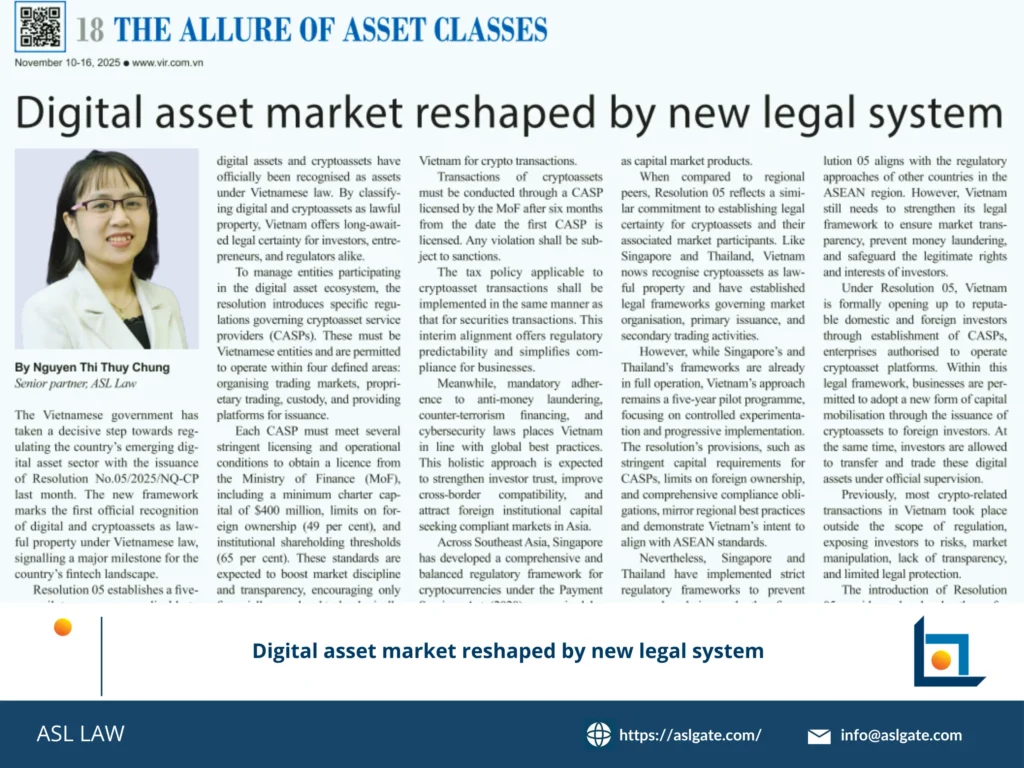
(Published on VIR – Vietnam Investment Review Newspaper) The Vietnamese government has taken a decisive step towards regulating the country’s emerging digital asset sector with the issuance of Resolution No.05/2025/NQ-CP last month. The new framework marks the first official recognition of digital and cryptoassets as lawful property under Vietnamese law, signalling a major milestone for the country’s fintech landscape.
Resolution 05 establishes a five-year pilot programme applicable to both service providers, issuers, as well as domestic and foreign investors. This pilot mechanism aims to create a structured and monitored environment for the fast-evolving crypto sector, balancing innovation with investor protection and financial stability.
Notably, under Resolution 05, digital assets and cryptoassets have officially been recognised as assets under Vietnamese law. By classifying digital and cryptoassets as lawful property, Vietnam offers long-awaited legal certainty for investors, entrepreneurs doing business in Vietnam, and regulators alike.
To manage entities participating in the digital asset ecosystem, the resolution introduces specific regulations governing cryptoasset service providers (CASPs). These must be Vietnamese entities and are permitted to operate within four defined areas: organising trading markets, proprietary trading, custody, and providing platforms for issuance.
Each CASP must meet several stringent licensing and operational conditions to obtain a licence from the Ministry of Finance (MoF), including a minimum charter capital of $400 million, limits on foreign ownership (49 per cent), and institutional shareholding thresholds (65 per cent). These standards are expected to boost market discipline and transparency, encouraging only financially sound and technologically competent players to enter the field.
Under the new regime, cryptoassets issued by a Vietnamese company must be backed by real assets, excluding securities or fiat currencies. Such tokens are tradable only by foreign investors. Foreign issuers are also eligible to obtain a local NAV by Vietnam for crypto transactions.
Transactions of cryptoassets must be conducted through a CASP licensed by the MoF after six months from the date the first CASP is licensed. Any violation shall be subject to sanctions.
The tax policy applicable to cryptoasset transactions shall be implemented in the same manner as that for securities transactions. This interim alignment offers regulatory predictability and simplifies compliance for businesses.
Meanwhile, mandatory adherence to anti-money laundering, counter-terrorism financing, and cybersecurity laws places Vietnam in line with global best practices. This holistic approach is expected to strengthen investor trust, improve cross-border compatibility, and attract foreign institutional capital seeking compliant markets in Asia.
Across Southeast Asia, Singapore has developed a comprehensive and balanced regulatory framework for cryptocurrencies under the Payment Services Act (2020), supervised by the Monetary Authority of Singapore (MAS). The laws classify assets like Bitcoin and Ether as digital payment tokens (DPTs), thereby recognising them as legal assets in Singapore.
In 2020, the Securities Futures Act was expanded to include public offering and trading of DPTs, categorising them as capital market products.
When compared to regional peers, Resolution 05 reflects a similar commitment to establishing legal certainty for cryptoassets and their associated market participants. Like Singapore and Thailand, Vietnam now recognises cryptoassets as lawful property and have established legal frameworks governing market organisation, primary issuance, and secondary trading activities.
However, while Singapore’s and Thailand’s frameworks are already in full operation, Vietnam’s approach remains a five-year pilot programme, focusing on controlled experimentation and progressive implementation.
The resolution’s provisions, such as stringent capital requirements for CASPs, limits on foreign ownership, and comprehensive compliance obligations, mirror regional best practices and demonstrate Vietnam’s intent to align with ASEAN standards.
Nevertheless, Singapore and Thailand have implemented strict regulatory frameworks to prevent money laundering and other financial crimes in the cryptoasset market. These jurisdictions require full transparency of all funding sources, as the tokenisation of assets can provide strong conditions for money laundering control. Therefore, stricter monitoring measures are necessary to help maintain the integrity of the market.
Thus, it can be seen that Resolution 05 aligns with the regulatory approaches of other countries in the ASEAN region. However, Vietnam still needs to strengthen its legal framework to ensure market transparency, prevent money laundering, and safeguard the legitimate rights and interests of investors.
Under Resolution 05, Vietnam is formally opening up to reputable domestic and foreign investors through establishment of CASPs, enterprises authorised to operate cryptoasset platforms. Within this legal framework, businesses are permitted to adopt a new form of capital mobilisation through the issuance of cryptoassets to foreign investors. At the same time, investors are allowed to transfer and trade these digital assets under official supervision.
Previously, most crypto-related transactions in Vietnam took place outside the scope of regulation, exposing investors to risks, market manipulation, lack of transparency, and limited legal protection.
The introduction of Resolution 05 provides a clear legal pathway for digital asset trading, helping to legitimise the market, reduce illegal activities, and enhance investor confidence through compliance and oversight. This framework not only enhances oversea investment opportunities but also positions Vietnam as an emerging and transparent hub for digital asset activities in the region.
Download the full article here.
ASL Law is a leading full-service and independent Vietnamese law firm made up of experienced and talented lawyers. ASL Law is ranked as the top tier Law Firm in Vietnam by Legal500, Asia Law, WTR, and Asia Business Law Journal. Based in both Hanoi and Ho Chi Minh City in Vietnam, the firm’s main purpose is to provide the most practical, efficient and lawful advice to its domestic and international clients. If we can be of assistance, please email to [email protected].
ASL LAW is the top-tier Vietnam law firm for Banking & Financial Services. If you need any advice, please contact us for further information or collaboration.