Tiếng Việt
 中文 (中国)
 日本語

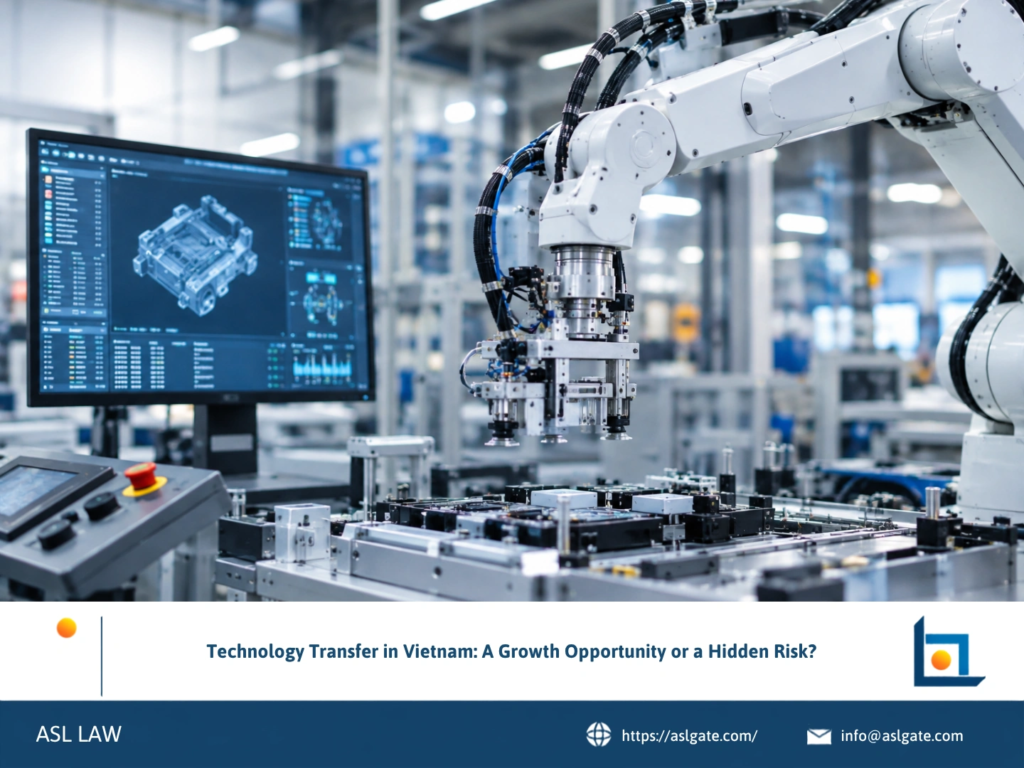
Technology transfer opportunities and risks Vietnam have become increasingly important as businesses seek to modernize production, improve competitiveness, and access advanced technologies. Vietnam’s technology transfer framework has also undergone significant changes in 2025–2026, creating new opportunities while requiring investors and businesses to pay closer attention to regulatory compliance, intellectual property, valuation, and contractual risks.
Why Technology Transfer Is Becoming More Important in Vietnam
Technology transfer has become an increasingly important component of Vietnam’s economic development strategy. Businesses entering Vietnam are no longer focused solely on expanding production capacity. They are also looking to introduce advanced manufacturing processes, digital technologies, automation systems, proprietary know-how, and other technological assets that can improve productivity and create higher-value products.
The regulatory environment has also developed significantly. The Law on Technology Transfer was amended by Law No. 115/2025/QH15, which took effect on April 1, 2026. The amended framework works alongside the Law on Science, Technology and Innovation and other legislation governing investment, intellectual property, digital technology, and high technology.
A particularly important development is Decree No. 101/2026/ND-CP, effective from April 1, 2026. The Decree provides detailed rules on technology appraisal, technology transfer management, technology assessment, supervision of technologies used in investment projects, and measures supporting technology application and innovation.
For businesses, this means technology transfer should no longer be treated simply as a commercial transaction between a technology owner and a Vietnamese enterprise. It may affect oversea investment licensing, intellectual property rights, taxation, manufacturing conditions, regulatory approvals, and the long-term operation of the recipient business.
Understanding technology transfer opportunities and risks Vietnam therefore requires an integrated assessment rather than a narrow review of the technology transfer agreement itself.
The Growth Opportunities Created by Technology Transfer in Vietnam
Technology transfer can provide Vietnamese businesses with a faster route to technological development than attempting to develop every capability internally. Instead of spending years building new technologies from the ground up, a company may obtain access to an existing technology and focus its resources on commercialization, production, distribution, or market expansion.
This approach can be particularly valuable in manufacturing, electronics, energy, telecommunications, biotechnology, advanced materials, automation, and digital industries. It can also allow foreign investors to introduce established technologies into Vietnamese production facilities while developing local supply chains and technical capabilities.
Vietnam’s current policy framework provides several mechanisms to encourage businesses to adopt and innovate with technology. Under Decree No. 101/2026/ND-CP, eligible businesses may receive support for technology transfer and technology innovation in certain circumstances, including where projects fall within preferential investment sectors or locations and the relevant technology transfer requirements are satisfied.
Technology Transfer in Vietnam may also generate benefits beyond the immediate transaction. A well-structured transfer can contribute to:
- improving production efficiency and product quality;
- reducing dependence on outdated production methods;
- developing local technical expertise;
- strengthening domestic supply chains;
- increasing the competitiveness of Vietnamese enterprises; and
- supporting the commercialization of research and innovation.
These benefits explain why evaluating tech transfer as growth strategy Vietnam has become increasingly relevant for businesses planning long-term operations in the country.
Where the Hidden Legal Risks May Arise
The commercial value of a technology does not necessarily mean that the transfer can be implemented without regulatory difficulties. One of the most important technology transfer opportunities and risks Vietnam considerations is the legal status of the technology itself.
Businesses should determine whether the transferred technology is legally transferable, whether it falls within a restricted or specially regulated category, and whether any appraisal, registration, certification, or approval requirements apply.
Decree No. 101/2026/ND-CP specifically addresses technology appraisal, technology lists, technology transfer management, and the inspection and supervision of technology in oversea investment projects. This makes regulatory classification an important part of transaction planning.
Intellectual property is another potential source of hidden exposure. A technology transfer may involve patents, copyrighted software, technical documents, trade secrets, industrial designs, trademarks, databases, or confidential know-how. The recipient should therefore establish exactly which rights are being transferred, licensed, or merely made available for use.
The distinction is critical. A company may receive permission to use a technology without acquiring ownership of the underlying intellectual property. If the agreement does not clearly define these rights, disputes may arise over improvements, derivative technologies, sublicensing, reverse engineering, confidentiality, or continued use after termination.
These are among the hidden legal risks in Vietnam technology transfer that may not be apparent from the commercial terms of a transaction.
Technology Valuation and Commercial Terms Require Careful Review
Technology transfer agreements can involve substantial payments, including upfront fees, royalties, milestone payments, technical service fees, training costs, maintenance fees, or payments based on production volume or revenue.
Determining whether the technology is actually worth the proposed consideration is therefore essential. A sophisticated technology may command a high price, but the economic value may decline rapidly if the technology becomes obsolete, depends on unavailable components, or cannot be effectively implemented in Vietnam.
Businesses should assess both the technical and commercial dimensions of the transaction. Important questions include whether the technology is proven in comparable operating environments, whether the supplier will provide sufficient technical assistance, whether local personnel can operate and maintain the technology, and whether future upgrades are included.
The valuation issue is particularly important when the parties are related companies or when technology is transferred as part of a broader investment structure. The commercial price should be supported by appropriate documentation and a defensible valuation methodology.
Balancing growth and risk in tech transfer Vietnam therefore requires businesses to look beyond the headline licensing fee and consider the total economic cost of adopting and maintaining the technology.
Contract Design Can Determine the Long-Term Outcome
A technology transfer agreement should clearly identify what is being transferred and what the recipient is actually entitled to do with it. Vague descriptions of the technology can create substantial uncertainty when the recipient later attempts to commercialize, modify, reproduce, or integrate the technology with other systems.
A well-structured agreement should address issues such as:
- scope and technical specifications of the transferred technology;
- intellectual property ownership and licensing rights;
- territory and permitted fields of use;
- confidentiality and protection of trade secrets;
- technical assistance, training, maintenance, and upgrades;
- ownership of improvements and derivative technologies;
- payment mechanisms and performance milestones;
- warranties and liability for technological defects;
- compliance with Vietnamese regulatory requirements; and
- termination, transition, and post-termination use.
The agreement should also establish clear mechanisms for verifying whether the technology actually meets the promised specifications. Without appropriate acceptance procedures, a recipient may find it difficult to demonstrate that the transferred technology failed to meet contractual requirements.
Managing risks in technology licensing Vietnam is consequently not limited to drafting payment or royalty provisions. It requires the contract to allocate technological, intellectual property, regulatory, operational, and commercial risks between the parties.
Intellectual Property and Confidentiality Should Be Integrated Into the Transaction
Technology Transfer in Vietnam and intellectual property protection are closely connected. A technology owner may be willing to transfer technical information only if the recipient provides strong safeguards against unauthorized disclosure or use.
For the recipient, however, excessive restrictions may make the technology commercially difficult to exploit. The agreement therefore needs to strike an appropriate balance between protecting the technology owner’s rights and providing the recipient with sufficient freedom to operate.
This is particularly important for trade secrets. Unlike registered intellectual property rights, trade secret protection depends heavily on maintaining confidentiality. Technical formulas, manufacturing processes, source code, production methods, customer information, and other confidential materials may lose their commercial value if they are improperly disclosed.
Businesses should also examine whether the technology incorporates third-party intellectual property. A supplier’s ownership of one component of a technological solution does not automatically establish its right to license every component used in that solution.
These issues are central to technology transfer opportunities and risks Vietnam because the commercial success of a transaction may ultimately depend on whether the recipient can legally use every relevant technological component.
How Businesses Can Balance Growth and Legal Risk
The most effective approach is not to avoid technology transfer altogether, but to conduct appropriate legal and commercial due diligence before committing to the transaction.
Businesses considering a technology transfer should generally evaluate at least five areas:
- Technology: Identify the technology, its technical specifications, maturity, compatibility, limitations, and expected useful life.
- Regulatory compliance: Determine whether the technology is subject to appraisal, registration, certification, approval, inspection, or other regulatory requirements under the current technology transfer framework.
- Intellectual property: Verify ownership, licensing authority, patent status, copyright, trade secrets, third-party rights, and restrictions on use.
- Commercial viability: Assess acquisition costs, implementation expenses, royalties, maintenance, upgrades, training, expected revenue, and potential technological obsolescence.
- Contractual protection: Allocate responsibility for defects, delays, non-compliance, infringement claims, confidentiality breaches, upgrades, and termination.
This process is especially important for foreign investors because technology transfer may form part of a broader investment project. The technology component should be consistent with the investment structure, project objectives, regulatory approvals, and actual operating capabilities of the Vietnamese recipient.
In practice, evaluating tech transfer as growth strategy Vietnam should therefore be conducted before the commercial terms become irreversible.
Is Technology Transfer a Growth Opportunity or a Hidden Risk?
Technology transfer can be both. The difference largely depends on how the transaction is structured and managed.
A well-designed transfer can provide access to advanced technology, shorten the development cycle, improve productivity, strengthen intellectual property portfolios, and support expansion into higher-value markets. Vietnam’s updated regulatory framework also provides mechanisms intended to encourage technology application, innovation, and technology-market development.
At the same time, poorly structured transactions can expose businesses to intellectual property disputes, regulatory violations, excessive licensing costs, technological dependence, confidentiality breaches, and difficulties terminating the relationship with the technology provider.
The current legal environment makes early assessment particularly important. Decree No. 101/2026/ND-CP has established more detailed rules for technology appraisal, transfer management, technology inspection, and support policies, while the amended Law on Technology Transfer has been effective since April 1, 2026.
For this reason, technology transfer opportunities and risks Vietnam should be assessed together. Businesses that focus exclusively on the potential productivity or revenue gains may overlook legal and operational exposures that only become visible after implementation.
Similarly, managing risks in technology licensing Vietnam should be regarded as an ongoing process rather than a one-time contract drafting exercise. Technology may evolve, ownership may change, regulations may be updated, and commercial relationships may develop in unexpected directions.
A successful transaction is therefore one in which the business understands not only what technology it is acquiring, but also what rights, obligations, restrictions, costs, and long-term dependencies come with it.
Frequently Asked Questions
1. What are the main technology transfer opportunities and risks Vietnam businesses should consider?
The main opportunities include access to advanced technology, improved productivity, faster innovation, better product quality, and stronger competitiveness. The main risks include regulatory non-compliance, intellectual property disputes, excessive costs, technology dependence, confidentiality breaches, and contractual uncertainty.
2. Does Vietnam require technology transfer transactions to be registered or approved?
The applicable requirement depends on the nature of the technology and the specific transaction. Vietnam’s technology transfer framework provides rules concerning technology appraisal, technology transfer management, inspection, supervision, and certification. Businesses should determine the applicable procedure before implementing the transaction, particularly for regulated technologies and investment projects.
3. How can businesses identify hidden legal risks in Vietnam technology transfer transactions?
Businesses should conduct due diligence covering the legal status of the technology, intellectual property ownership, regulatory requirements, technical specifications, valuation, contractual restrictions, confidentiality obligations, and the rights of third parties. Reviewing only the commercial price is generally insufficient.
4. Why is balancing growth and risk in tech transfer Vietnam important for foreign investors?
Foreign investors may use technology transfer as part of a broader investment and production strategy. A transaction that appears commercially attractive may nevertheless create regulatory, intellectual property, tax, operational, or contractual exposure. Integrating legal and commercial due diligence can help investors pursue technology-driven growth without assuming unnecessary risks.
5. What should businesses focus on when managing risks in technology licensing Vietnam?
Businesses should focus on clearly defining the licensed technology, intellectual property rights, permitted use, territory, technical support, confidentiality, improvements, payment obligations, warranties, liability, termination, and post-termination rights. These provisions should reflect the actual commercial purpose and technical structure of the transaction.
ASL Law is a leading full-service and independent Vietnamese law firm made up of experienced and talented lawyers. ASL Law is ranked as the top tier Law Firm in Vietnam by Legal500, Asia Law, WTR, and Asia Business Law Journal. Based in both Hanoi and Ho Chi Minh City in Vietnam, the firm’s main purpose is to provide the most practical, efficient and lawful advice to its domestic and international clients. If we can be of assistance, please email to [email protected].
ASL LAW is the top-tier Vietnam law firm for technology transfer services in Vietnam. If you need any advice, please contact us for further information or collaboration.