Tiếng Việt
 中文 (中国)
 日本語
日本語
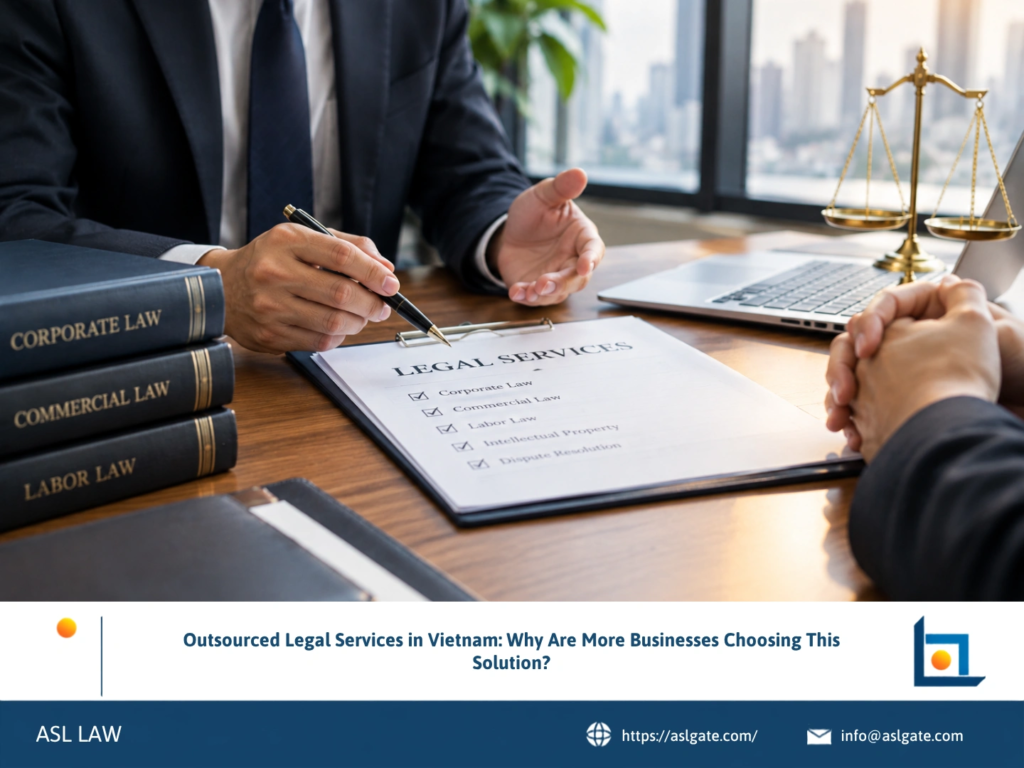
The demand for outsourced legal services in Vietnam is becoming increasingly relevant as businesses face a more complex regulatory environment, expanding compliance obligations, and growing pressure to control operating costs. Rather than maintaining large in-house legal teams for every legal function, many companies are turning to external legal providers for specialized advice, contract work, compliance support, dispute management, and other recurring legal tasks. Understanding the reasons businesses choose legal outsourcing Vietnam is therefore important for companies considering how to build a more flexible and efficient legal function.
Why Businesses Are Rethinking the Traditional In-House Legal Model
For many years, companies in Vietnam primarily relied on internal personnel to handle day-to-day legal matters. This model can work well for businesses with stable operations and sufficient legal workloads to justify a dedicated legal department.
However, the legal needs of a growing business are rarely static. A company may require employment advice during one period, assistance with an oversea investment project in another, and specialized support for intellectual property, data protection, competition, tax, construction, or commercial disputes at a later stage.
Maintaining specialists in every area can become expensive and inefficient. A permanent legal team may have significant capacity during quiet periods but become overloaded when major transactions or disputes arise.
This is one of the principal reasons businesses choose legal outsourcing Vietnam. External providers can give companies access to specialized legal resources without requiring the business to build a large permanent team for every possible legal issue.
The changing regulatory environment reinforces this consideration. In 2026, the Ministry of Justice has been conducting a broad review of Vietnam’s legal system, involving more than 43,000 legal documents, with authorities identifying provisions that may require amendment, replacement, or repeal.
For businesses, regulatory change creates a continuing need to monitor legislation and adapt internal processes. Outsourcing can provide additional legal capacity when companies need it without necessarily increasing permanent headcount.
The Growing Demand for External Legal Support
The growing trend of outsourced legal services Vietnam reflects a broader shift in how companies think about legal functions. Legal work is increasingly being viewed not only as an internal support function but also as a service that can be organized according to business requirements.
This is particularly relevant for small and medium-sized enterprises. Many businesses need professional legal assistance but may not have enough recurring legal work to justify employing several specialized lawyers internally.
An external provider can instead support the company on a project, retainer, or task-specific basis. This makes it possible to obtain specialized assistance when necessary while maintaining a more flexible cost structure.
The trend is also relevant to larger companies. Even organizations with established legal departments may outsource particular functions when they require additional capacity, specialist expertise, independent review, or support during periods of unusually high workload.
Vietnam’s policy environment also recognizes the importance of improving businesses’ access to legal information and assistance. The Government’s 2026–2030 inter-agency legal support program for small and medium-sized enterprises aims to improve access to law, strengthen compliance culture, and help businesses resolve legal difficulties in a timely and effective manner.
At the same time, the Ministry of Justice stated in August 2026 that developing a transparent, professional, and effective legal services market is important for improving the business environment and supporting sustainable economic development.
These developments help explain why the growing trend of outsourced legal services Vietnam is becoming more visible across different business sectors.
Why Vietnamese Companies Prefer Legal Process Outsourcing
Legal process outsourcing does not necessarily mean transferring all legal responsibilities to an external provider. In practice, companies can outsource specific processes while retaining strategic legal decision-making internally.
Routine or document-intensive tasks are particularly suitable for this model. Depending on the company’s requirements, an external legal provider may assist with contract review, legal research, compliance monitoring, corporate documentation, due diligence, intellectual property administration, employment documentation, regulatory filings, or preparation of legal reports.
This approach allows internal management and legal personnel to focus on matters that require direct knowledge of the company’s business strategy, while external professionals handle defined areas of work.
This explains why Vietnamese companies prefer legal process outsourcing when their legal workload becomes more diverse but does not justify expanding the internal department for every function.
Another factor is specialization. A generalist in-house team may be capable of handling ordinary commercial matters but may need outside assistance for highly specialized matters such as competition law, trade remedies, intellectual property litigation, technology transactions, cross-border investment, or complex regulatory projects.
Outsourcing can therefore supplement—not necessarily replace—the internal legal function.
The most effective model is often a hybrid one in which the company retains control over legal strategy, risk appetite, and business decisions while external counsel provides specialized expertise and additional execution capacity.
The Benefits Driving Legal Outsourcing Adoption
The benefits driving legal outsourcing adoption Vietnam extend beyond reducing the direct cost of employing legal personnel. For many companies, the more important advantage is the ability to obtain the appropriate level of legal expertise for each particular business requirement.
External legal providers can offer access to professionals with experience across different industries and legal disciplines. A company dealing with an oversea investment project, for example, may need different expertise from a company responding to an intellectual property dispute or a trade remedy investigation.
Outsourcing can also improve scalability. When a company enters a period of rapid expansion, undertakes an acquisition, restructures its operations, or faces a dispute, its legal workload can increase dramatically. External resources can be added without requiring a permanent expansion of the internal legal department.
Cost predictability can be another advantage. Depending on the engagement structure, businesses may use fixed fees, monthly retainers, project-based fees, or other agreed arrangements. This can make legal expenditure easier to align with actual business requirements.
The model can also provide an independent perspective. External lawyers are not directly involved in the company’s daily management and may therefore identify contractual, regulatory, or governance issues that internal teams have overlooked.
For these reasons, the benefits driving legal outsourcing adoption Vietnam are often connected to flexibility and access to expertise as much as cost reduction.
Key Advantages of Outsourcing Legal Work in Vietnam
The key advantages of outsourcing legal work in Vietnam become particularly clear when companies compare the flexibility of external support with the fixed structure of a fully internal legal department.
One major advantage is access to specialized expertise. Instead of maintaining permanent specialists in every area, businesses can engage professionals according to the matter at hand.
Another is workload management. External legal support can help internal teams handle periods of increased demand, including major transactions, regulatory changes, disputes, investigations, or compliance projects.
Outsourcing may also allow companies to establish more systematic legal processes. Contract review, compliance monitoring, document management, and recurring legal research can be organized according to agreed workflows and service standards.
For foreign-invested companies, external legal support can provide an additional advantage: local legal knowledge. Businesses entering or operating in Vietnam may understand their global legal requirements but still need professionals familiar with Vietnamese legislation, administrative procedures, market practice, and interactions with local authorities.
The model can therefore be particularly useful where the business needs both international commercial standards and Vietnam-specific legal implementation.
However, outsourcing should not be regarded as a solution that automatically eliminates legal risk. The quality of the service provider, scope of engagement, confidentiality arrangements, communication procedures, and allocation of responsibility remain critical.
How Companies Can Choose the Right Outsourcing Model
There is no single outsourcing structure that is suitable for every business. Companies should first identify which legal functions genuinely benefit from external support.
A company with a small internal team may outsource a broad range of recurring legal work. A larger company may instead outsource only specialized matters or temporary capacity.
Before entering into an outsourcing arrangement, businesses should consider:
- which legal functions should remain under direct internal control;
- which tasks can be standardized or delegated;
- whether the provider has relevant sector-specific expertise;
- how confidential and sensitive information will be protected;
- how work quality and response times will be monitored;
- how fees and additional expenses will be calculated; and
- who remains responsible for final legal and business decisions.
The engagement should also clearly distinguish between legal advice, administrative support, document preparation, and other services. This helps prevent misunderstandings about the provider’s responsibilities.
Data protection and confidentiality deserve particular attention where the provider will receive customer information, employee records, contracts, intellectual property materials, financial information, or other sensitive business data.
The most effective outsourcing arrangement is therefore one that defines responsibilities clearly rather than simply transferring a large volume of work to an external provider.
Is Legal Outsourcing Becoming a Long-Term Business Strategy?
The evidence from Vietnam’s legal and business environment suggests that outsourcing is increasingly capable of becoming a long-term component of corporate legal management rather than merely a short-term cost-cutting measure.
The legal environment is becoming more complex while businesses are simultaneously expected to strengthen compliance and respond more quickly to regulatory developments. In 2026, the Ministry of Justice’s legal support program for enterprises specifically emphasizes improving access to legal information, strengthening compliance culture, and resolving legal difficulties proactively.
At the same time, the Ministry of Justice has highlighted the importance of a professional and effective legal services market for a safer and more transparent investment and business environment.
Technology is also changing how legal services can be delivered. In September 2026, the Ministry of Justice reported progress on a digital platform and software system designed to support businesses with legal information and assistance.
These developments point toward a legal environment in which businesses will increasingly expect legal support to be accessible, specialized, responsive, and integrated with their broader compliance systems.
For this reason, the reasons businesses choose legal outsourcing Vietnam are likely to extend beyond immediate savings. The deeper rationale is the ability to combine internal business knowledge with external legal expertise in a way that can adapt as the company grows.
The growing trend of outsourced legal services Vietnam should therefore be understood as part of a broader transformation in corporate legal management. Businesses are increasingly looking for legal models that can scale with their operations, provide specialized expertise when required, and avoid unnecessary fixed costs.
For Vietnamese companies, the question is no longer simply whether legal work should be outsourced. The more important question is which legal functions should remain internal, which should be outsourced, and how the two models can work together effectively.
Frequently Asked Questions
1. Why are businesses increasingly choosing outsourced legal services in Vietnam?
Businesses are increasingly using external legal providers because they can access specialized expertise, manage fluctuating workloads, improve cost flexibility, and obtain additional legal capacity without maintaining a large permanent legal department.
2. Is legal outsourcing suitable only for small and medium-sized enterprises?
No. Small and medium-sized enterprises may benefit substantially because they may not have sufficient resources for a full legal department, while larger companies can use outsourcing for specialized matters, major transactions, disputes, regulatory projects, or temporary increases in workload.
3. Why Vietnamese companies prefer legal process outsourcing instead of handling everything internally?
Legal process outsourcing allows companies to delegate defined or recurring legal tasks while retaining strategic decision-making internally. It can also provide access to specialized professionals without requiring the company to maintain permanent expertise in every legal field.
4. What are the key advantages of outsourcing legal work in Vietnam?
The principal advantages include access to specialized expertise, flexible capacity, potentially more predictable legal costs, support during periods of increased workload, independent legal perspectives, and access to professionals familiar with Vietnamese laws and procedures.
5. How should a company manage risks when outsourcing legal services?
The company should clearly define the scope of work, responsibilities, confidentiality obligations, data protection requirements, service standards, fees, communication procedures, and decision-making authority. It should also select a provider with appropriate expertise and experience in the company’s industry and legal requirements.
ASL Law is a leading full-service and independent Vietnamese law firm made up of experienced and talented lawyers. ASL Law is ranked as the top tier Law Firm in Vietnam by Legal500, Asia Law, WTR, and Asia Business Law Journal. Based in both Hanoi and Ho Chi Minh City in Vietnam, the firm’s main purpose is to provide the most practical, efficient and lawful advice to its domestic and international clients. If we can be of assistance, please email to [email protected].
ASL LAW is the top-tier Vietnam law firm for Legal Outsourcing, Retainer Service. If you need any advice, please contact us for further information or collaboration.