Tiếng Việt
 中文 (中国)
 日本語
日本語
This article outlines the legal challenges that employers in Vietnam may face when dismissing employees, terminating labor contracts, or dealing with labor disputes — and how to handle them in compliance with Vietnamese law. Businesses should consider contact law firms specializing in advising labour law in Vietnam to receive detailed assistance on a case-by-case basis….
08
Jul
Jul
Effective from January 1, 2026, Vietnam’s newly enacted Law on Personal Data Protection No. 91/2025/QH15 introduces comprehensive obligations for employers in the collection, processing, and retention of employee personal data—especially emphasizing the mandatory deletion of such data once the employment relationship ends. Employers and employees are advised to contact Vietnamese law firms specializing in advising…
22
Jun
Jun
The year 2025 marks a pivotal shift in Vietnam’s legal and human resources landscape. A range of new legislative drafts and prevailing enforcement practices reflect a clear policy direction: enhancing employee protection while promoting greater flexibility in labor relations—an evolution that both workers and employers must keep abreast of. 1. The trend toward standardized contracts…
11
Jul
Jul
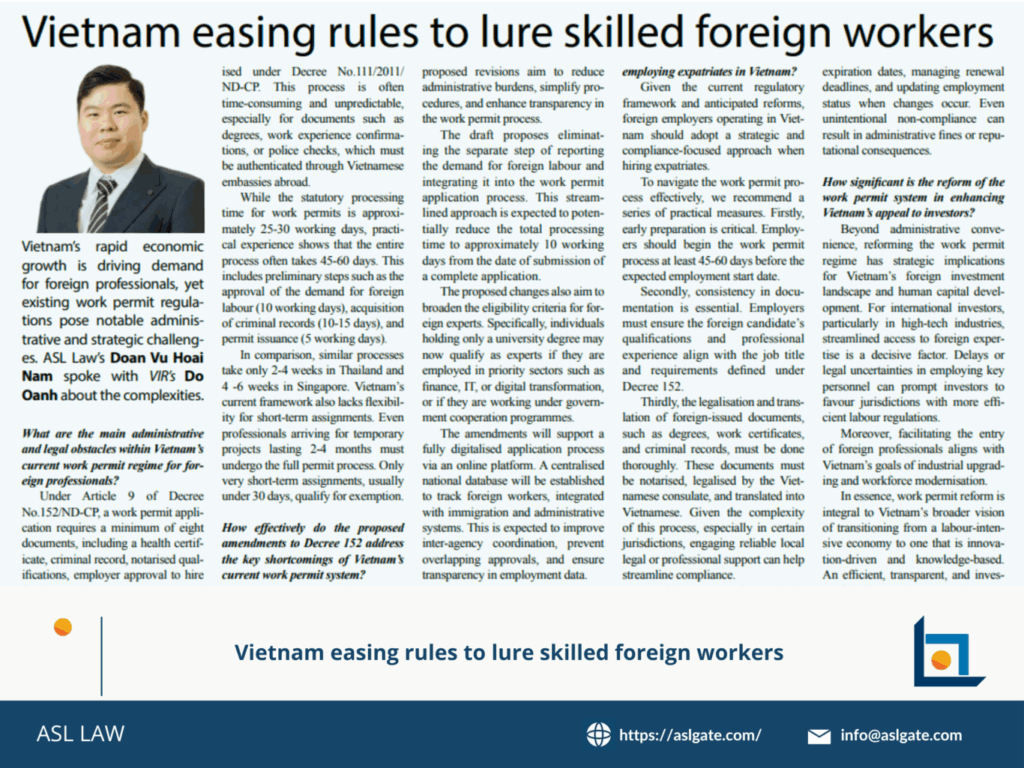
(Published on VIR) Vietnam’s rapid economic growth is driving demand for foreign professionals, yet existing work permit regulations pose notable administrative and strategic challenges. ASL Law’s Doan Vu Hoai Nam spoke with VIR’s Do Oanh about the complexities. What are the main administrative and legal obstacles within Vietnam’s current work permit regime for foreign professionals? Under…
03
Apr
Apr
From July 1, 2025, voluntary social insurance (VSI) participants who meet the required age and contribution period can start receiving pensions. Specifically, those who contributed to VSI before January 1, 2021, and have completed 20 years of contributions will be eligible to retire immediately upon reaching 60 years old (for men) and 55 years old…
16
Apr
Apr
Throughout thousands of years of human history, women have always been subjected to disadvantages and inequality. In Vietnam, this situation has persisted due to the traditional mindset of ‘male preference,’ passed down from generation to generation, affecting women’s rights in society. In the modern era, although Vietnam’s 2019 Labor Code No. 45/2019/QH14 (“2019 Labor Code“)…
11
Mar
Mar
In the face of global economic fluctuations, many manufacturing companies in Vietnam experience difficulties due to declining orders, leading to reduced working hours or temporary production halts. This raises the question: can a company legally withhold wages from employees when there are no orders? Employer’s Wage Payment Obligations Under the Law According to the 2019…
16
Mar
Mar
According to many current workers, the personal income tax (PIT) family deduction in Vietnam has become outdated, failing to keep up with inflation and rising living costs, thus placing financial pressure on taxpayers. Currently, the deduction stands at VND 11 million per month (VND 132 million per year) for individuals and VND 4.4 million per…
18
Mar
Mar
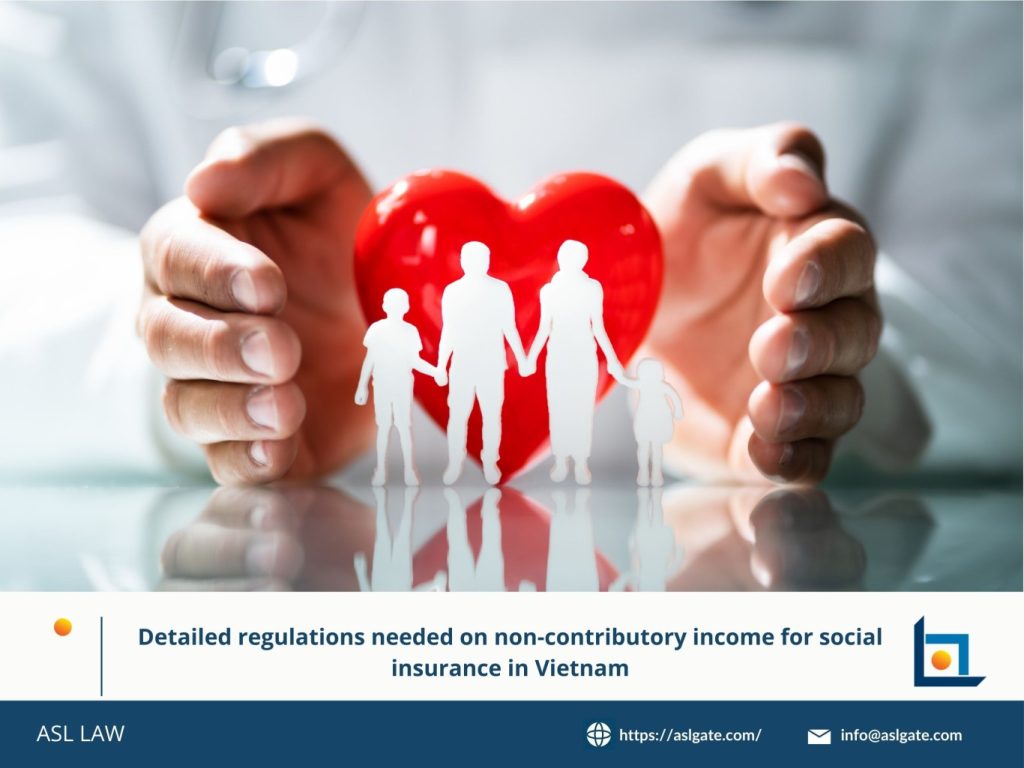
Vietnam Social Insurance has submitted a proposal to the Ministry of Labor, Invalids, and Social Affairs, requesting a clear definition of bonuses, meal allowances, fuel costs, and other benefits that are not subject to mandatory social insurance contributions. The objective of this proposal is to ensure transparency and facilitate the social insurance collection process. In…

09
Feb
Feb
Disciplinary actions are a legitimate tool for employers to maintain order and discipline in the workplace. However, this right must be exercised in compliance with the law to avoid legal risks and to protect the lawful rights of employees. In 2025, with the evolving legal environment in Vietnam, employers should take note of key aspects…