Tiếng Việt
 中文 (中国)
 日本語

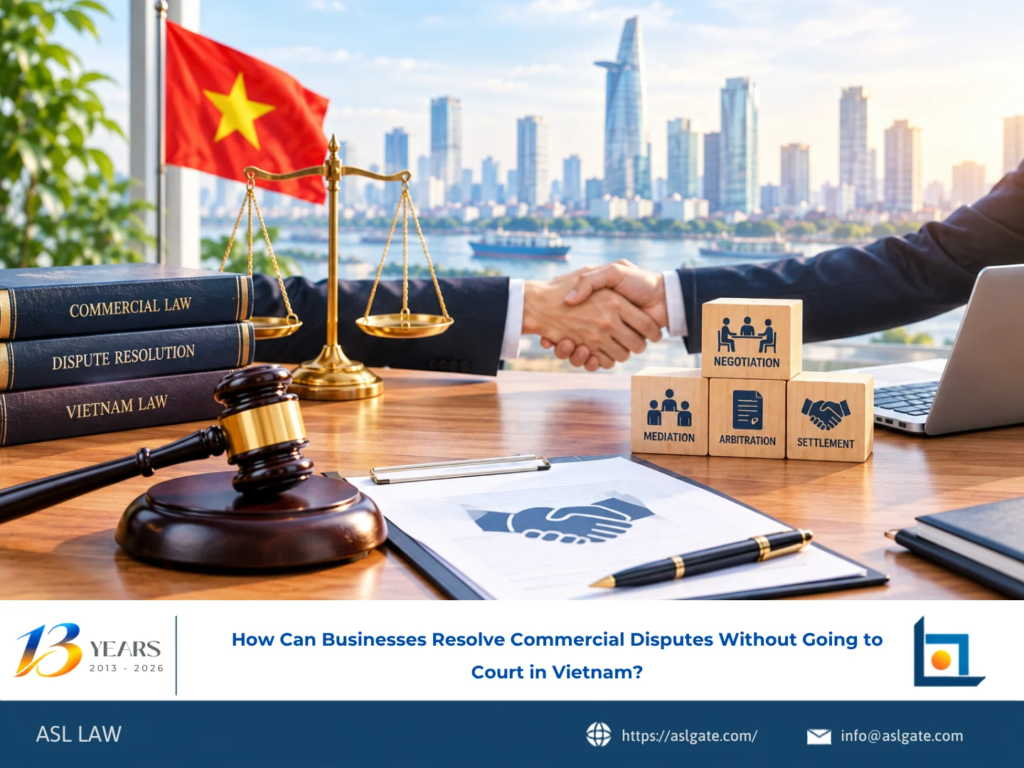
Commercial disputes can disrupt business relationships, delay payments, and increase operating costs. However, litigation is not always the most suitable way to resolve disagreements. Resolving commercial disputes without court Vietnam allows businesses to explore negotiation, mediation, and arbitration, depending on their contracts, commercial priorities, and applicable law. Choosing the right approach can help parties control costs, preserve relationships, and reach enforceable outcomes where legally available.
Negotiation as the First Step in Commercial Dispute Resolution
Negotiation is often the simplest option for resolving commercial disputes without court Vietnam. The parties communicate directly or through their representatives to identify the disputed issues and seek a mutually acceptable solution.
This approach can be particularly useful for payment disagreements, delivery delays, contractual performance issues, and disputes involving long-term business partners. Negotiation also allows parties to consider commercial solutions that a court might not provide, such as revised delivery schedules, staged payments, or continued cooperation under amended terms.
To improve the likelihood of success, businesses should review the contract, organise supporting evidence, identify their commercial objectives, and document any settlement reached. Where the contract requires formal notices or escalation procedures, those requirements should be followed carefully.
Alternative Dispute Resolution Methods in Vietnam
Alternative dispute resolution methods Vietnam businesses commonly consider include negotiation, mediation, and arbitration. Each has different procedural characteristics, costs, and legal consequences.
Mediation involves a neutral third party helping the parties explore a settlement, while arbitration involves an arbitral tribunal deciding the dispute under the applicable arbitration agreement and rules. Arbitration can provide a binding decision, whereas mediation depends on the parties reaching an agreement.
Businesses should review whether their contract contains an arbitration clause, specifies an institution, or establishes mandatory negotiation or mediation steps before proceedings can begin. The suitability of each method depends on the nature of the dispute, urgency, confidentiality needs, and the parties’ willingness to cooperate.
Out-of-Court Settlement for Business Disputes in Vietnam
An out-of-court settlement for business disputes Vietnam can help parties avoid prolonged proceedings and maintain greater control over the outcome. Settlement terms may cover payment obligations, compensation, revised contractual performance, confidentiality, and the release of specified claims.
However, a settlement should be drafted carefully. The agreement should identify the parties, clearly state the obligations and deadlines, address the consequences of non-compliance, and specify which claims are resolved. Businesses should also confirm that the representatives signing the agreement have appropriate authority.
A Vietnam full Service law firm can assist with assessing legal exposure, negotiating settlement terms, and documenting an agreement that reflects the parties’ commercial objectives.
Mediation and Arbitration for Commercial Conflicts
Mediation and arbitration for commercial conflicts provide different ways to manage disputes when direct negotiations are insufficient.
Under Vietnam’s Law on Commercial Arbitration No. 54/2010/QH12, arbitration may be used where the parties have a valid arbitration agreement and the dispute falls within the law’s scope. Arbitration can offer procedural flexibility and confidentiality, although the parties should consider tribunal fees, legal costs, and the requirements for enforcing an award.
Mediation may be preferable when the parties want to preserve their business relationship and remain in control of the settlement. Arbitration may be more suitable when a binding determination is needed and the contractual requirements are satisfied.
For cross-border transactions, businesses should examine the arbitration clause, seat of arbitration, governing law, language, and enforcement considerations before a dispute arises.
Choosing an Effective Non-Litigation Strategy
Effective non-litigation dispute resolution in Vietnam begins with evaluating the dispute’s financial value, supporting evidence, contractual provisions, urgency, and relationship between the parties. Businesses should also assess whether interim measures or urgent protection may be necessary, as an out-of-court process may not address every immediate risk.
A Chinese Law Firm in Hanoi may be relevant when a dispute involves Chinese counterparties or related cross-border issues. A Law firm in Vietnam can help assess local legal requirements and coordinate the appropriate resolution strategy.
The objective is not simply to avoid court proceedings at all costs. Rather, businesses should select the process that offers the best balance of efficiency, legal protection, enforceability, and commercial value.
FAQ
1. Can commercial disputes in Vietnam be resolved without going to court?
Yes. Depending on the circumstances, parties may resolve disputes through negotiation, mediation, settlement agreements, or arbitration.
2. What is the difference between mediation and arbitration?
Mediation helps parties negotiate a mutually acceptable solution with the assistance of a neutral third party. Arbitration involves an arbitral tribunal deciding the dispute, generally through a binding award.
3. Is an out-of-court settlement legally binding?
A properly formed settlement agreement can create binding obligations. Its enforceability depends on the agreement’s terms, the parties’ authority, and applicable law.
4. Does a business need an arbitration clause to use arbitration in Vietnam?
Generally, arbitration requires a valid arbitration agreement between the parties. Businesses should review the contract and applicable legal requirements before commencing proceedings.
5. How can businesses choose the best non-litigation dispute resolution method?
They should consider the contract, the nature and value of the dispute, urgency, costs, confidentiality, the need for a binding outcome, and the importance of preserving the business relationship.
ASL Law is a leading full-service and independent Vietnamese law firm made up of experienced and talented lawyers. ASL Law is ranked as the top tier Law Firm in Vietnam by Legal500, Asia Law, WTR, and Asia Business Law Journal. Based in both Hanoi and Ho Chi Minh City in Vietnam, the firm’s main purpose is to provide the most practical, efficient and lawful advice to its domestic and international clients. If we can be of assistance, please email to [email protected].
ASL LAW is the top-tier Vietnam law firm for litigation and dispute resolution. If you need any advice, please contact us for further information or collaboration.