Tiếng Việt
 中文 (中国)
 日本語

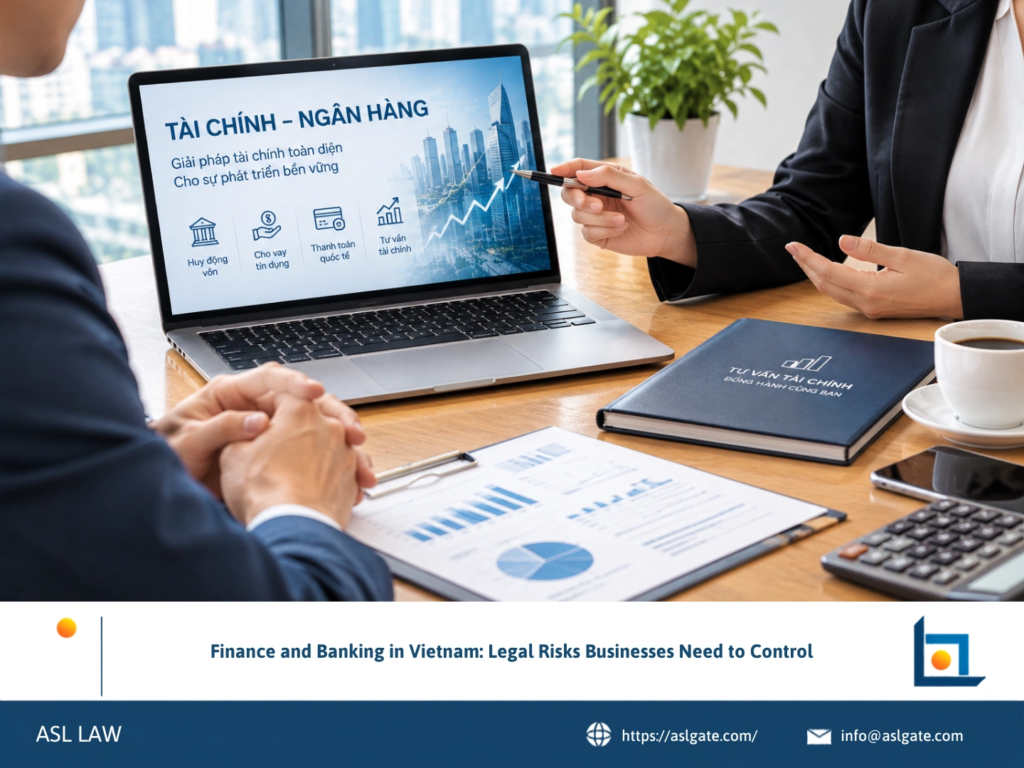
As financial activities become increasingly connected with credit, electronic payments, cross-border transactions, and digital data, businesses in Vietnam are facing more extensive legal requirements in raising, using, and transferring funds. Legal risks in corporate finance and banking that businesses need to control do not only concern credit agreements or repayment obligations, but also involve foreign exchange, anti-money laundering, taxation, personal data protection, electronic transactions, and banking compliance requirements. In 2026, controlling these risks should be viewed as an integral part of corporate governance rather than merely an issue to be addressed when disputes arise.
Vietnam’s Finance and Banking Legal Framework in 2026
Financial and banking activities in Vietnam are governed by various groups of regulations, including laws on credit institutions, civil matters, enterprises, investment, foreign exchange, taxation, anti-money laundering, data protection, and electronic transactions.
The Law on Credit Institutions No. 32/2024/QH15 took effect on July 1, 2024, and is currently one of the key legal instruments governing the operations of credit institutions and foreign bank branches in Vietnam.
Notably, 2026 has continued to see changes in the banking regulatory framework. Circular No. 25/2026/TT-NHNN dated June 22, 2026 amended regulations on limits and prudential ratios applicable to the operations of banks and foreign bank branches, taking effect on July 1, 2026. At the same time, Consolidated Document No. 83/VBHN-NHNN dated June 23, 2026 continued to consolidate regulations relating to limits and prudential ratios in banking operations.
Although many of these regulations directly apply to banks, businesses using banking services are also significantly affected. Changes to credit conditions, transaction controls, customer documentation, or banks’ risk management requirements can directly affect a business’s ability to raise capital and conduct transactions.
Therefore, legal risks in corporate finance and banking that businesses need to control must be considered from both perspectives: the obligations of the business and the compliance requirements of the credit institution providing the relevant services.
Businesses operating in Vietnam’s finance and banking sector should consider contacting ASL LAW, a Top Law Firm in Vietnam providing legal support as a Debt recovery law firm in Vietnam, Legal Advice on Business in ASEAN, and through a retainer service to enterprises tailored to the enterprise’s specific legal and commercial circumstances.
Risks from Loans, Credit, and Security Assets
For most businesses, banking relationships are among the most significant sources of legal risk.
Businesses often focus negotiations on credit limits, interest rates, and loan terms, but other provisions in credit agreements can also have significant consequences when financial conditions change.
Key matters that should be carefully reviewed may include:
- Disbursement conditions and conditions precedent.
- Obligations to maintain financial ratios or other covenants.
- Events that constitute a default.
- The bank’s right to accelerate repayment.
- Obligations to provide additional or replacement security assets.
- Rights to enforce security assets.
- Cross-default or cross-acceleration provisions.
- Restructuring or early repayment conditions.
Security assets are also an issue requiring particular attention. Before making commitments to a bank, a business should clearly determine the ownership rights, land-use rights, legal status, and eligibility of an asset to be used as security.
Where security consists of real estate, property rights, shares, capital contributions, or assets to be formed in the future, reviewing the relevant documents and security conditions becomes even more important.
This is why legal risk management in corporate finance in Vietnam should not focus solely on securing a loan, but should consider the entire lifecycle of the credit relationship.
Anti-Money Laundering and Banking Compliance Risks
Legal risks requiring attention in the banking sector do not apply only to banks or financial institutions. Ordinary businesses may also encounter issues when conducting high-value transactions, cross-border transactions, or transactions involving counterparties with complex ownership structures.
The Law on Anti-Money Laundering No. 14/2022/QH15 took effect on March 1, 2023 and establishes the legal framework for anti-money laundering activities in Vietnam.
In practice, banks may require businesses to provide or update information relating to customers, legal representatives, beneficial owners, the purpose of transactions, sources of funds, or documents evidencing the basis of a transaction.
Businesses may face risks if the information provided to the bank is inconsistent with enterprise registration records, contracts, invoices, accounting documents, or actual cash flows.
In particular, businesses engaged in international activities should establish procedures for screening counterparties and transactions before making payments. A transaction may have a legitimate commercial basis, but incomplete documentation or inconsistent information may still result in the bank requesting explanations or conducting additional verification.
Accordingly, legal risk control in banking activities should not be limited to monitoring the conduct of finance personnel, but should also include procedures for counterparty verification and document retention.
Foreign Exchange and Cross-Border Financial Transactions
Cross-border transactions are another category creating legal risks in corporate finance and banking that businesses need to control.
Foreign-invested enterprises and Vietnamese businesses engaged in international activities may conduct various transactions, such as capital contributions, foreign loans, debt repayments, service payments, dividend payments, profit remittances, or payments between companies within the same corporate group.
The legality of a commercial contract drafting does not necessarily mean that the selected payment method fully complies with foreign exchange and banking regulations.
Before conducting a transaction, a business should consider the following matters simultaneously:
- The purpose and legal basis of the payment.
- The type of account and currency to be used.
- Documents and supporting evidence required by the bank.
- Tax obligations and tax withholding, if applicable.
- Regulations relating to foreign loans or foreign investment.
- Consistency among the contract, invoice, accounting documents, and payment instructions.
Legal risk control when conducting financial transactions in Vietnam therefore requires coordination among the legal, finance, accounting, and tax departments. If different departments use different sets of documents or interpretations, the business may encounter difficulties when providing explanations to the bank or regulatory authorities.
For intercompany loans, management fees, service fees, royalties, or transactions between related parties, clearly establishing the commercial basis and maintaining supporting documentation is also particularly important.
Personal Data Protection and Electronic Transactions in Financial Activities
The development of digital banking and electronic payments has made data an inseparable part of financial activities.
The Law on Personal Data Protection No. 91/2025/QH15 took effect on January 1, 2026. This means that the processing of personal data in activities relating to banking, payments, credit, and finance must be considered within a new legal framework.
Businesses may process data relating to customers, employees, legal representatives, shareholders, beneficial owners, or counterparties in the course of conducting financial transactions.
Issues requiring consideration may include the purposes of data processing, the scope of use, data sharing with banks or service providers, data storage, and information security measures.
In addition, the Law on Electronic Transactions No. 20/2023/QH15 took effect on July 1, 2024 and was consolidated under Consolidated Document No. 36/VBHN-VPQH dated March 13, 2026.
This is particularly relevant to financial transactions conducted through electronic means. Businesses need to ensure appropriate mechanisms for approval, electronic signatures, authentication of authorized persons, document retention, and the ability to demonstrate the integrity of transaction records.
These risks demonstrate that legal risks requiring attention in the banking sector today have expanded beyond traditional credit relationships to include data and technology.
Tax, Documentation, and Reporting Obligations in Financial Transactions
A financial transaction may simultaneously give rise to tax, accounting, and reporting obligations. If a business considers a transaction solely from a banking perspective while overlooking these obligations, risks may arise after the transaction has already been completed.
In 2026, Law No. 09/2026/QH16 was issued on April 24, 2026, amending certain provisions of the laws on personal income tax, value-added tax, corporate income tax, and special consumption tax.
Interest payments, financial fees, cross-border payments, related-party transactions, or payments to foreign suppliers may need to be assessed simultaneously from both tax and banking perspectives.
Businesses should also maintain a sufficiently comprehensive set of documents to demonstrate the basis of a transaction. Depending on the circumstances, the documentation may include contracts, internal resolutions or decisions, invoices, payment records, loan documentation, security asset documentation, and tax records.
Consistency among these documents is particularly important. For example, if a contract specifies one payment purpose while the bank transfer instruction describes a different transaction, the business may be required to provide additional explanations.
Therefore, legal risk management in corporate finance in Vietnam should also include document and record management, rather than focusing solely on whether the transaction is legally valid on paper.
Establishing a Corporate Financial Legal Risk Control Mechanism
Businesses cannot completely eliminate legal risks in financial and banking activities. However, they can significantly reduce the level of risk by establishing control procedures before transactions are carried out.
First, a business needs to clearly determine the legal nature of the transaction. Whether the funds under consideration constitute a loan, capital contribution, commercial payment, service fee, royalty, or another type of transaction will lead to different legal requirements.
Next, the business should conduct contract reviewing and implementation mechanism simultaneously. A contract may be legally valid, but the implementation process may nevertheless fail to comply with banking, foreign exchange, or tax regulations.
Finally, businesses need to maintain a continuous monitoring mechanism. Financial and banking regulations may change during the term of a loan or long-term contract. The amendment of regulations on limits and prudential ratios under Circular No. 25/2026/TT-NHNN effective July 1, 2026 is an example demonstrating that businesses should not assume that a previous compliance assessment will remain appropriate indefinitely.
An appropriate control mechanism may focus on the following areas:
| Activity | Risks to Control |
| Bank loans | Loan conditions, covenants, security assets, defaults, and debt acceleration |
| Cross-border transactions | Foreign exchange, taxation, documentation, and payment purposes |
| Guarantees and security | Authority, assets, and enforceability |
| Related-party transactions | Commercial basis, taxation, and supporting documentation |
| Electronic payments | Authority, authentication, and data retention |
| Financial data processing | Personal data protection and information security |
| Reporting and compliance | Accuracy, completeness, and consistency of records |
This is also an appropriate approach to implementing legal risk control measures in banking activities proactively.
Risk Control Based on Business Type and Transaction Type
Not all businesses face the same level of risk. A manufacturing enterprise borrowing from a domestic bank will have a different risk profile from a foreign-invested enterprise receiving a loan from its overseas parent company.
Similarly, a trading enterprise conducting hundreds of cross-border payment transactions will require a different control mechanism from a business whose banking relationship is limited to domestic credit facilities.
Therefore, legal risk management in corporate finance in Vietnam should be designed based on actual business activities rather than using a general checklist for every situation.
Businesses may prioritize reviewing the following transactions:
- High-value loans and guarantees.
- Transactions with related parties or companies within the same corporate group.
- Cross-border loans or payments.
- Foreign currency transactions.
- Transactions involving high-value assets used as security.
- Financial transactions conducted entirely through electronic means.
This approach enables businesses to focus resources on areas most likely to create significant legal and financial consequences.
In practice, legal risks in corporate finance and banking that businesses need to control do not arise solely because a business “violates” a specific regulation. Risks may also arise where contracts are unclear, documentation is inconsistent, internal procedures are inappropriate, or the business fails to promptly update its practices in response to changes in the law.
Accordingly, legal risk control when conducting financial transactions in Vietnam should be established as an end-to-end process covering transaction design, contract negotiation, internal approval, payment execution, document retention, and post-transaction review.
An effective control system is not intended to eliminate every risk, but to ensure that the business identifies risks before making commitments, allocates responsibilities clearly, and has appropriate measures in place if the terms or conditions of a transaction change.
Risk Control by Type of Business and Transaction
Not every business faces the same level of risk. A manufacturing enterprise borrowing from a domestic bank will have a different risk profile from a foreign-invested enterprise receiving a loan from an overseas parent company.
Likewise, a trading enterprise conducting hundreds of cross-border payment transactions will require a different control mechanism from a business whose banking relationship is limited to domestic credit facilities.
Therefore, legal risk management in corporate finance in Vietnam should be designed based on actual business activities rather than applying a general checklist to every situation.
For businesses, priority may be given to reviewing the following transactions:
- High-value loans and guarantees.
- Transactions with related parties or companies within the same corporate group.
- Cross-border loans or payments.
- Foreign currency transactions.
- Transactions involving high-value assets used as security.
- Financial transactions conducted entirely through electronic means.
This approach enables businesses to focus resources on areas most likely to result in significant legal and financial consequences.
In practice, legal risks in corporate finance and banking that businesses need to control do not arise solely from a business “violating” a specific regulation. Risks may also arise where contracts are unclear, documentation is inconsistent, internal procedures are inappropriate, or the business fails to keep pace with changes in the law.
Therefore, legal risk control when conducting financial transactions in Vietnam should be established as an end-to-end process, from transaction design and contract negotiation to internal approval, payment execution, document retention, and post-transaction review.
An effective control system is not intended to eliminate all risks, but to ensure that the business identifies risks before making commitments, clearly allocates responsibilities, and has a response plan in place if the terms or conditions of the transaction change.
FAQ: Legal Risks in Finance and Banking in Vietnam
1. What legal risks in corporate finance and banking do businesses need to control?
Legal risks in corporate finance and banking that businesses need to control include risks arising from loans, security assets, credit conditions, foreign exchange, anti-money laundering, taxation, electronic transactions, personal data protection, and documentation requirements. The level of risk depends on the type of business and the specific transaction.
2. How can businesses control legal risks when conducting financial transactions in Vietnam?
Legal risk control when conducting financial transactions in Vietnam should begin with correctly determining the nature of the transaction, reviewing the applicable regulations, examining contracts and documentation, identifying tax and foreign exchange obligations, and establishing appropriate procedures for approval, payment, and document retention.
3. What legal risks should businesses pay attention to in the banking sector?
Legal risks requiring attention in the banking sector include credit and security risks, anti-money laundering, foreign exchange, data security and protection, electronic transactions, information disclosure obligations, and compliance requirements relating to the operations of credit institutions.
4. How should Vietnamese businesses manage financial legal risks?
Legal risk management in corporate finance for Vietnamese businesses should combine pre-transaction legal reviews, internal controls, contract management, document control, coordination among legal, finance, accounting, and tax departments, and regular updates on changes in the law.
5. What legal risk control measure in banking activities is most important for businesses?
A key legal risk control measure in banking activities is conducting a legal assessment before carrying out a transaction and maintaining sufficient supporting documentation throughout its implementation. For large or complex transactions, businesses should simultaneously assess credit, security, foreign exchange, tax, anti-money laundering, and data protection issues.
ASL Law is a leading full-service and independent Vietnamese law firm made up of experienced and talented lawyers. ASL Law is ranked as the top tier Law Firm in Vietnam by Legal500, Asia Law, WTR, and Asia Business Law Journal. Based in both Hanoi and Ho Chi Minh City in Vietnam, the firm’s main purpose is to provide the most practical, efficient and lawful advice to its domestic and international clients. If we can be of assistance, please email to [email protected].
ASL LAW is the top-tier Vietnam law firm for Banking & Financial Services. If you need any advice, please contact us for further information or collaboration.