Tiếng Việt
 中文 (中国)
 日本語
日本語
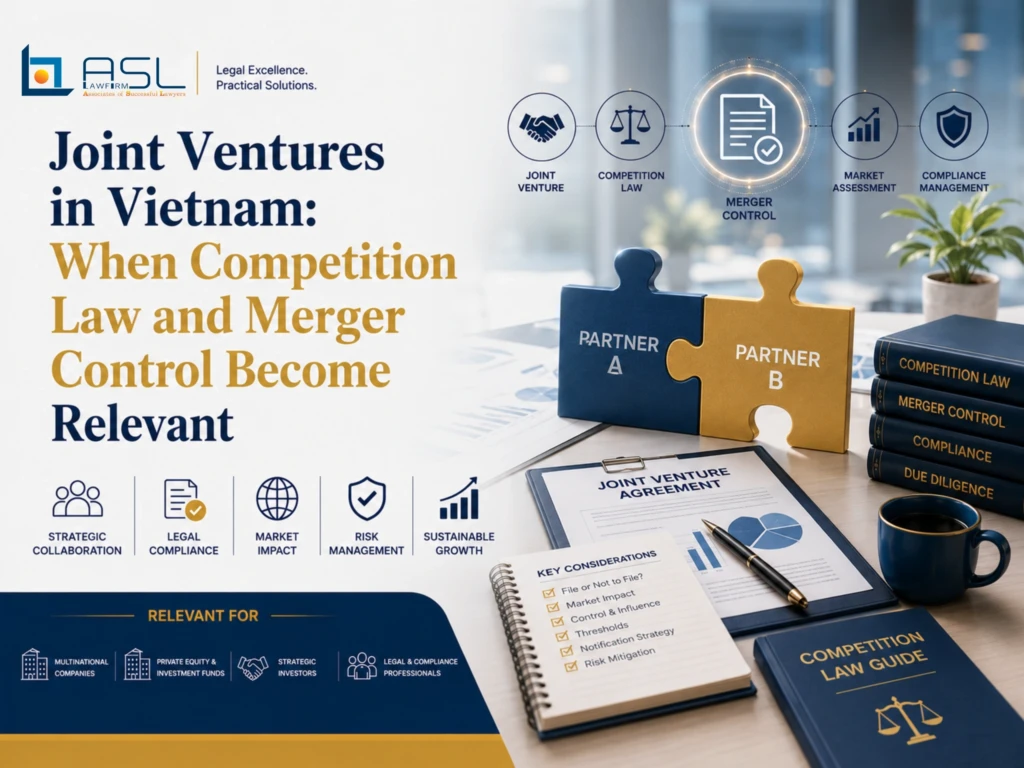
From 1 July 2026, Vietnam increased several financial thresholds for merger notification under Resolution No. 66.18/2026/NQ-CP, while keeping the 20% combined market share threshold unchanged. Under joint venture Vietnam competition law, a joint venture does not automatically require notification, but it should always be assessed before signing. Where a joint venture qualifies as an economic concentration, Vietnam joint venture merger control and economic concentration filing Vietnam requirements may still apply. In addition, cooperation between the parties may create separate issues under competition law Vietnam, making early antitrust compliance Vietnam essential alongside merger control analysis.
For investors, a joint venture is not only an investment structure. Depending on the relationship between the parties and the markets involved, it may also require review under competition law Vietnam before implementation.
Why Can a Joint Venture Raise Competition Law Issues?
Joint ventures are commonly used to enter new markets, share investment costs, develop new technologies or combine complementary business strengths.
However, not every joint venture is simply a corporate or investment matter.
Where the parties already compete with one another, operate at different levels of the same supply chain or cooperate within the same relevant market, the transaction may raise issues under joint venture competition law Vietnam.
For example, competition concerns may arise where the parties are:
- direct competitors;
- important suppliers and customers;
- manufacturers and distributors;
- businesses operating in closely related markets.
In these situations, the legal assessment should extend beyond investment approvals and corporate documentation.
The transaction should also be reviewed from a competition law perspective before the Joint Venture Agreement is signed.
When Can a Joint Venture Become an Economic Concentration?
Not every joint venture constitutes an economic concentration.
The assessment depends on the structure of the arrangement and whether the joint venture performs the functions of an autonomous economic entity under competition law Vietnam.
If the transaction qualifies as an economic concentration, the next question is whether it meets any applicable notification threshold.
Resolution No. 66.18/2026/NQ-CP increases several financial thresholds applicable to merger notification between 1 July 2026 and 28 February 2027. However, the combined market share threshold remains unchanged.
As a result, Vietnam joint venture merger control should be assessed on the basis of both the transaction structure and the applicable notification criteria.
A transaction may fall below the revised financial thresholds but still require an economic concentration filing Vietnam assessment because the market share criterion is satisfied.
What Changed from 1 July 2026?
The revised notification thresholds are intended to simplify administrative procedures and reduce unnecessary filing obligations for enterprises doing business in Vietnam.
The principal changes are summarised below.
| Notification Criterion | Before 1 July 2026 | From 1 July 2026 |
| Total assets | VND 3,000 billion | VND 6,000 billion |
| Total turnover | VND 3,000 billion | VND 6,000 billion |
| Transaction value | VND 1,000 billion | VND 2,000 billion |
| Combined market share | 20% | 20% (unchanged) |
Although the revised thresholds reduce notification requirements for certain transactions, they do not change the legal framework governing economic concentrations.
The 20% market share threshold still matters.
Accordingly, every significant joint venture should be reviewed before implementation.
Does Market Share Still Matter?
Yes.
The increase in financial thresholds should not distract parties from assessing their market position.
Where the combined market share reaches the applicable statutory threshold, notification obligations may still arise even if turnover, assets or transaction value remain below the revised financial limits.
Market definition therefore continues to play an important role in every Vietnam joint venture merger control assessment.
Determining the relevant market often requires consideration of product substitutability, customer behaviour and geographic scope rather than relying solely on accounting information.
For investors, the practical issue is identifying these competition issues early enough to avoid delays later in the transaction process.
Why Information Exchange Can Create Competition Risks
The negotiation of a joint venture frequently requires the parties to exchange commercial information.
That exchange should be managed carefully.
During due diligence and commercial negotiations, businesses may share:
- pricing information;
- customer data;
- future business strategies;
- production plans;
- procurement information;
- commercially sensitive financial information.
Some information may be necessary for evaluating the proposed investment.
However, unnecessary exchanges between competitors may create competition law concerns that exist independently of the merger control assessment.
Accordingly, information sharing protocols should be considered as part of a broader antitrust compliance Vietnam programme before confidential business information is exchanged.
Should Competitors Be More Careful When Forming a Joint Venture?
Generally, yes.
Where joint venture partners compete in the same market, the competition law assessment is likely to be more extensive.
The existence of a joint venture does not automatically exempt the parties from their ongoing obligations under competition law Vietnam.
Each party should continue making independent commercial decisions except to the extent cooperation is legitimately required for the operation of the joint venture.
This principle remains relevant throughout the negotiation process as well as after the joint venture begins operating.
Accordingly, the legal review should consider both Vietnam joint venture merger control requirements and broader competition compliance issues before the Joint Venture Agreement is finalized.
Can Non-Compete and Exclusivity Clauses Create Competition Risks?
Yes.
Non-compete, exclusivity and market allocation clauses are common provisions in Joint Venture Agreements. While these provisions may be commercially justified in some transactions, they should be reviewed carefully to ensure they are proportionate and consistent with Vietnamese competition law.
Examples include:
- non-compete obligations extending beyond what is reasonably necessary;
- long-term exclusive supply or distribution arrangements;
- customer allocation between the joint venture partners;
- territorial restrictions;
- limitations on future market entry.
Whether a particular provision raises competition concerns depends on its purpose, duration, scope and competitive effects.
Accordingly, the review should extend beyond the investment structure itself and consider the commercial arrangements that will govern the relationship between the parties after the joint venture is established.
Why Should Competition Law Be Reviewed Before Signing a JVA?
Competition law review should be completed before the Joint Venture Agreement is signed.
Waiting until closing preparations may require amendments to the transaction documents or delay implementation if notification is later found to be necessary.
For investors, the practical issue is timing.
An early review helps determine:
- whether the joint venture qualifies as an economic concentration;
- whether an economic concentration filing Vietnam assessment is required;
- whether regulatory approval should become a condition precedent;
- whether the proposed contractual provisions create unnecessary competition risks.
This should be checked before signing, not after closing.
Where the parties operate in multiple jurisdictions, the competition law assessment should also be coordinated with merger filings and regulatory approvals required outside Vietnam.
Practical Checklist Before Signing a Joint Venture Agreement
Before signing a Joint Venture Agreement, investors should complete the following review.
| Checklist Item | Practical Review |
| Transaction structure | Confirm whether the joint venture qualifies as an economic concentration. |
| Notification thresholds | Review assets, turnover, transaction value and market share. |
| Relationship between the parties | Determine whether the parties are competitors or operate within the same supply chain. |
| Information sharing | Limit the exchange of commercially sensitive information where appropriate. |
| Contractual restrictions | Review non-compete, exclusivity and market allocation provisions. |
| Regulatory approvals | Determine whether merger clearance should be obtained before closing. |
Completing these steps during transaction planning helps reduce execution risk and supports a smoother implementation process.
Why Competition Compliance Continues After the Joint Venture Is Established
Competition law obligations do not end once the Joint Venture Agreement becomes effective.
After the joint venture begins operating, the parties should continue ensuring that their conduct remains consistent with applicable competition rules.
This includes reviewing:
- information exchange procedures;
- board governance arrangements;
- commercial cooperation between the shareholders;
- pricing and distribution practices;
- compliance policies for employees and management.
An effective antitrust compliance Vietnam programme helps reduce legal risk throughout the life of the joint venture rather than only during its establishment.
Where the joint venture achieves a significant market position over time, additional assessments relating to abuse of dominance Vietnam may also become relevant depending on the facts and market conditions.
The Role of Vietnam Merger Control Lawyers
Joint venture transactions often involve multiple legal disciplines, including corporate law, foreign investment, regulatory approvals and competition law.
An effective merger control assessment should therefore be integrated into the overall transaction planning process rather than conducted as a separate exercise shortly before closing.
Experienced Vietnam merger control lawyers assist investors with:
- assessing whether a joint venture constitutes an economic concentration;
- reviewing notification obligations;
- preparing merger filings where required;
- analysing competition risks arising from the Joint Venture Agreement;
- coordinating regulatory approvals with transaction counsel.
For international investors, legal advice should also form part of broader Vietnam M&A and investment planning.
Working with experienced competition lawyers in Vietnam at an early stage helps identify regulatory issues before they affect transaction timing, negotiation strategy or closing arrangements.
In addition to merger notification, investors should also consider broader obligations under competition law Vietnam, including merger control Vietnam requirements and ongoing compliance relating to economic concentration Vietnam and antitrust compliance Vietnam. Early legal review also helps identify potential issues relating to abuse of dominance Vietnam where the joint venture may obtain significant market power after implementation.
Frequently Asked Questions
Merger control is the process requiring certain mergers, acquisitions and joint ventures to be reviewed before completion if the applicable notification thresholds are met.
Merger notification is required when an economic concentration satisfies one or more notification thresholds under Vietnamese competition law.
Yes. Resolution No. 66.18/2026/NQ-CP increases several financial thresholds but keeps the 20% combined market share threshold unchanged.
Yes. A joint venture may require notification if it qualifies as an economic concentration and meets the applicable notification thresholds.
Yes. Sharing commercially sensitive information may create competition law concerns depending on the relationship between the parties.
Yes. Early review helps identify filing obligations and competition risks before the transaction is implemented.
Conclusion
A joint venture in Vietnam should not be viewed solely as an investment or corporate transaction. Depending on its structure, the relationship between the parties and the relevant market, it may also require merger notification and raise broader competition law issues.
The increase in financial notification thresholds under Resolution No. 66.18/2026/NQ-CP reduces filing obligations for some transactions but does not eliminate the need for careful legal analysis. The unchanged 20% combined market share threshold and the potential competition risks associated with information exchange, exclusivity arrangements and post-transaction conduct mean that competition law should be considered from the earliest stages of transaction planning.
ASL LAW assists investors and enterprises doing business in Vietnam with merger control assessment, economic concentration filings, antitrust compliance review and competition law advice in Vietnam.
ASL Law is a leading full-service and independent Vietnamese law firm made up of experienced and talented lawyers. ASL Law is ranked as the top tier Law Firm in Vietnam by Legal500, Asia Law, WTR, and Asia Business Law Journal. Based in both Hanoi and Ho Chi Minh City in Vietnam, the firm’s main purpose is to provide the most practical, efficient and lawful advice to its domestic and international clients. If we can be of assistance, please email to [email protected].
Contact antitrust and competition law firm in Vietnam ASL LAW for advice on competition law Vietnam from competition lawyers in Vietnam specializing in antitrust and economic concentration Vietnam.