Tiếng Việt
 中文 (中国)
 日本語
日本語
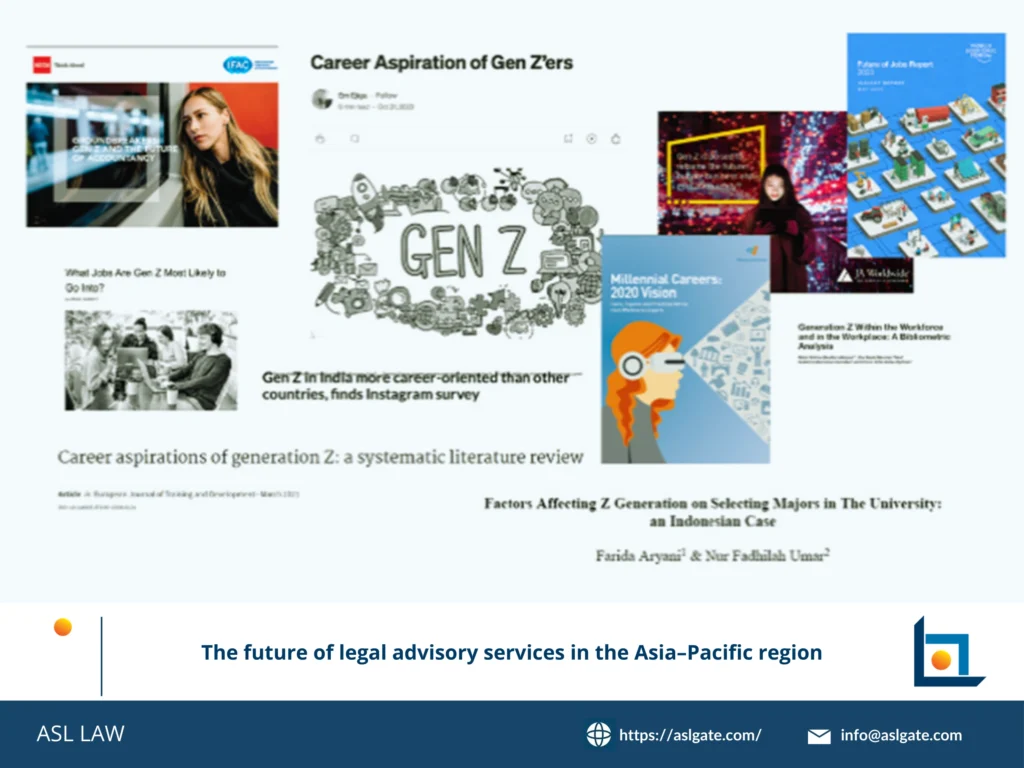
On 16 January 2026, the International Bar Association organized a seminar entitled “The future of legal services in the Asia Pacific” with the participation of a representative of ASL LAW. This seminar was an opportunity for ASL LAW to connect with leading legal advisory organizations worldwide as well as with professional delegates who possess extensive legal practice experience in the Asia–Pacific region and internationally.
Notable topics addressed at the seminar included:
The challenges with the highest level of impact on the legal sector
People-related challenges continue to dominate the top ten factors with the greatest short-term impact on the legal sector. However, the order of priorities has changed significantly compared to the previous year. Change management and staff training in the use of AI have risen to the number one position in terms of expected short-term impact.
Meanwhile, the issue of attracting and retaining talent—which ranked first in the previous year—has fallen to third place. Mental health and wellbeing remain within the top ten but have dropped from third to seventh place. Similarly, the promotion of diversity, equity and inclusion (DEI) continues to be highly valued but has declined from eighth to tenth place.
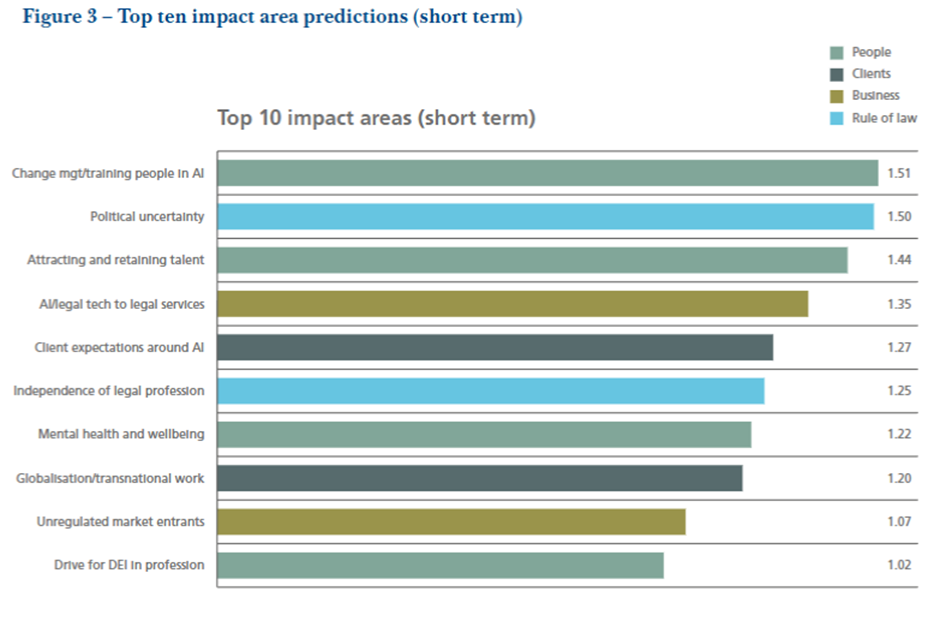
Notably, this year marks the first time that two rule-of-law-related factors have entered the top ten. Political instability and its impact on the legal and regulatory environment represent the fastest-rising factor, currently ranking second, just behind AI.
In addition, challenges to the independence of the legal profession have rapidly become a major concern, ranking just outside the top five factors. A prominent trend throughout is the rise of AI, with three of the four AI-related topics appearing in the top five most pressing short-term issues facing the sector.
Perspectives on the rise of artificial intelligence (AI)
The Global Heatmap survey does not separate AI into a standalone topic, but instead treats it as a cross-cutting factor affecting all major thematic groups, including people, clients, business models and the rule of law. This approach reflects the comprehensive and deeply transformative nature of AI for both personal life and professional activities.
Training teams in the use of AI is currently the top short-term priority, alongside growing concerns related to client expectations and professional standards in the context of AI adoption.
Although the legal sector is currently one step ahead of many other industries, the risk of being overtaken by technology startups remains if focus and adaptability are not maintained. In the medium term, AI is forecast to continue to be the central transformative factor for at least the next five years, including impacts on dispute resolution mechanisms and judicial processes, with the potential to improve access to justice.
The IBA’s inclusion of legal technology capability within the Global Legal Competency Framework, under the “International Principles on Professional Standards for the Legal Profession”, demonstrates the urgent requirement for readiness and continuous learning among legal professionals in response to these systemic changes.
Businesses should consider contacting a full Service law firm in Vietnam providing Legal Advice on Business oversea to receive detail support on their specific case.
Is Gen Z losing interest in the legal profession?
The report conducted by the IBA’s Future of Legal Services Committee (FOLS) examines whether Generation Z—the current young workforce—remains as interested in legal careers as previous generations. This concern arises from declining numbers of law school applications in certain countries, together with increasingly evident worries regarding the legal sector’s ability to attract and retain young talent.
Gen Z comprises individuals born approximately between 1997 and 2012. The earliest Gen Z individuals pursuing higher education and professional legal qualifications have already begun entering the labour market, making the impact of this generation on the legal sector increasingly visible at present. By 2030, Gen Z is expected to account for more than 30% of the global workforce, becoming a core talent group across many sectors, including law.
As a “digital native” generation, Gen Z grew up with social media, was strongly influenced by the Covid-19 pandemic, and is entering the labour market in a world that is more geopolitically unstable, more economically fragile, and facing increasing environmental risks. These characteristics shape Gen Z’s expectations, professional values and attitudes towards work in general and the legal profession in particular.
This issue is particularly significant for the legal sector, as it remains a people-intensive profession with a tradition of recruiting individuals at the very start of their careers, often with long-term career trajectories in mind. While AI is increasingly used as a supporting tool, the human element continues to play a central role. Accordingly, assessing Gen Z’s level of interest in the legal profession, as well as understanding this generation’s motivations, expectations and concerns, will become a strategic topic for legal organizations in the years ahead.
From a timing perspective, the earliest members of Gen Z could enter the legal profession around 2021, depending on the education systems and professional licensing processes in each country. While some markets began recruiting Gen Z several years ago, many other jurisdictions have only witnessed the first wave of Gen Z entrants during the 2024–2025 period. Overall, Gen Z is expected to dominate the inflow of new talent into the legal sector from the early 2020s through to the early 2040s.
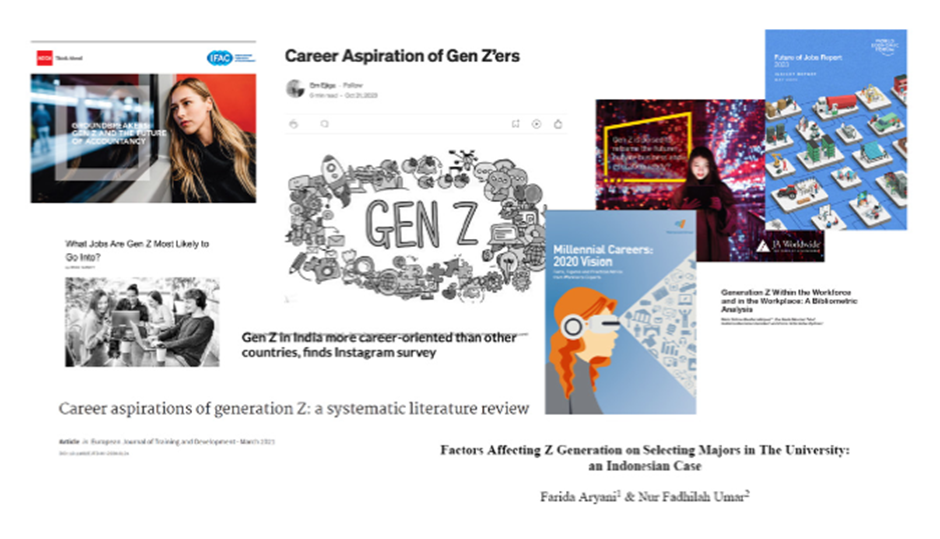
After many years of the legal sector focusing on analysing the impact of the Millennial generation, Gen Z has now formally entered the workforce and is contributing to more profound shifts in societal attitudes towards work. Although demands for diverse, supportive and values-driven workplaces do not originate solely from Gen Z, the emergence of this generation amid rapid technological and demographic transformation has exposed evolutionary currents that were already latent within the legal sector, while simultaneously challenging traditional models.
In the near future, a shrinking and increasingly unstable lawyer workforce in certain countries will compel the legal sector to adapt to shorter career spans and to develop more flexible, life-stage-based strategies for attracting and retaining talent. This will occur alongside intensifying debates on legal service delivery models, the role of alternative legal service providers, interdisciplinary professionals and the regulation of the legal profession. Gen Z is not a solution to “legal deserts” or shortages of lawyers in criminal law and legal aid, nor does this generation view Biglaw as a lifelong destination.
Over the next half-century, the legal sector is expected to undergo profound transformation, with Gen Z acting more as a catalyst than as a purely workforce-related issue. Beyond that lies Gen Alpha—the generation expected to enter the labour market from the early 2030s—bringing with it entirely new skills and challenges, but that is a story for the future.
View the entire conference’s content here.
ASL Law is a leading full-service and independent Vietnamese law firm made up of experienced and talented lawyers. ASL Law is ranked as the top tier Law Firm in Vietnam by Legal500, Asia Law, WTR, and Asia Business Law Journal. Based in both Hanoi and Ho Chi Minh City in Vietnam, the firm’s main purpose is to provide the most practical, efficient and lawful advice to its domestic and international clients. If we can be of assistance, please email to [email protected].
ASL LAW is the top-tier Vietnam law firm for in-depth legal advice in Vietnam and internationally. If you need any advice, please contact us for further information or collaboration.