Tiếng Việt
 中文 (中国)
 日本語
日本語
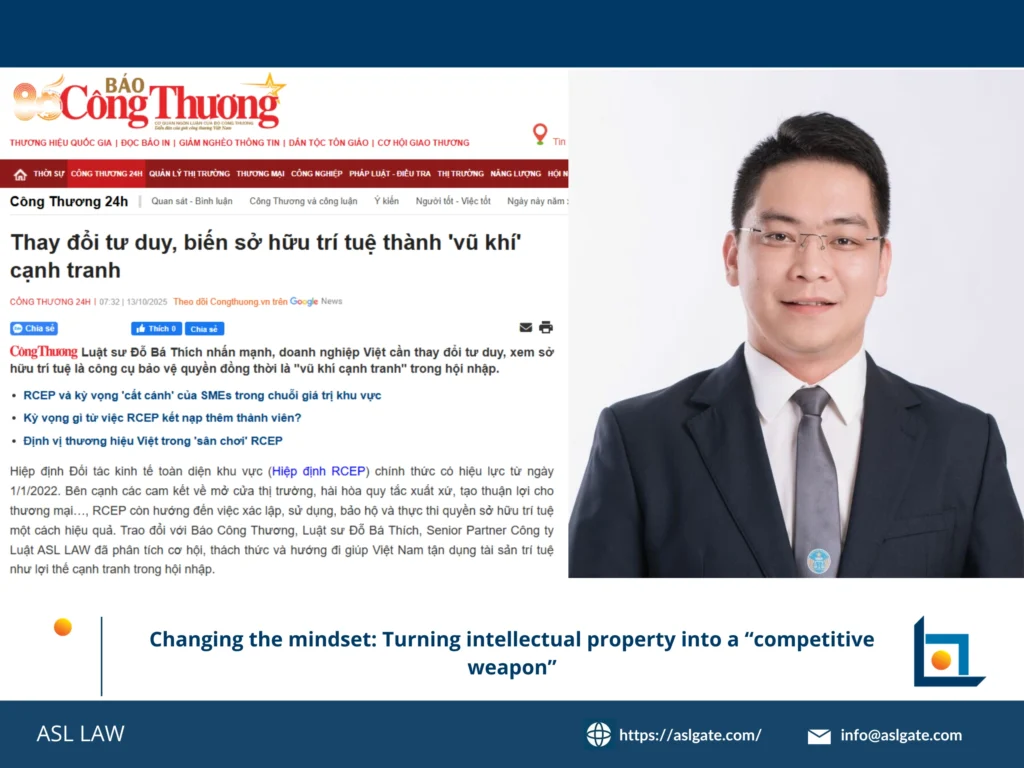
(Published in Industry and Trade Newspaper) Lawyer Do Ba Thich emphasized that Vietnamese enterprises need to change their mindset and view intellectual property as both a tool to protect their rights and a “competitive weapon” in the era of international integration.
The Regional Comprehensive Economic Partnership (RCEP) officially came into effect on January 1, 2022. Along with commitments on market access, harmonization of rules of origin, and trade facilitation, RCEP also aims to establish, utilize, protect, and enforce intellectual property (IP) rights effectively.
In an interview with Industry and Trade Newspaper, Lawyer Do Ba Thich, Senior Partner at ASL LAW, analyzed the opportunities, challenges, and directions to help Vietnam leverage IP assets as a competitive advantage in the integration process.
High-level and comprehensive commitments
– RCEP is considered the world’s largest free trade agreement. In this overall picture, how does intellectual property play a role in shaping the “new rules” for trade, oversea investment, and innovation?
Lawyer Do Ba Thich: The inclusion of intellectual property as a separate chapter in RCEP affirms the central role of IP assets in trade, investment, and innovation in the region, particularly by establishing a shared, crucial foundation for regional trade participants — they must either meet the standards or leave the game.
First, this creates a common benchmark that helps member countries enhance the level of IP protection and enforcement, thereby increasing investor confidence when participating in cross-border business activities.
At the same time, it lays the foundation for promoting innovation, encouraging research, development, and technology commercialization across the region. The establishment of a unified standard is a prerequisite for ensuring a fair, transparent, and healthy competitive environment among member countries.
For Vietnam, RCEP provides opportunities to access capital, technology, and large markets while encouraging domestic enterprises to view IP assets as a core element in building sustainable competitive advantages. The agreement’s inclusion of provisions on the protection of genetic resources, traditional knowledge, and folklore is especially meaningful for Vietnam — a country rich in cultural identity and biodiversity.
This creates an important legal basis to protect and effectively exploit the nation’s cultural heritage, transforming traditional values into resources for developing the creative economy, thereby enhancing Vietnam’s position within the RCEP and globally.
– RCEP’s IP commitments emphasize transparency, simplification of procedures, and the application of digital technologies in registration and management of rights. In your opinion, what should Vietnam do to improve its IP administrative system?
Lawyer Do Ba Thich: If Vietnam does not quickly transform, it will be difficult to take advantage of the opportunities that RCEP offers, especially as IP assets are becoming a key factor determining national competitiveness.
First, it is necessary to build a synchronized, digitalized, and interconnected data infrastructure that is easily accessible, allowing individuals, enterprises, and management agencies to submit applications, search information, and track processing progress transparently and efficiently. Once procedures are digitalized, processing time will be significantly shortened, costs reduced, and businesses will find it easier to register, protect, and exploit IP assets. The more streamlined the administrative procedures are, the sooner intangible IP assets can be brought into economic life — turning them into tangible resources of real value that directly contribute to business and economic growth.
Next, the capacity of IP management agencies must be improved, including both the expertise of officials and data management capabilities. It is urgent to invest in information technology systems and develop secure, modern digital platforms capable of handling large datasets.
In particular, the application of artificial intelligence (AI), blockchain, and automation technologies in examination, comparison, and granting of IP rights will create a breakthrough, helping Vietnam shorten procedures, reduce errors, and improve enforcement efficiency. These are essential integration criteria for Vietnam to align with RCEP’s international standards, moving toward a transparent, modern digital administration that puts enterprises at the center and innovation as the driving force for development.
Proactive adaptation and raising awareness
– In the context that many Vietnamese enterprises, especially small and medium-sized enterprises (SMEs), still have limited understanding and resources regarding intellectual property, what would you recommend so that they can both seize opportunities from RCEP and minimize international IP dispute risks?
Lawyer Do Ba Thich: In reality, most Vietnamese enterprises, particularly SMEs, have not yet considered IP as a strategic asset. As they become more deeply involved in free trade agreements like RCEP, opportunities to expand markets come with significant risks, especially the risk of infringement or loss of IP rights abroad.
SMEs often face three major difficulties:
(1) Lack of investment in research and development (R&D), resulting in fewer protectable innovations and greater vulnerability to copying;
(2) Lack of IP protection strategies — many businesses register trademark in Vietnam exclusively and forget to register in export markets, leading to cases where partners or third parties register first, causing loss of brand or invention rights abroad;
(3) Limited legal and financial capacity to handle disputes, while large international corporations use IP as a legitimate legal barrier to prevent smaller competitors from entering the market.
To make effective use of opportunities from RCEP, Vietnamese enterprises must change their mindset and view intellectual property not only as a means of protection but also as a “competitive weapon” in the integration process. In my view, there are four key solutions that need to be implemented simultaneously:
First, develop a long-term IP strategy aligned with the business strategy, establishing an early list and protection plan for assets such as trademarks, patents, designs, and copyright in Vietnam and RCEP member countries.
Second, invest in R&D and cooperate with research institutes, universities, and Vietnam Intellectual Property Law Firm to develop genuine innovation capacity with strong legal foundations.
Third, take advantage of government support programs such as the Science and Technology Development Fund, initiatives for international trademark registration, or free advisory services for SMEs.
Fourth, raise internal awareness and provide training on IP, helping business leaders and legal departments understand the value, protection, and commercial exploitation of IP assets as competitive advantages.
If Vietnamese enterprises fail to act promptly, they may be “swallowed by bigger fish” as foreign corporations use IP to create legal barriers. Conversely, with proper investment, registration, and effective protection, intellectual property will become both a “shield” and a “lever” that helps businesses assert their position in regional and global value chains.
ASL Law is a leading full-service and independent Vietnamese law firm made up of experienced and talented lawyers. ASL Law is ranked as the top tier Law Firm in Vietnam by Legal500, Asia Law, WTR, and Asia Business Law Journal. Based in both Hanoi and Ho Chi Minh City in Vietnam, the firm’s main purpose is to provide the most practical, efficient and lawful advice to its domestic and international clients. If we can be of assistance, please email to [email protected].
ASL LAW is the top-tier Vietnam law firm for Intellectual Property Services. If you need any advice, please contact us for further information or collaboration.