Tiếng Việt
 中文 (中国)
 日本語
日本語
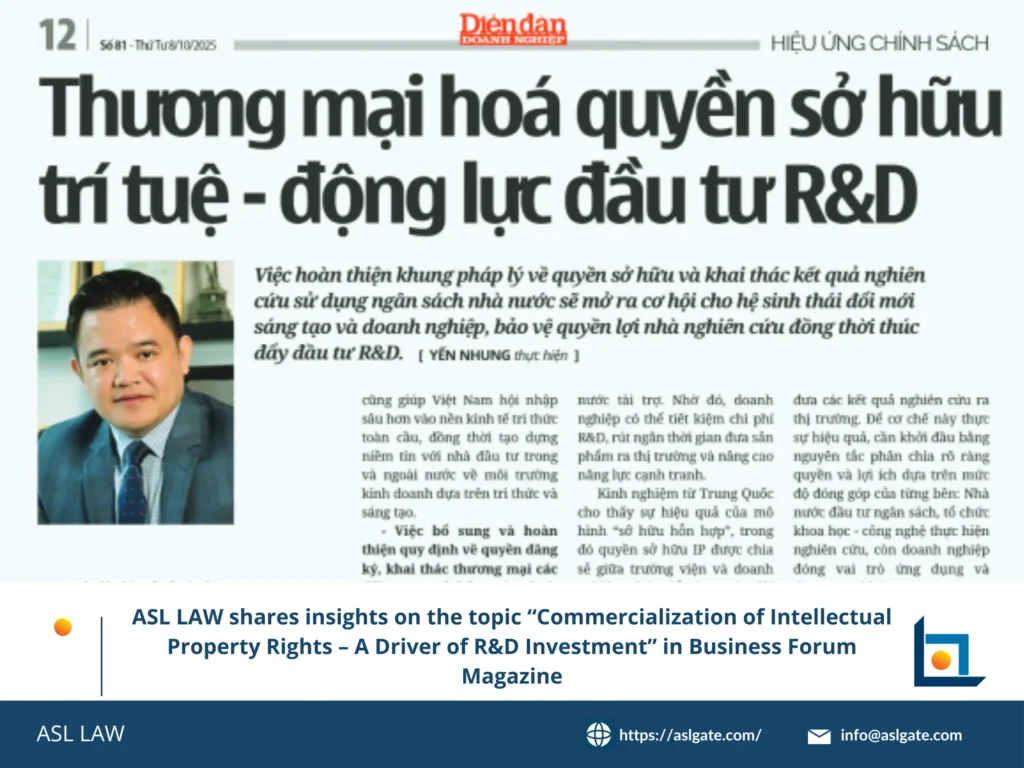
ASL LAW has recently published an in-depth article in Business Forum Magazine on the topic “Commercialization of Intellectual Property Rights – A Driver of R&D Investment,” contributed by Lawyer Pham Duy Khuong, Managing Partner of ASL LAW.
The article analyzes the pivotal role of monetizing intellectual property (IP) assets in fostering innovation, enhancing competitiveness, and encouraging enterprises and investors to increase oversea investment in research and development (R&D). This is a subject that has attracted particular attention in the context of Vietnam promoting its knowledge-based economy strategy and deep integration into global value chains.
(Published in Business Forum Magazine) The improvement of the legal framework on the ownership and exploitation of research outcomes funded by the state budget will create opportunities for the innovation ecosystem and enterprises, thereby stimulating R&D investment. Below are the insights shared by Lawyer Pham Duy Khuong, Managing Partner of ASL LAW, with Business Forum Magazine:
– How do you assess the emphasis on transforming intellectual property rights into assets of real commercial value in the current draft amendments to the Intellectual Property Law?
I believe that the most significant implication of recognizing IP rights as commercial assets lies in creating a major shift in mindset: from viewing them merely as legal protection tools (intangible assets) to recognizing them as true economic resources, acknowledging and respecting the real value of intellectual property assets.
Once valued, assigned, mortgaged, or contributed as capital, IP rights can help enterprises mobilize funds, expand operations, and enhance brand value. This directly incentivizes individuals and organizations to invest more heavily in R&D and innovation, as they can recover and monetize the economic value of their creations.
At the macro level, commercialization of IP contributes to the development of a transparent IP trading market, drives innovation, and enhances national competitiveness. It also facilitates Vietnam’s deeper integration into the global knowledge economy, while building investor confidence—both domestic and foreign—in a business environment founded on knowledge and creativity.
– How will the improvement of regulations on registration rights and commercialization of IP derived from state-funded research impact innovation and research offshore investment in Vietnam?
Improving regulations on registration rights and commercialization of IP derived from state-funded research will generate clear positive impacts on the innovation ecosystem. First, when ownership and exploitation rights are clearly defined, research institutes, universities, and scientists will be more motivated to bring research results to market, rather than leaving them idle in academic works.
This helps reduce waste of public resources, as research products will be commercialized and generate real socio-economic value. For enterprises, the new regulations open up access to patents, utility solutions, technologies, and products from state-funded research. As a result, enterprises doing business in Vietnam can save on R&D costs, shorten time-to-market, and enhance competitiveness.
China’s experience demonstrates the effectiveness of a “mixed ownership” model, where IP rights are shared between institutions and enterprises, fostering mutually beneficial cooperation. Technology transfer funds support enterprises in accessing research outcomes and mitigating risks, while specialized IP courts ensure swift dispute resolution. Notably, the recognition of research data as IP assets has opened a new pathway for scientific knowledge management.
Meanwhile, Singapore—ASEAN’s leader in commercializing publicly funded inventions—allows institutions such as A*STAR and the National University of Singapore (NUS) to own, register, and license patents to enterprises. A professional Technology Transfer Office (TTO) system and transparent benefit-sharing mechanisms have significantly increased the number of commercialized patents, while strengthening trust among scientists, research organizations, and the private sector.
– In your opinion, how should the mechanism for sharing IP rights among the State, scientific organizations, and enterprises be designed to ensure that policies are effectively implemented in practice?
The mechanism for sharing IP rights among the State, scientific organizations, and enterprises is key to bringing research outcomes to market. For this mechanism to be truly effective, it should start with clearly defined principles of benefit and right allocation based on each party’s contribution: the State provides funding, scientific organizations conduct research, and enterprises apply and commercialize the results.
Most importantly, the parties need to agree on how to value their contributions to the project. Who provides funding, who contributes market access, who develops the product, who manages it, and who bears responsibility for R&D—all must be quantified into specific values to create a “level playing field.” This not only fosters long-term cooperation but also ensures that each party receives benefits commensurate with their contributions, while allowing the State to safeguard its initial public investment and prevent non-transparent transfers of public assets.
In addition, a synchronized legal framework must be established, clearly stipulating procedures for establishing and registering IP rights in cases of joint ownership, mechanisms for profit-sharing based on contribution ratios, principles for valuing IP assets when contributed as capital, as well as solutions for dispute resolution to protect all parties’ interests.
If properly designed, this sharing mechanism will unlock enormous potential from dormant research outcomes, create flexible and sustainable cooperation models between research institutions and enterprises, and strongly disseminate the value of innovation throughout the entire economy.
Read the full article here.
ASL Law is a leading full-service and independent Vietnamese law firm made up of experienced and talented lawyers. ASL Law is ranked as the top tier Law Firm in Vietnam by Legal500, Asia Law, WTR, and Asia Business Law Journal. Based in both Hanoi and Ho Chi Minh City in Vietnam, the firm’s main purpose is to provide the most practical, efficient and lawful advice to its domestic and international clients. If we can be of assistance, please email to [email protected].
ASL LAW is the top-tier Vietnam law firm for Intellectual Property Services. If you need any advice, please contact us for further information or collaboration.