Tiếng Việt
 中文 (中国)
 日本語

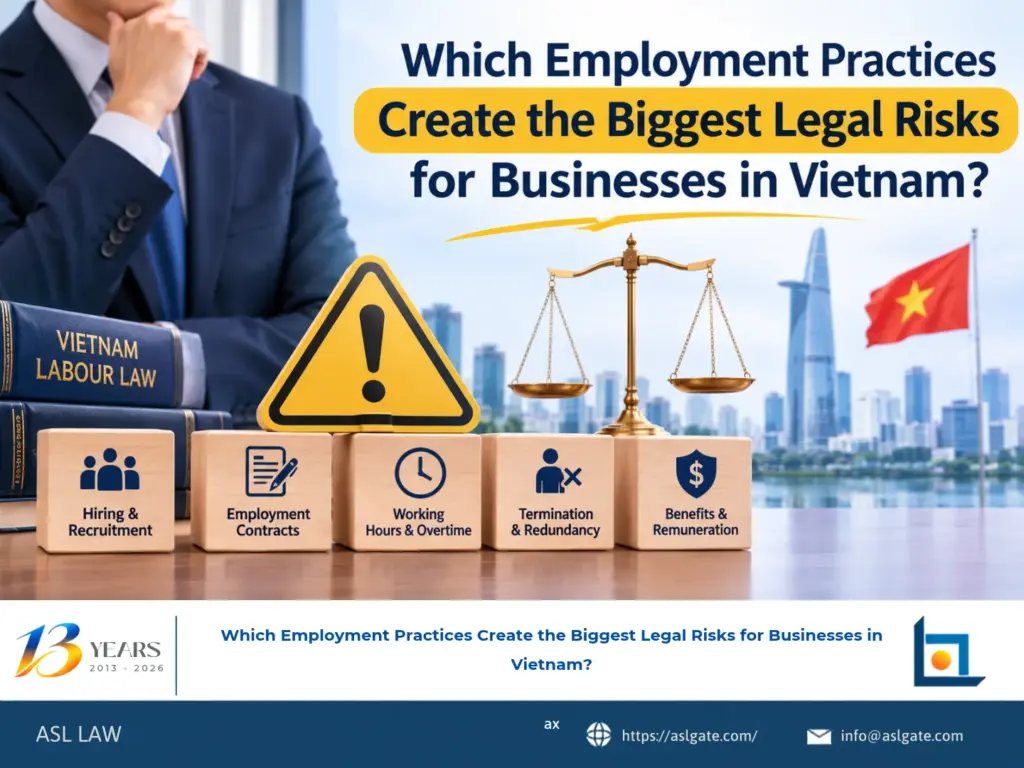
Employment practices creating legal risks Vietnam businesses must address include misclassifying workers, using non-compliant employment contracts, failing to pay statutory wages, neglecting compulsory insurance obligations, and terminating employees without lawful grounds. These practices can expose employers to administrative penalties, compensation claims, back payments, and labor disputes. As Vietnam’s employment regulatory framework continues to evolve, businesses should regularly review their HR policies and employment procedures to ensure compliance and prevent avoidable legal liabilities.
Employment Contract Violations and Worker Classification
One of the biggest labor law risks for Vietnam employers arises from incorrectly establishing or classifying employment relationships.
Under Vietnam’s Labour Code 2019, an agreement may be treated as an employment contract regardless of its name if it involves paid work, wages, and the management, direction, or supervision of one party over another.
Consequently, businesses cannot automatically avoid employment obligations by calling a working arrangement a consultancy, freelance, or service agreement.
Common high-risk practices include:
- Using service agreements for workers who are effectively employees.
- Failing to execute written employment contracts where required.
- Omitting essential contractual terms or using unclear job descriptions.
- Retaining employees beyond the permitted duration of fixed-term contracts without following applicable requirements.
- Requiring employees to deposit money or retain original identity documents as security for their employment.
Employers should ensure that contracts accurately reflect actual working arrangements, including job responsibilities, salary, working location, working hours, and termination conditions.
Professional Advising Employment Law and Labour Law in Vietnam can help businesses assess employment structures and identify contractual weaknesses before they result in disputes.
Wage, Overtime, and Compulsory Insurance Compliance
Another major category of employment compliance risks businesses face Vietnam concerns wages, working time, and statutory employee benefits.
Under the Labour Code, normal working hours generally cannot exceed eight hours per day or 48 hours per week. Overtime is subject to statutory limits, employee consent requirements, and applicable premium payment rates.
Employers should particularly avoid:
- Paying salaries below applicable regional minimum wage levels.
- Failing to calculate overtime and night-work payments correctly.
- Making unlawful deductions from employee salaries.
- Delaying wage payments without legally acceptable grounds.
- Failing to maintain accurate attendance and payroll records.
From January 1, 2026, Decree 293/2025/ND-CP establishes the applicable regional minimum wage levels, replacing the previous minimum wage framework under Decree 74/2024/ND-CP.
Compulsory insurance is another important compliance area. The Social Insurance Law No. 41/2024/QH15, effective July 1, 2025, expanded compulsory social insurance coverage to additional categories of workers, including certain individuals working under agreements that may not formally be called employment contracts.
The Law on Employment No. 74/2025/QH15 also took effect on January 1, 2026, establishing an updated framework for employment policies and unemployment insurance.
Employers should periodically reconcile employment contracts, payroll records, and insurance declarations to prevent underpayment, late contributions, and potential administrative penalties.
Businesses operating in Vietnam should also review the relevant requirements concerning employment law in Vietnam when updating their internal HR policies.
Unlawful Disciplinary Actions and Employment Termination
Legal liability from employment practices in Vietnam frequently arises when employers impose disciplinary measures or terminate employment without satisfying statutory requirements.
Vietnamese labor law recognizes specific disciplinary measures and requires employers to follow prescribed procedures. Employers should not impose arbitrary fines, deduct salaries as punishment, or dismiss employees based solely on managerial dissatisfaction.
Dismissal generally requires a legally recognized ground and compliance with procedural requirements, including relevant evidence, notification, and disciplinary meetings where applicable.
Unlawful termination can create significant financial exposure. Depending on the circumstances, an employer may be required to reinstate the employee, pay outstanding wages and insurance contributions, provide compensation, and fulfill other statutory obligations.
Employers must also distinguish between disciplinary dismissal and unilateral termination of an employment contract. The latter is governed by separate statutory grounds and notice requirements.
Where restructuring, technological changes, or economic reasons affect employment, businesses should assess whether a labor utilization plan, consultation, notification, or other prescribed procedure is required.
For companies undertaking workforce restructuring or handling sensitive employment disputes, advising employment law in Vietnam can help assess the appropriate legal grounds and procedures before management makes a final decision.
Workplace Safety, Discrimination, and Foreign Employee Compliance
High-risk employment practices to avoid Vietnam businesses must consider also include failures to maintain workplace safety and prevent prohibited conduct.
Employers have obligations concerning occupational health and safety, risk assessment, employee training, protective equipment, and the handling of workplace accidents and occupational diseases.
A company may face liability if it fails to implement appropriate safety measures or neglects its statutory responsibilities following an occupational accident.
Discrimination and sexual harassment are additional areas of concern. Employers should establish internal procedures for receiving complaints, investigating allegations, protecting affected employees, and taking appropriate disciplinary action.
Businesses employing foreign nationals must separately review immigration and employment requirements. Under Decree 219/2025/ND-CP, employers must comply with the applicable work permit or exemption procedures and conditions for foreign employees working in Vietnam.
Companies should not assume that a foreign employee’s position within an international corporate group automatically exempts that person from Vietnamese work authorization requirements.
Building an Effective Employment Compliance Strategy
Managing employment practices creating legal risks Vietnam companies face requires a continuous compliance framework rather than occasional HR document reviews.
Employers should regularly assess employment contracts, internal labor regulations, payroll systems, insurance contributions, occupational safety procedures, and termination practices.
An effective compliance program should include:
- Standardized employment contracts reflecting actual working arrangements.
- Regular reviews of wage and insurance obligations.
- Clear disciplinary and complaint-handling procedures.
- Proper documentation of working hours, leave, and employee performance.
- Periodic legal reviews when labor regulations change.
Businesses can also consider Vietnam legal outsourcing to obtain external legal support without maintaining a large in-house legal department.
Companies operating in southern Vietnam may consult a law firm in Ho Chi Minh, while businesses in northern Vietnam may consider a Vietnam Hanoi law firm for assistance with employment policies, contract reviews, and labor disputes.
For businesses managing regional workforces, legal Advice on Business in ASEAN may also help identify differences between employment requirements across Southeast Asian jurisdictions.
Ultimately, preventing legal liability from employment practices Vietnam employers encounter requires early risk identification, accurate documentation, and consistent compliance management. Businesses that integrate employment law into their everyday management decisions are better positioned to protect both their operations and their employees.
Frequently Asked Questions
1. Which employment practices create the biggest legal risks for businesses in Vietnam?
Common high-risk practices include misclassifying employees, using non-compliant contracts, underpaying wages, failing to contribute to compulsory insurance, violating working-time rules, and terminating employees unlawfully.
2. Can a company use a service contract instead of an employment contract in Vietnam?
Not necessarily. If the arrangement involves paid work, wages, and the management, direction, or supervision of one party, it may be classified as an employment relationship regardless of the contract’s title.
3. What happens if an employer terminates an employee unlawfully?
Depending on the circumstances, the employer may be required to reinstate the employee, pay outstanding wages, compensate the employee, and fulfill other statutory obligations.
4. Are foreign employees subject to Vietnamese labor regulations?
Yes. Foreign employees working in Vietnam must comply with applicable employment and work authorization requirements, including work permit or exemption procedures under Decree 219/2025/ND-CP.
5. How can businesses reduce employment compliance risks in Vietnam?
Businesses should regularly review employment contracts, payroll, compulsory insurance, workplace safety, internal labor regulations, and disciplinary procedures. Obtaining professional legal advice before significant HR decisions can also help prevent disputes and financial liabilities.
ASL Law is a leading full-service and independent Vietnamese law firm made up of experienced and talented lawyers. ASL Law is ranked as the top tier Law Firm in Vietnam by Legal500, Asia Law, WTR, and Asia Business Law Journal. Based in both Hanoi and Ho Chi Minh City in Vietnam, the firm’s main purpose is to provide the most practical, efficient and lawful advice to its domestic and international clients. If we can be of assistance, please email to [email protected].
ASL LAW is the top-tier Vietnam law firm for Employment and Labor Law. If you need any advice, please contact us for further information or collaboration.