Tiếng Việt
 中文 (中国)
 日本語

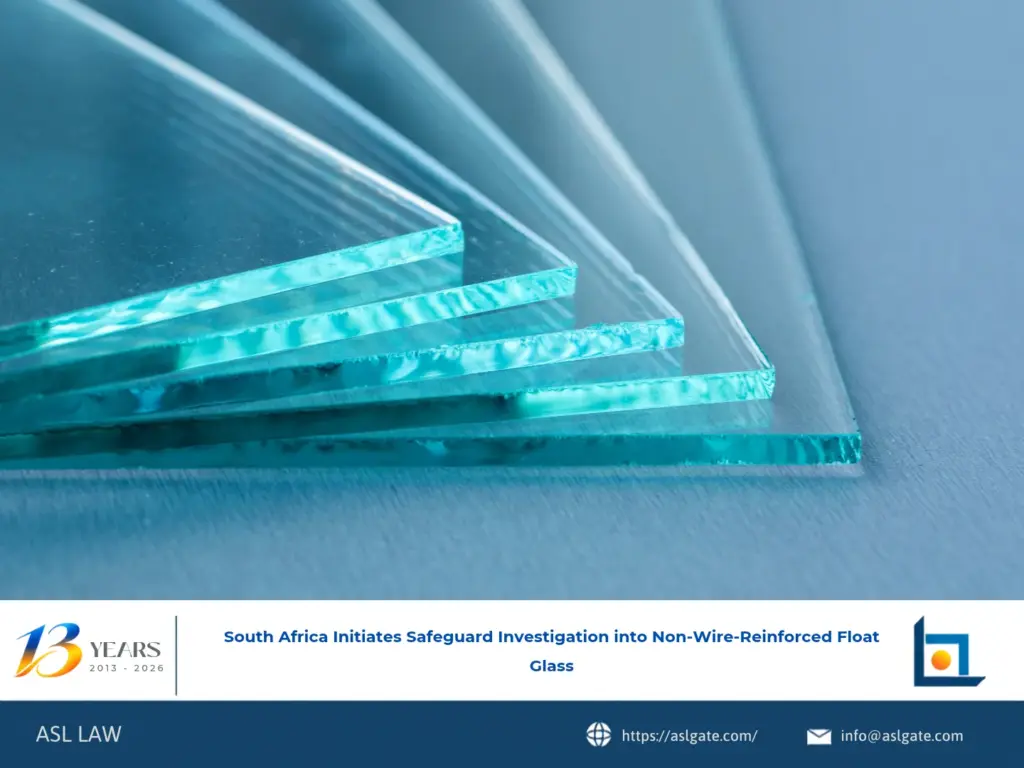
On 3 November 2026, the International Trade Administration Commission of South Africa (ITAC) initiated a safeguard investigation into certain non-wire-reinforced float glass products imported into the Southern African Customs Union (SACU). On 11 November 2026, South Africa notified the World Trade Organization (WTO) Committee on Safeguards of the investigation under document number G/SG/N/6/ZAF/15. The investigation could result in import restrictions on goods from all sources if ITAC determines that increased imports have caused serious injury to the SACU domestic industry.
Scope of the Products under Investigation
The products under investigation are non-wire-reinforced float glass, comprising two main categories:
- Mass-coloured, tinted, frosted, surface-coloured, or merely surface-ground glass, excluding optical glass;
- Other types of non-wire-reinforced glass, excluding solar glass and optical glass.
The products fall under HS codes 7005.21.13, 7005.21.15, 7005.21.17, 7005.21.23, 7005.21.29, 7005.21.35, 7005.21.45, 7005.21.55, 7005.21.65, 7005.21.85; 7005.29.13, 7005.29.15, 7005.29.17, 7005.29.23, 7005.29.25, 7005.29.35, 7005.29.45, 7005.29.55, 7005.29.65, and 7005.29.85.
Enterprises should note that ITAC indicated that the relevant products may also be declared under HS code 7004.90.90, which covers drawn glass. This issue has previously arisen in anti-dumping investigations involving float glass. Accordingly, it is important to review product descriptions, technical specifications, origin documents, and the HS codes actually declared.
Grounds for Initiating the Investigation
The application was filed by PFG Building Glass. According to the notice, the company is the sole producer of the product concerned in SACU and accounts for the entire domestic production in the region.
ITAC considers that there is prima facie evidence of a sharp, sudden, recent, and significant increase in imports during the period from 1 December 2024 to 30 November 2025, both in absolute terms and relative to domestic production.
The injury investigation period covers 1 December 2022 to 30 November 2025. The applicant argued that the SACU domestic industry had experienced declines in sales volume, production, market share, net profits, capacity utilisation, and productivity. ITAC also preliminarily identified a causal link between the increase in imports and the alleged injury.
According to the application, the applicant cited the global oversupply of float glass, expanded production capacity, trade diversion, and developments in container shipping, packaging, and logistics that have reduced transportation costs. These factors were invoked to support the argument concerning “unforeseen developments” in the safeguard investigation.
Deadlines for Participating in the Investigation
Interested parties were required to register their participation, submit written comments, and request a hearing within 20 days of the initiation date, as stated in the notice dated 3 November 2026. The deadline specified in the notice passed on 23 November 2026, and ITAC expressly stated that late submissions would not be accepted.
For confidential information, enterprises must explain the grounds for confidentiality and provide a sufficiently detailed non-confidential summary. If a summary cannot be prepared, the enterprise must submit an affidavit explaining the reasons. ITAC may disregard confidential information that does not satisfy these requirements.
Recommendations for Vietnamese Enterprises
As this is a safeguard investigation, any definitive measure, if imposed, could affect glass products within the scope of the investigation imported from Vietnam, even though Vietnamese enterprises are not individually accused of dumping or subsidisation.
Glass manufacturers and exporters should promptly:
- Review float glass transactions involving South Africa and other SACU markets, checking HS codes, product characteristics, thickness, intended uses, and whether the products qualify for exclusions applicable to solar glass or optical glass;
- Verify customs documents, declared HS codes, technical records, and certificates of origin to minimise the risk of misclassification;
- Compile data on exports, selling prices, customers, production capacity, SACU market share, and potential impacts if safeguard measures are imposed;
- Proactively coordinate with importers, industry associations, and the Trade Remedies Authority of Vietnam to monitor subsequent proceedings, while considering whether to request that ITAC accept late submissions if the enterprise has a directly affected interest;
- Prepare contingency plans for markets, pricing, and contractual terms in the event that South Africa imposes provisional or definitive safeguard measures.
The investigation is still at the initiation stage. Enterprises should continue monitoring ITAC and WTO announcements for developments, particularly the possibility of provisional measures, the investigation findings, and the forms of import restrictions that may be proposed.
To protect their legitimate interests, manufacturers and exporters should familiarize themselves with the procedure and actively contact Vietnam Antidumping Law Firm specializing in anti-dumping and trade remedy for timely assistance.
ASL Law is a leading full-service and independent Vietnamese law firm made up of experienced and talented lawyers. ASL Law is ranked as the top tier Law Firm in Vietnam by Legal500, Asia Law, WTR, and Asia Business Law Journal. Based in both Hanoi and Ho Chi Minh City in Vietnam, the firm’s main purpose is to provide the most practical, efficient and lawful advice to its domestic and international clients. If we can be of assistance, please email to [email protected].
ASL LAW is the top-tier Vietnam law firm for Anti-dumping & countervailing. If you need any advice, please contact us for further information or collaboration.