Tiếng Việt
 中文 (中国)
 日本語

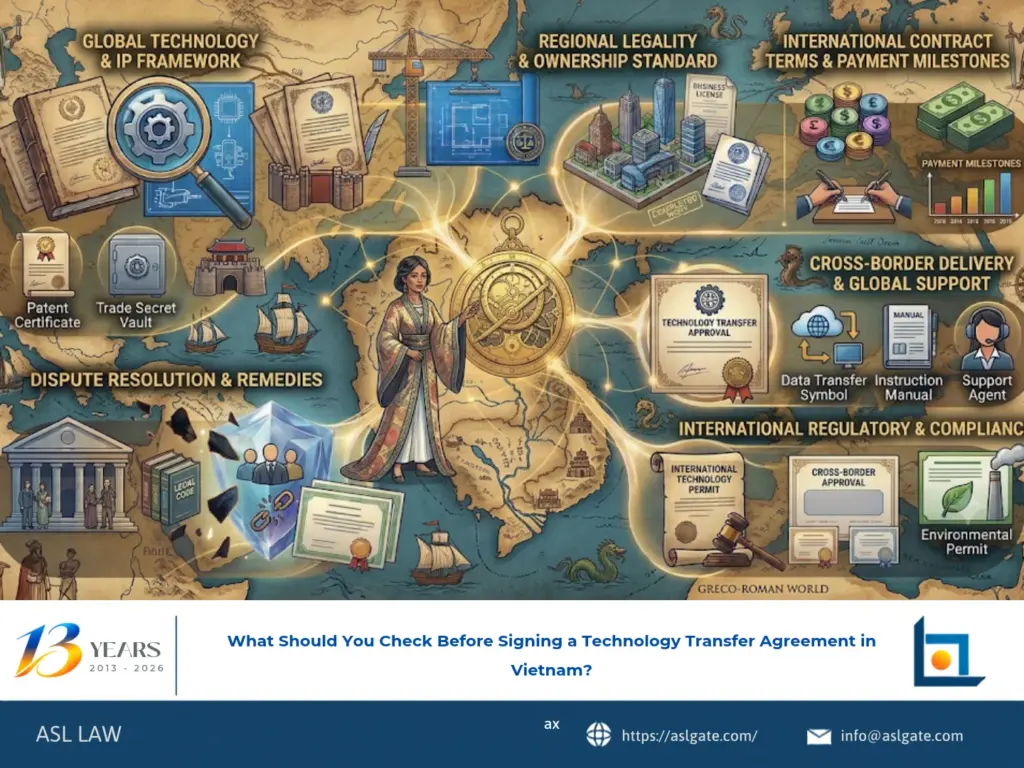
A checklist before signing tech transfer agreement Vietnam is essential for businesses seeking to acquire, license, or commercialize technology while minimizing legal and financial risks. Before signing, the parties should verify ownership rights, assess technology transfer restrictions, agree on the scope of licensed rights, establish payment terms, and confirm applicable registration or licensing requirements. A carefully reviewed agreement helps prevent disputes over intellectual property, technical performance, confidentiality, and contractual obligations.
Verify Technology Ownership and the Legal Right to Transfer
One of the most important key legal points to verify in tech transfer deals is whether the transferor legally owns the technology or has sufficient authority to transfer or license it.
Under Vietnam’s Law on Technology Transfer, technology transfer may involve transferring ownership or granting the right to use technology. Businesses should distinguish between these arrangements because they create different rights and obligations.
Before signing, the recipient should examine:
- Patent certificates and other intellectual property documents, where applicable.
- Ownership records and agreements with inventors or previous developers.
- Existing licenses, sublicensing restrictions, and third-party rights.
- Technical documentation, software, manufacturing processes, and know-how included in the transaction.
The parties should also determine whether the technology can legally be transferred to Vietnam and whether it falls within a category of prohibited or restricted technology transfer.
For cross-border technology transfer in Vietnam, this assessment is particularly important because an otherwise valid commercial agreement cannot override statutory restrictions or third-party intellectual property rights.
Conduct Technical and Legal Due Diligence
Due diligence for technology transfer contracts Vietnam should assess not only ownership but also whether the technology can perform as promised.
The recipient should examine its technical readiness, operational compatibility, required machinery, personnel qualifications, maintenance arrangements, and expected production capacity.
The agreement should identify the transferred technology precisely, including its components, technical specifications, accompanying documents, implementation requirements, and expected products or services.
Businesses should avoid vague descriptions such as “manufacturing know-how” or “technical assistance” without defining the actual deliverables.
It is also important to establish measurable acceptance criteria. These may include production capacity, product quality, operational efficiency, testing procedures, and deadlines for completing installation or training.
Where necessary, independent technical experts or professional technology transfer services can help assess whether the proposed technology is suitable for the recipient’s operations.
Review Contract Terms, Payment, and Intellectual Property Obligations
Essential checks before tech transfer signing Vietnam should include a detailed review of contractual provisions under the Law on Technology Transfer.
Under Article 23, a technology transfer contract should address the transferred technology, resulting products and their standards, ownership or usage rights, transfer methods, parties’ rights and obligations, price, payment method, duration, effective date, implementation schedule, warranty responsibilities, penalties, liability for breaches, and dispute resolution.
The parties should pay particular attention to the following matters.
Payment and valuation: Technology transfer fees may be paid in installments, in cash or goods, or calculated based on net sales, net revenue, or the recipient’s pre-tax profit. Special valuation, audit, and tax requirements may apply to transactions involving state capital, parent-subsidiary relationships, or related parties.
Intellectual property rights: The agreement should clarify whether the recipient receives ownership or merely a license. It should also specify territorial scope, duration, exclusivity, permitted applications, and sublicensing rights.
Confidentiality: Technical documents, source code, production processes, and business secrets should be protected through confidentiality obligations. The parties should also determine whether confidentiality continues after termination.
A Vietnam Hanoi law firm can assist businesses with reviewing contractual provisions and identifying ownership or licensing risks before execution.
Check Registration and Licensing Requirements Before Signing
A pre-signing review for technology transfer Vietnam must establish whether the transaction requires registration, approval, or a technology transfer license.
Vietnam’s Law No. 115/2025/QH15, amending the Law on Technology Transfer, took effect on April 1, 2026. The latest consolidated legislation, Document No. 138/2026/VBHN-LQ-VPQH, dated September 21, 2026, reflects the current consolidated framework.
Under Article 31, technology transfer registration is generally mandatory for:
- Technology transferred from abroad into Vietnam.
- Technology transferred from Vietnam to another country.
- Domestic technology transfers involving state capital or the state budget.
The registration application must generally be submitted within 90 days from the date the technology transfer agreement is signed. Where registration is mandatory, the contract takes effect upon issuance of the registration certificate.
Restricted technology transfers require a separate licensing process. Under the amended framework, approval and licensing procedures have been decentralized to provincial-level authorities in relevant cases. Certain projects whose technology has already been assessed during the investment approval process may not require a separate technology transfer approval step.
The distinction between registration and licensing is important: a contract involving restricted technology should not be treated as an ordinary registration transaction.
For businesses unfamiliar with these procedures, obtaining technology transfer advice before signing can help determine the applicable requirements and avoid delays in implementation.
Allocate Liability and Establish Dispute Resolution Mechanisms
A complete checklist before signing tech transfer agreement Vietnam should also address what happens when the technology fails to meet contractual expectations.
The agreement should establish responsibility for technical defects, incomplete documentation, delayed implementation, unsuccessful testing, and failure to provide agreed training or support.
The transferor should provide appropriate warranties regarding its legal right to transfer the technology and its obligation to perform the agreed technical commitments. The recipient should undertake to use the technology within the permitted scope and protect confidential information.
The parties should also specify breach penalties, compensation, termination rights, and procedures for resolving disputes.
For international transactions, particular attention should be given to governing law, arbitration arrangements, procedural language, and enforcement of awards.
A Ho Chi Minh law firm may assist with local contractual and regulatory matters, while a law firm in Ho Chi Minh may be useful for transactions involving manufacturing facilities or technology recipients in southern Vietnam.
Businesses operating in northern industrial and technology zones may also consider working with a law firm hanoi to coordinate contractual reviews and regulatory procedures.
Ultimately, the right pre-signing review should address legal ownership, technical feasibility, contractual allocation of risk, and regulatory compliance together. This approach helps businesses obtain the intended commercial benefits while reducing the risk of disputes after implementation.
Frequently Asked Questions
1. What should businesses check before signing a technology transfer agreement in Vietnam?
Businesses should verify technology ownership, transfer rights, technical specifications, restricted technology requirements, registration obligations, payment terms, warranties, confidentiality, and dispute resolution provisions.
2. Must technology transfer agreements in Vietnam be registered?
Not all agreements require registration. Registration is generally mandatory for transfers from abroad into Vietnam, from Vietnam abroad, and certain domestic transfers involving state capital or the state budget.
3. When does a technology transfer agreement become effective?
The parties may agree on its effective date. However, agreements involving restricted technology take effect upon issuance of the relevant license, while agreements subject to mandatory registration take effect upon issuance of the registration certificate.
4. Can technology transfer fees be calculated based on business revenue?
Yes. Vietnamese law permits payment methods based on net sales, net revenue, or the recipient’s pre-tax profit, in addition to fixed or installment payments, subject to applicable legal requirements.
5. Why should businesses obtain legal advice before signing a technology transfer agreement?
Legal review helps verify ownership, identify regulatory requirements, clarify contractual obligations, assess financial exposure, and establish effective mechanisms for handling technical failures or disputes.
ASL Law is a leading full-service and independent Vietnamese law firm made up of experienced and talented lawyers. ASL Law is ranked as the top tier Law Firm in Vietnam by Legal500, Asia Law, WTR, and Asia Business Law Journal. Based in both Hanoi and Ho Chi Minh City in Vietnam, the firm’s main purpose is to provide the most practical, efficient and lawful advice to its domestic and international clients. If we can be of assistance, please email to [email protected].
ASL LAW is the top-tier Vietnam law firm for technology transfer services in Vietnam. If you need any advice, please contact us for further information or collaboration.