Tiếng Việt
 中文 (中国)
 日本語
日本語
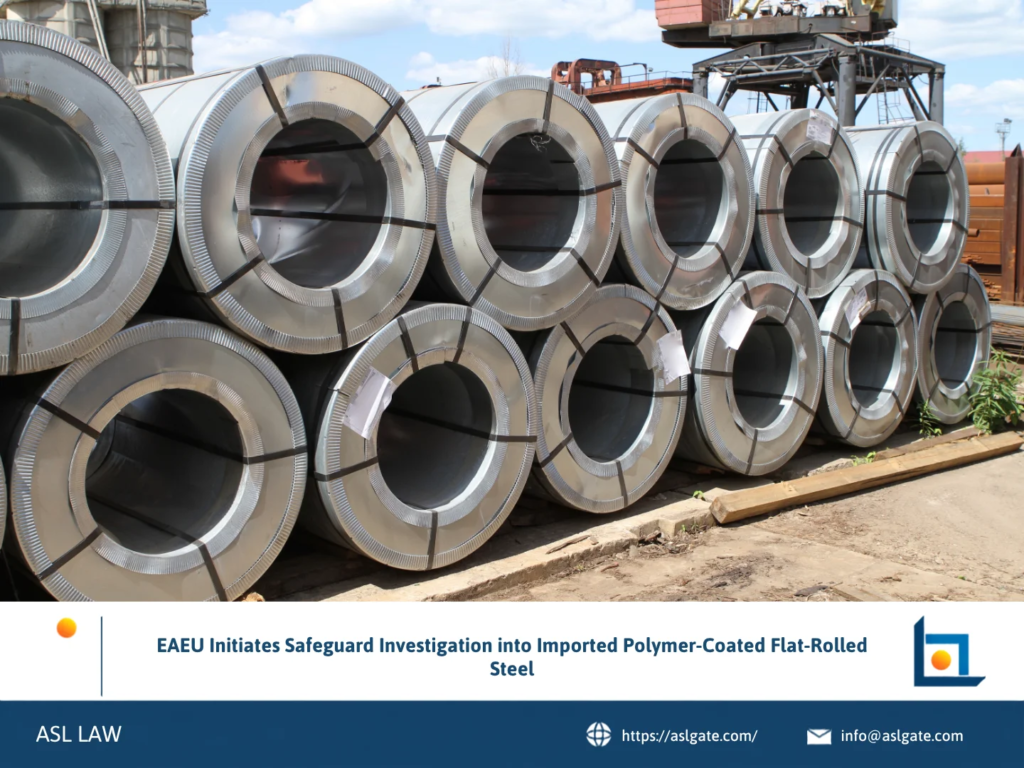
On September 7, 2026, the Department for Protection of the Internal Market of the Eurasian Economic Commission (EEC) initiated a safeguard investigation into imported flat-rolled steel coated with polymers entering the Eurasian Economic Union (EAEU), case No. SG-15. The investigation was initiated based on an application filed by three EAEU producers: PJSC Magnitogorsk Iron and Steel Works, MMK-Lysvensky Metallurgical LLC, and PJSC Severstal.
The case may affect companies manufacturing and exporting polymer-coated flat-rolled steel to the EAEU market in the coming period. Interested parties should pay attention to the deadlines for registering as participants in the investigation and submitting information in accordance with the investigating authority’s requirements.
Investigated Product and Scope of the Case
The investigated product is flat-rolled steel with a metallic base thickness of more than 0.2 mm but not exceeding 2 mm, a width exceeding 50 mm, and coated with polymers. The products are classified under HS codes 7210 70 800 0, 7210 90 800 0, 7212 40 800 0, and 7225 99 000 0 under the EAEU’s commodity classification system.
Certain products are excluded from the scope of the investigation, including cold-rolled or hot-rolled tin-plated steel, tinplate products, corrugated or ribbed coated products, metal roofing tiles, profiled steel sheets, and enameled or lacquered steel.
EAEU Domestic Industry Alleges Significant Injury
The application alleges that the increase in imports occurred against a backdrop of a contracting EAEU market. Between 2023 and 2025, consumption of the product concerned in the EAEU decreased by 5% and declined by a further 10% in the first quarter of 2026.
Meanwhile, the ratio of imports to EAEU production increased by 86% during 2023–2025 and by an additional 30% in the first quarter of 2026. The share of imports in total consumption also increased by 68% and 31%, respectively, during the corresponding periods.
According to the data contained in the application, the EAEU domestic industry allegedly experienced deterioration across several performance indicators. During 2023–2025 and the first quarter of 2026, production decreased by 18% and 20%, respectively; capacity utilization declined by 12% and 23%; sales decreased by 18% and 29%; and market share fell by 13% and 21%.
The impact was also reflected in financial indicators. Profit from sales allegedly decreased by 49% and 53%, respectively; the production profit margin declined by 47% and 26%; while the sales profit margin decreased by 43% and 24% during the two periods.
The application further alleges that the average import price of the product was lower than the average price of products manufactured and sold by the EAEU domestic industry in the internal market. According to the Applicants, this development contributed to pressure on the production, commercial, and financial performance of the EAEU domestic industry.
Risk of Further Increase in Imports
A notable aspect of the application is the argument that import volumes may continue to increase in the coming period.
According to the Applicants, major exporting countries to the EAEU have excess production capacity and significant production and export potential. Meanwhile, the like product is subject to certain trade remedy measures in other markets, including anti-dumping measures in Brazil and Ukraine, safeguard measures in Egypt, tariff-rate quotas in the European Union, and additional tariffs imposed by the United States under Section 232 of the Trade Expansion Act of 1962 and Section 301 of the Trade Act of 1974.
Based on the information and data provided in the application, the investigating authority considered that there were sufficient grounds to initiate a safeguard investigation pursuant to Article 206 of the Protocol on the Application of Safeguard, Anti-Dumping and Countervailing Measures to Goods Imported from Third Countries.
The initiation of the investigation does not mean that the EAEU has imposed a safeguard measure on the investigated product. The investigating authority will continue to collect, verify, and assess information from interested parties before reaching a determination in accordance with the applicable regulations.
Exporting Companies Should Pay Attention to the Investigation Deadlines
Interested parties have 25 days from the date of initiation of the investigation to register for recognition as participants in the investigation. The registration application must specify and be accompanied by documents proving the status of the interested party in accordance with Article 259 of the Protocol.
Once recognized, participants in the investigation may access the public version of the application and non-confidential investigation documents through the Electronic Document Library for Investigation Participants available on the EAEU Portal for Common Information Resources and Open Data.
Interested parties may also submit written comments and information to the investigating authority within 60 days from the date of initiation of the investigation. Submissions must be prepared in Russian and include both confidential and non-confidential versions as required by the investigating authority.
In addition, participants in the investigation may request a public hearing within 45 days from the date of initiation of the investigation.
For companies exporting polymer-coated flat-rolled steel to the EAEU, proactively monitoring the case and participating in the investigation within the prescribed deadlines is important for providing information concerning production volumes, exports, sales prices, markets, and other factors relevant to their export activities, thereby protecting their lawful rights and interests throughout the investigation.
The registration form for participation in the investigation has been published by the EEC under the “Internal Market Protection” section of the EAEU’s official website. Companies may also access guidance on preparing public versions of submissions and other non-confidential documents related to the case through the EEC’s electronic system.
To protect their legitimate interests, manufacturers and exporters should familiarize themselves with the procedure and actively contact Vietnam Antidumping Law Firm specializing in anti-dumping and trade remedy for timely assistance.
ASL Law is a leading full-service and independent Vietnamese law firm made up of experienced and talented lawyers. ASL Law is ranked as the top tier Law Firm in Vietnam by Legal500, Asia Law, WTR, and Asia Business Law Journal. Based in both Hanoi and Ho Chi Minh City in Vietnam, the firm’s main purpose is to provide the most practical, efficient and lawful advice to its domestic and international clients. If we can be of assistance, please email to [email protected].
ASL LAW is the top-tier Vietnam law firm for Anti-dumping & countervailing. If you need any advice, please contact us for further information or collaboration.