Tiếng Việt
 中文 (中国)
 日本語
日本語
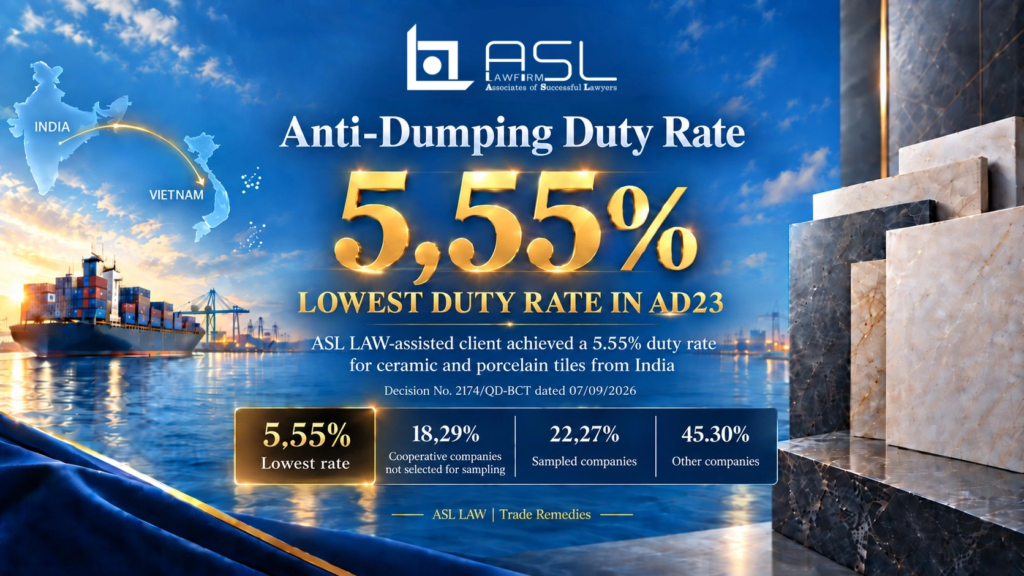
The Ministry of Industry and Trade (MOIT) has officially imposed anti-dumping duties on certain ceramic and porcelain tiles originating from India, with one producer and exporter achieving a duty rate of only 5.55% – the lowest rate in the entire case and significantly lower than those applicable to other enterprises.
According to Decision No. 2174/QD-BCT dated September 7, 2026, issued by the MOIT, official anti-dumping duty rates were determined at different levels. For sampled enterprises, the applicable rates are 22.27%, 5.55%, and 45.30%, respectively; non-sampled enterprises that cooperated by responding to the investigation questionnaire are subject to a rate of 18.29%; while other producers and exporters from India are subject to a rate of 45.30%.
Accordingly, the 5.55% rate represents the most notable anti-dumping duty outcome in the case.
5.55% – A Significant Competitive Advantage over Competitors
In trade remedy cases, differences in anti-dumping duty rates can create substantial differences in competitiveness.
Compared with the highest duty rate of 45.30%, the 5.55% rate is nearly 40 percentage points lower. Even compared with non-sampled cooperating enterprises, which are subject to a rate of 18.29%, the difference remains more than 12 percentage points.
For ceramic and porcelain tiles – a sector in which import costs and selling prices directly affect a company’s ability to enter and maintain market share – such a difference can create a significant commercial advantage.
An enterprise benefiting from the 5.55% duty rate is therefore in a more favorable position to develop pricing strategies, maintain its distribution network, expand its customer base, and compete with suppliers of the same origin in the Vietnamese market.
Notably, the official anti-dumping duties in this case will apply for a period of five years from their effective date, unless extended, modified, or terminated pursuant to another decision of the MOIT.
As a result, the 5.55% outcome is significant not only at the conclusion of the investigation but may also directly affect the client’s business strategy in Vietnam for years to come.
A Notable Outcome in the Context of Vietnam’s New Trade Remedy Legal Framework
The case is also particularly significant because it was initiated and conducted during the period when Vietnam had just introduced a new legal framework governing trade remedies.
On April 11, 2025, the Government issued Decree No. 86/2025/ND-CP, detailing certain provisions of the Law on Foreign Trade Management concerning trade remedy measures. The Decree took effect on July 1, 2025.
On the same date, July 1, 2025, Circular No. 26/2025/TT-BCT of the MOIT also came into effect, replacing and further developing various detailed provisions relating to the investigation and application of trade remedy measures.
Just over one month later, on August 18, 2025, the MOIT issued Decision No. 2333/QD-BCT initiating AD23 concerning certain ceramic and porcelain tiles originating from India. The Trade Remedies Authority of Vietnam (TRAV) confirmed that the investigation was initiated based on a valid petition for investigation submitted on July 2, 2025.
Accordingly, this was one of the first anti-dumping cases to be conducted shortly after the new trade remedy legal framework came into effect.
One notable aspect of the new framework is its more detailed provisions on the selection of foreign producers and exporters for sampling, cooperation obligations, and the methodology for determining dumping margins applicable to different groups of enterprises.
The outcome of AD23 clearly demonstrates the practical significance of this classification: sampled enterprises may receive an individual duty rate based on the investigation findings applicable specifically to that enterprise, while other groups may be subject to duty rates determined using different methodologies.
Therefore, being selected for sampling, fully participating in the investigation, and properly responding to the requirements of the Investigating Authority can result in substantial differences in the final outcome.
From the Investigation Process to the 5.55% Outcome
A favorable outcome in an anti-dumping case generally depends on more than legal arguments alone.
An enterprise must satisfy an investigation process involving extensive data requirements, including information concerning its corporate structure, production, costs, revenues, export transactions, domestic market, and various other financial and accounting data.
Such information must not only be complete but also consistent, verifiable, and accurately reflective of the enterprise’s actual operations.
Against the backdrop of the newly applicable regulations, correctly understanding the requirements of the Investigating Authority, the sampling mechanism, calculation methodologies, and cooperation obligations from the outset becomes even more important.
Accordingly, the 5.55% duty rate is a notable outcome not only in terms of the final figure itself but also in light of the entire process through which the enterprise participated in and responded to the investigation.
The Role of Vietnam Antidumping Law Firm ASL LAW and Its Legal Team
In this case, the enterprise that achieved the 5.55% duty rate was advised and supported by ASL LAW throughout its participation in the investigation in Vietnam.
The legal team in charge consisted of Lawyer Pham Duy Khuong, Lawyer Vu Tuan Anh, and Lawyer Doan Vu Hoai Nam.
Throughout the case, the team of Vietnam Antidumping Law Firm ASL LAW worked closely with the client in addressing the requirements of the Investigating Authority, preparing and reviewing information, data, and documentation, handling arising legal issues, and supporting the development of arguments in accordance with the applicable trade remedy regulations.
In particular, as the case was conducted during the early stage of implementation of Decree No. 86/2025/ND-CP and Circular No. 26/2025/TT-BCT, keeping up to date with, analyzing, and correctly applying the new regulations became an important part of the case strategy.
The client’s achievement of the lowest duty rate of 5.55% in the entire case, while many other enterprises were subject to rates ranging from 18.29% to 45.30%, represents an excellent outcome and provides a significant advantage for the client’s business operations in Vietnam.
This outcome also marks a notable achievement in ASL LAW‘s advisory practice in the field of Trade Remedies, particularly in supporting foreign producers and exporters in responding to anti-dumping investigations in Vietnam.
To protect their legitimate interests, manufacturers and exporters should familiarize themselves with the procedure and actively contact Vietnam Antidumping Law Firm specializing in anti-dumping and trade remedy for timely assistance.
ASL Law is a leading full-service and independent Vietnamese law firm made up of experienced and talented lawyers. ASL Law is ranked as the top tier Law Firm in Vietnam by Legal500, Asia Law, WTR, and Asia Business Law Journal. Based in both Hanoi and Ho Chi Minh City in Vietnam, the firm’s main purpose is to provide the most practical, efficient and lawful advice to its domestic and international clients. If we can be of assistance, please email to [email protected].
ASL LAW is the top-tier Vietnam law firm for Anti-dumping & countervailing. If you need any advice, please contact us for further information or collaboration.