Tiếng Việt
 中文 (中国)
 日本語
日本語
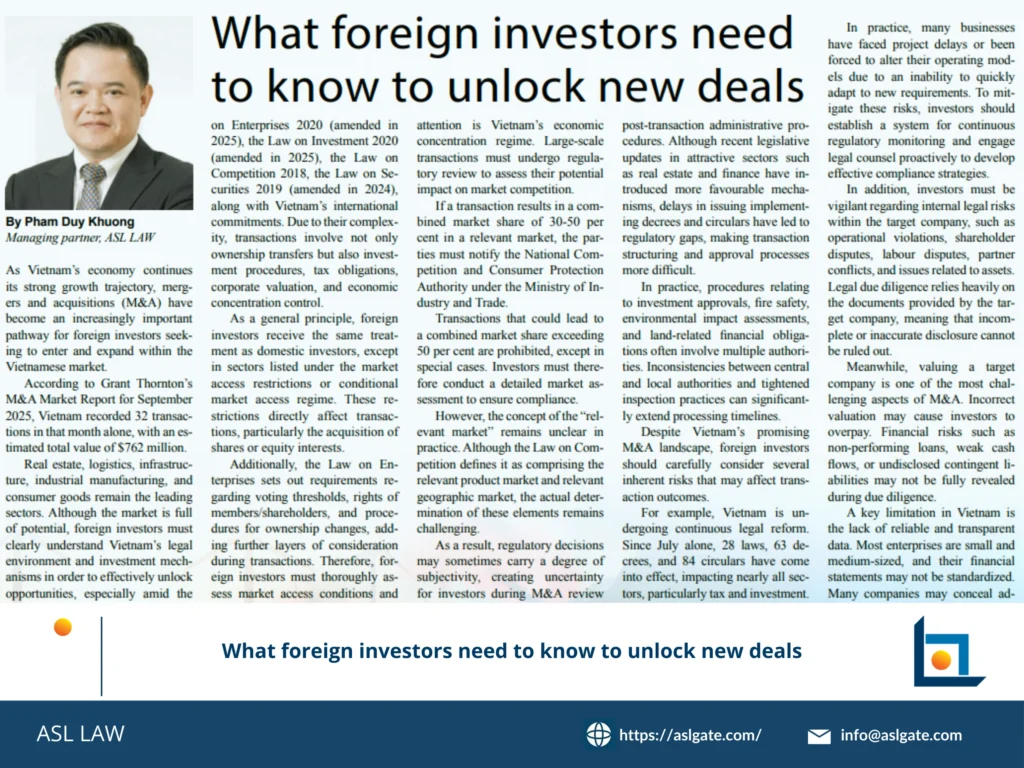
(Published on Vietnam Investment Review – VIR) As Vietnam’s economy continues its strong growth trajectory, mergers and acquisitions (M&A) have become an increasingly important pathway for foreign investors seeking to enter and expand within the Vietnamese market.
According to Grant Thornton’s M&A Market Report for September 2025, Vietnam recorded 32 transactions in that month alone, with an estimated total value of USD 762 million. Real estate, logistics, infrastructure, industrial manufacturing, and consumer goods remain the leading sectors.
Although the market is full of potential, foreign investors must clearly understand Vietnam’s legal environment and investment mechanisms in order to effectively unlock opportunities, especially amid the country’s rapidly evolving economic, political, and social landscape.
M&A activities in Vietnam are governed by core legislation such as the Civil Code 2015, the Law on Enterprises 2020 (amended in 2025), the Law on Investment 2020 (amended in 2025), the Law on Competition 2018, and the Law on Securities 2019 (amended in 2024), along with Vietnam’s international commitments. Due to their complexity, transactions involve not only ownership transfers but also offshore investment procedures, tax obligations, corporate valuation, and economic concentration control.
As a general principle, foreign investors receive the same treatment as domestic investors, except in sectors subject to market access restrictions or conditional market access regimes. These restrictions directly affect transactions, particularly the acquisition of shares or equity interests.
Additionally, the Law on Enterprises sets out requirements regarding voting thresholds, the rights of members or shareholders, and procedures for ownership changes, adding further layers of consideration during transactions. Therefore, foreign investors must thoroughly assess market access conditions and select a transaction structure that aligns with Vietnam’s regulatory framework before conducting M&A activities.
A key area requiring special attention is Vietnam’s economic concentration regime. Large-scale transactions must undergo regulatory review to assess their potential impact on market competition.
If a transaction results in a combined market share of 30–50 per cent in a relevant market, the parties must notify the National Competition and Consumer Protection Authority under the Ministry of Industry and Trade. Transactions that could lead to a combined market share exceeding 50 per cent are prohibited, except in special cases. Investors must therefore conduct a detailed market assessment to ensure compliance.
However, the concept of the “relevant market” remains unclear in practice. Although the Law on Competition defines it as comprising the relevant product market and the relevant geographic market, the actual determination of these elements remains challenging. As a result, regulatory decisions may sometimes carry a degree of subjectivity, creating uncertainty for investors during M&A review processes.
For foreign investors, a crucial aspect of transactions is the requirement to obtain approval for equity acquisitions and to complete post-transaction administrative procedures. Although recent legislative updates in sectors such as real estate and finance have introduced more favourable mechanisms, delays in issuing implementing decrees and circulars have led to regulatory gaps, making transaction structuring and approval processes more difficult.
In practice, procedures relating to offshore investment approvals, fire safety, environmental impact assessments, and land-related financial obligations often involve multiple authorities. Inconsistencies between central and local authorities, together with tightened inspection practices, can significantly extend processing timelines.
Despite Vietnam’s promising M&A landscape, foreign investors should carefully consider several inherent risks that may affect transaction outcomes. Vietnam is undergoing continuous legal reform. Since July alone, 28 laws, 63 decrees, and 84 circulars have come into effect, impacting nearly all sectors, particularly tax and investment.
Such regulatory shifts directly affect both M&A processes and post-transaction operations, especially when new legislation applies retroactively or lacks clear transitional provisions. In practice, many businesses have faced project delays or been forced to alter their operating models due to difficulties in quickly adapting to new requirements.
To mitigate these risks, investors should establish a system for continuous regulatory monitoring and engage legal counsel proactively to develop effective compliance strategies. In addition, investors must be vigilant regarding internal legal risks within the target company, such as operational violations, shareholder disputes, labour disputes, partner conflicts, and issues related to assets.
Legal due diligence relies heavily on the documents provided by the target company, meaning that incomplete or inaccurate disclosure cannot be ruled out. Meanwhile, valuing a target company is one of the most challenging aspects of M&A. Incorrect valuation may cause investors to overpay, while financial risks such as non-performing loans, weak cash flows, or undisclosed contingent liabilities may not be fully revealed during due diligence.
A key limitation in Vietnam is the lack of reliable and transparent data. Most enterprises are small and medium-sized, and their financial statements may not be fully standardized. Many companies may conceal adverse information, hidden debts, or ongoing legal disputes, exposing investors to significant risks due to insufficient information prior to decision-making.
ASL Law is a leading full-service and independent Vietnamese law firm made up of experienced and talented lawyers. ASL Law is ranked as the top tier Law Firm in Vietnam by Legal500, Asia Law, WTR, and Asia Business Law Journal. Based in both Hanoi and Ho Chi Minh City in Vietnam, the firm’s main purpose is to provide the most practical, efficient and lawful advice to its domestic and international clients. If we can be of assistance, please email to [email protected].
ASL LAW is the top-tier Vietnam law firm for Investment Services. If you need any advice, please contact us for further information or collaboration.