Tiếng Việt
 中文 (中国)
 日本語

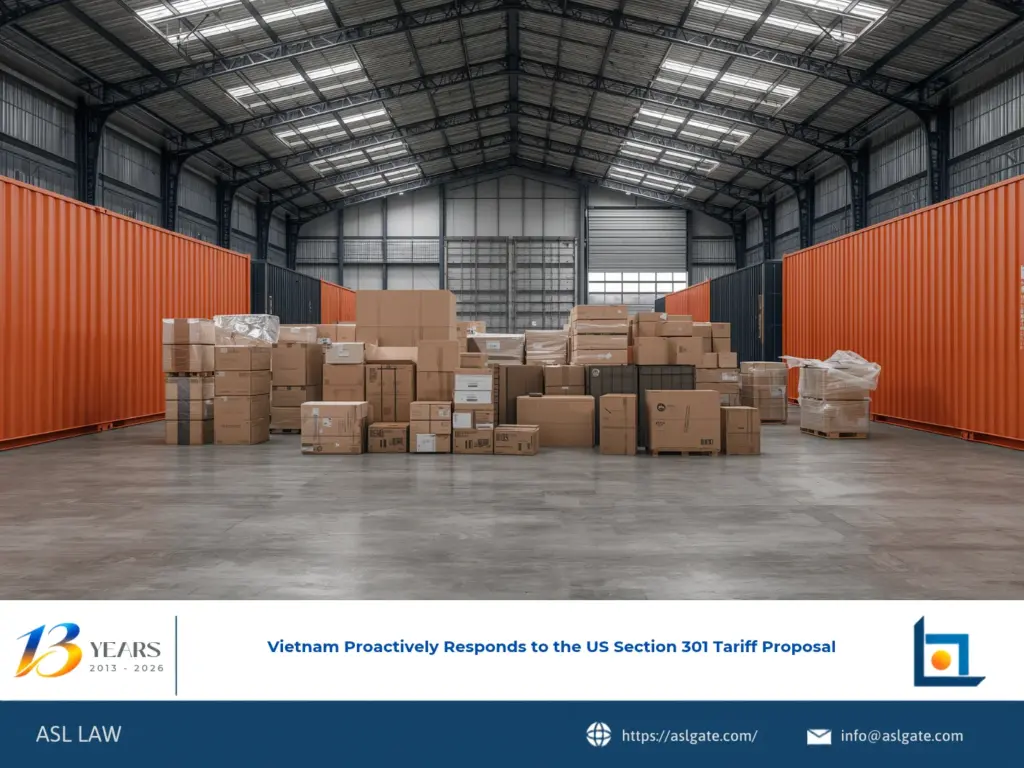
On 25 November 2026, the Office of the United States Trade Representative (USTR) announced its findings concerning 14 of the 16 economies under investigation pursuant to Section 301 of the Trade Act of 1974 regarding structural excess capacity and production in the manufacturing sector. With respect to Vietnam, the USTR identified certain policies, acts, and practices that could be subject to action under Section 301 and proposed additional tariffs of up to 35% on imports from Vietnam, subject to certain product exclusions. The proposal has not yet taken effect, and the USTR is currently accepting public comments before deciding on the final measures.
Background to the Section 301 Investigation
The USTR initiated an investigation into Vietnam on 11 March 2026, together with 15 other economies. On 25 November 2026, the USTR announced its findings concerning Vietnam and 13 other economies, namely China, the European Union, Singapore, Switzerland, Indonesia, Malaysia, Cambodia, Thailand, South Korea, Taiwan (China), Bangladesh, Japan, and India. The USTR has not yet issued findings concerning Mexico and Norway.
According to the notice specifically addressing Vietnam, the USTR considers that certain policies, acts, and practices relating to industrial planning, land, labor, finance, exchange rates, capital allocation to priority industries, foreign investment, input imports, and transshipment contribute to or sustain excess capacity and production in the manufacturing sector. These are the findings of the US investigating authority within the framework of the Section 301 investigation.
Proposed Additional Tariffs of Up to 35%
The USTR proposed considering additional tariffs of up to 35% on Vietnamese goods, taking into account duties currently imposed under other Section 301 measures. The actual tariff rates, application mechanisms, interaction with other tariffs, and list of products subject to the additional duties will be determined at a later stage.
The USTR also proposed considering tariff adjustments to account for duties currently imposed under Section 232. Product categories already subject to Section 232 tariffs, including certain steel, aluminum, and copper products, automobiles, automotive parts, trucks, wood products, patented pharmaceuticals, and semiconductors, are included in the proposed exclusions.
Notably, the USTR proposed an exclusion list covering 2,121 products classified under 8-digit HS codes. This list includes certain input materials, goods that cannot be produced in sufficient quantities in the United States or cannot easily be substituted with alternative sources of supply, and products for which the USTR considers that additional tariffs would not make a significant contribution to addressing the issues under investigation.
The proposed tariff rate could be reduced to 20% if Vietnam and the United States reach a Fair and Balanced Reciprocal Trade Agreement containing commitments that address the concerns raised in the investigation.
Key Procedural Milestones to Note
The USTR is accepting written comments and requests to participate in the public hearing until 5 January 2027. The public hearing is scheduled to commence on 25 January 2027.
The USTR’s notice has not specified a date for the final determination. According to information from Vietnam’s Ministry of Industry and Trade, the final decision could be issued as early as February 2027 and no later than 11 March 2027. Therefore, enterprises should not yet regard the proposed 35% tariff as an effective duty but should proactively assess its potential impact in the event that the United States adopts final measures.
Vietnam Implements Response Measures
Vietnam continues to negotiate a Fair and Balanced Reciprocal Trade Agreement with the United States while implementing reforms relating to the issues raised by the United States.
On 21 November 2026, the Government issued Resolution No. 403/NQ-CP on the Master Plan for Managing Trade Surpluses and Preventing Risks in International Trade Activities for the 2026–2030 Period. The plan aims to manage trade surpluses sustainably, increase domestic value added, strengthen imports serving production needs, prevent excess production capacity, combat circumvention and illegal transshipment, prevent origin fraud, and effectively control goods produced using forced labor.
The Ministry of Industry and Trade stated that it would coordinate with other ministries and relevant authorities to participate fully in the subsequent USTR procedures, including registering for and attending hearings, presenting opinions, responding to questions, preparing counterarguments and written submissions, and engaging in discussions with US authorities.
Recommendations for Exporting Enterprises
Enterprises exporting to the United States should proactively review their export product lists against the US 8-digit HS codes to determine whether their products fall within the proposed exclusion list or may be subject to additional tariffs.
In addition, enterprises should:
- Review pricing terms, price adjustment provisions, and the allocation of tax liabilities in contracts with US customers; prepare cost scenarios in the event that additional tariffs are imposed; and coordinate closely with importers to stay updated on changes to customs declarations.
- Strengthen documentation demonstrating Vietnamese origin, raw material sources, production processes, and domestic value added. Such documentation is particularly important given the USTR’s concerns regarding illegal transshipment, inputs originating from non-market economies, and dependence on supply sources outside Vietnam.
- Industry associations and enterprises with substantial export turnover to the United States should consider participating in the USTR’s public comment process, either directly or through US partners, associations, and consulting firms.
Submissions should focus on the impact of the proposed measures on supply chains, consumers, US importers, the availability of alternative supply sources, and specific grounds for requesting product exclusions.
To protect their legitimate interests, manufacturers and exporters should familiarize themselves with the procedure and actively contact Vietnam Antidumping Law Firm specializing in anti-dumping and trade remedy for timely assistance.
ASL Law is a leading full-service and independent Vietnamese law firm made up of experienced and talented lawyers. ASL Law is ranked as the top tier Law Firm in Vietnam by Legal500, Asia Law, WTR, and Asia Business Law Journal. Based in both Hanoi and Ho Chi Minh City in Vietnam, the firm’s main purpose is to provide the most practical, efficient and lawful advice to its domestic and international clients. If we can be of assistance, please email to [email protected].
ASL LAW is the top-tier Vietnam law firm for Anti-dumping & countervailing. If you need any advice, please contact us for further information or collaboration.