Tiếng Việt
 中文 (中国)
 日本語

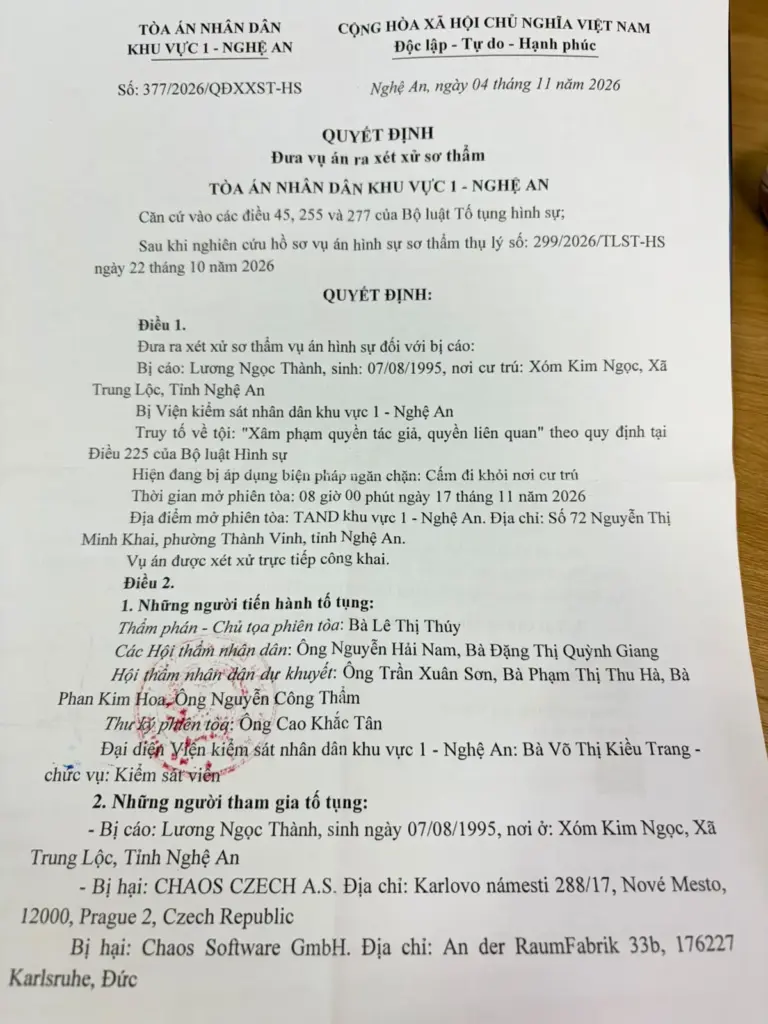
On 17 November 2026, the People’s Court of Region 1, Nghe An Province, held a first-instance criminal trial of Mr. Luong Ngoc Thanh, Director of Nha Thoang Consulting and Construction Co., Ltd., on a charge of “Infringement of Copyright and Related Rights” under Article 225 of Vietnam’s Penal Code.
ASL LAW acted as the authorized legal representative of three rights holders within the Chaos technology group, based in the Czech Republic, Germany and Bulgaria. The case concerned the design and visualization software V-Ray, Corona and Chaos Vantage.
Based on publicly available case information, this is the first reported case in Vietnam in which the director of an end-user company has faced a criminal trial relating to unlicensed software installed and used for the company’s own business activities.
The case differs from the 2026 matter publicly reported in Phu Tho, which involved the unauthorized installation and activation of software on computers supplied to the market. In the Nha Thoang case, the software was used within the company’s own operations.
Trial outcome: Monetary penalty, remediation and recovery of contract-related proceeds
The first-instance proceedings on 17 November 2026 resulted in a monetary penalty being imposed on Mr. Luong Ngoc Thanh. Earlier in the criminal proceedings, he had been subject to a restriction on leaving his place of residence. The case therefore went well beyond a request to purchase additional software licenses: the company director was involved in criminal proceedings and subjected to a preventive measure under Vietnamese law.
As regards the rights holders, Nha Thoang completed the full remediation arrangement accepted by Chaos before the trial.
Notably, according to information concerning the trial outcome, the financial consequences also extended to certain amounts arising from contracts involving the use of unlicensed software. Amounts falling within the scope of recovery specified by the judgment must be paid over, in addition to the remediation made to the software rights holders. The economic consequences were therefore not limited to license costs; they also concerned work performed and contracts carried out using the software.
Determining these amounts requires specific evidence: which software was used, when and to what extent it was used, which contracts were connected to that use, and which proceeds were actually linked to the conduct under examination. Technical data must be reconciled with contracts and financial records.
From technical indicators to 13 installations on seven computers
The case concerned V-Ray, Corona and Chaos Vantage, software products used for design, rendering and visualization in the architecture and construction sectors. The review and cross-checking process concerned seven computers and 13 software installations: five V-Ray installations, four Corona installations and four Vantage installations.
Technical information recorded by the rights holders’ systems provided an initial indication of possible unlicensed use. For such information to be relied upon in legal proceedings, however, it must be checked against the actual devices, software versions, user accounts, licensing status and other materials collected by the competent authorities.
A distinction must be drawn between the first and last recorded activity timestamps, on the one hand, and the frequency or duration of actual use, on the other. Two timestamps do not, by themselves, establish continuous use throughout the intervening period, nor do they establish how many deliverables or contracts were produced using the software.
Collection and assessment of digital evidence are central to establishing the alleged conduct
Throughout the proceedings, ASL LAW worked with Chaos to provide documentation of ownership, licensing status and technical data, and to explain the meaning and evidentiary limitations of each category of information at the request of the competent authorities.
System logs, data recovered from computers and contract documents may each capture different aspects of the same events. Establishing the conduct in question requires verification of the origin, integrity and collection date of the evidence, as well as the connections among different sources. Conclusions should not be drawn from a single technical indicator in isolation.
Where criminal liability may arise, evidence must also establish who performed, directed or knew of the relevant activities and the specific role of each individual. Neither the title of company director nor the absence of direct involvement in installing the software is, by itself, determinative of criminal responsibility.
License value, damages and contract proceeds must be assessed separately
A key issue in the case was determining the value of the software and the alleged loss. During the proceedings, Chaos and ASL LAW reviewed and adjusted the licensing basis used for comparison. The final remediation arrangement accepted by Chaos involved the purchase of seven three-year V-Ray Solo Named licenses, completed on 7 October 2026.
Three figures must be distinguished: the commercial price of a software license, the damages claimed by the rights holder, and the value of the remediation arrangement ultimately accepted. In addition, where proceeds from contracts involving the software are considered, their connection to the relevant conduct must be established through evidence of actual operations, contracts and financial records.
ASL LAW’s role: Representing three rights holders and examining digital evidence
ASL LAW participated in the proceedings as the authorized legal representative of the following three entities identified as injured parties:
- CHAOS CZECH A.S., based in the Czech Republic;
- Chaos Software GmbH, based in the Federal Republic of Germany;
- Chaos Software EOOD, based in Bulgaria.
In the course of the case, ASL LAW coordinated with Chaos and the competent authorities to submit documentation on ownership, licensing status, technical data and the legal and factual grounds relevant to protecting the rights holders’ interests.
ASL LAW also assisted in clarifying the damages claim and the remediation arrangement, and conveyed the injured parties’ positions in the criminal proceedings.
Practical considerations for businesses using software
The case illustrates the legal risks associated with using software without valid licenses in business operations. Not every instance of unlicensed use constitutes a criminal offense under Article 225 of Vietnam’s Penal Code; the legal assessment depends on the conduct, the required mental element, the consequences and the applicable statutory conditions.
Businesses should establish controls for software purchasing approvals, user accounts and devices, license scope and duration, periodic compliance checks and record retention. For intellectual property enforcement, technical information must be collected and evaluated using sound methods so that it accurately reflects the conduct and the amounts at issue.
Through its representation of the three Chaos rights holders in this case, ASL LAW hopes that effective enforcement will help raise awareness among businesses of the importance of respecting and protecting intellectual property rights.