Tiếng Việt
 中文 (中国)
 日本語
日本語
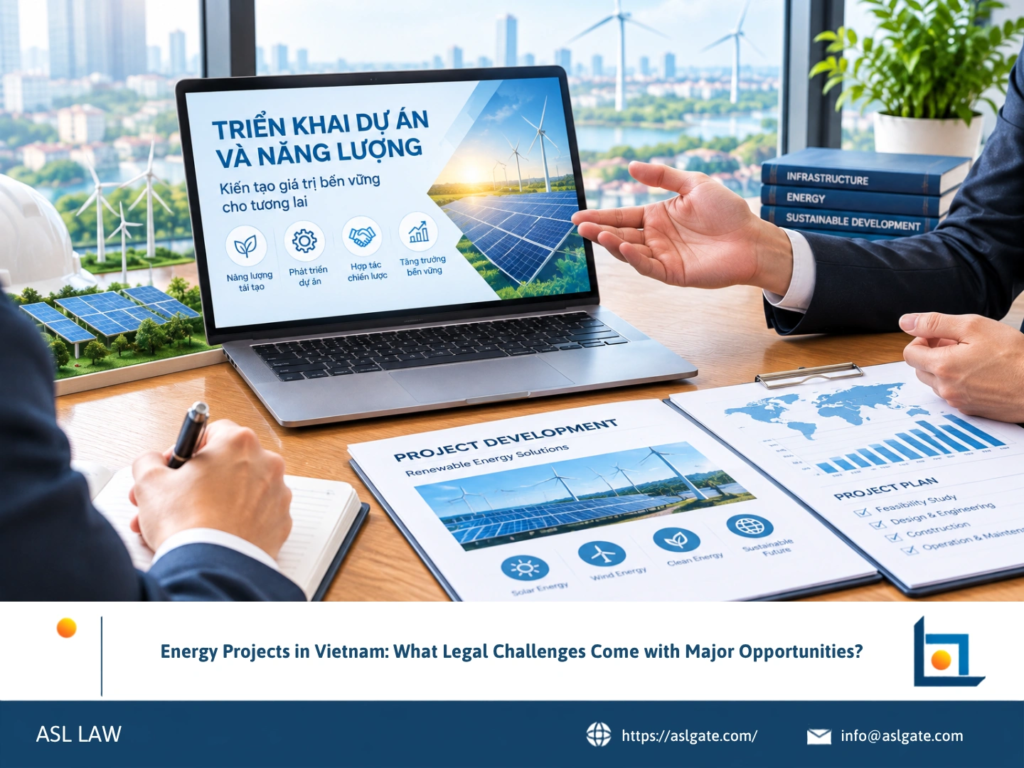
Vietnam’s energy sector is entering a period of major investment and regulatory development, creating substantial opportunities for domestic and foreign investors. At the same time, large-scale power and energy projects often involve complicated investment approvals, land access, construction, environmental requirements, grid connection, electricity purchase arrangements and sector-specific regulations. The legal challenges in Vietnam energy project development are therefore becoming increasingly important as investors move from identifying opportunities to actually developing and financing projects. In 2026, successful energy investment requires not only a strong commercial model but also careful management of regulatory uncertainty throughout the project lifecycle.
Vietnam’s Energy Sector Is Entering a New Investment Phase
Vietnam’s energy development strategy is creating opportunities across a broad range of projects, including renewable energy, offshore wind, gas-fired power, electricity transmission, energy storage and other emerging technologies.
The legal framework has also been substantially updated. The Electricity Law No. 61/2024/QH15 took effect on 1 February 2025 and introduced a dedicated framework for renewable and new energy electricity, investment in power projects, electricity markets, power trading and the operation of the national power system.
In 2026, the Government continued to develop mechanisms supporting national energy development. Resolution No. 253/2025/QH15 established special policies for national energy development during 2026–2030, while Decree No. 272/2026/NĐ-CP, effective from 4 July 2026, provides detailed implementation of several of those policies.
These developments create a more structured environment for investors, but they also mean that legal due diligence must keep pace with a rapidly changing regulatory framework.
For investors, the central issue is therefore not simply whether Vietnam offers attractive energy opportunities. It is whether a particular project can navigate the regulatory framework efficiently enough to reach construction, financing and commercial operation within the expected timeframe.
The First Legal Challenge: Investment Approval and Project Eligibility
One of the most important legal challenges in Vietnam energy project development is determining whether the proposed project is legally eligible to proceed and which investment approval procedures apply.
The Investment Law No. 143/2025/QH15 has been effective since 1 March 2026 and forms an important part of the current investment framework.
Energy projects can involve multiple layers of approval depending on their scale, location, technology, ownership structure and relationship with national or provincial planning.
This becomes particularly important for foreign investors. Before committing significant development expenditure, an investor should establish:
- Whether the proposed energy activity is open to foreign investment and subject to specific market-access conditions.
- Whether the project requires approval of its investment policy.
- Which authority has jurisdiction over the relevant approval.
- Whether the project is consistent with applicable power and provincial planning.
- Whether additional sector-specific approvals are required.
Offshore wind demonstrates how complex these issues can become. The national energy policy framework provides specific mechanisms concerning offshore wind development, including procedures relating to surveys and investment-policy approval. In 2026, Decree No. 272/2026/NĐ-CP further detailed procedures and documentation connected with offshore wind projects.
Accordingly, overcoming legal hurdles in Vietnam power projects often begins before the project company is fully established or significant capital is committed. Investors need to establish regulatory feasibility at the earliest stage.
Land, Site Control and Infrastructure Can Determine Project Viability
A technically attractive project can still fail commercially if the developer cannot secure the necessary site and infrastructure.
For conventional power plants, solar projects, wind farms and energy-storage facilities, site-related issues may include land-use rights, land allocation or leasing, compensation, resettlement, access roads and connection infrastructure.
Energy projects can also require extensive transmission infrastructure. A project may have strong generation potential but face delays if the necessary grid connection is unavailable or requires substantial additional investment.
The legal challenges in Vietnam energy project development therefore extend beyond the power plant itself. Developers should examine the legal status of the project site and related infrastructure as part of the initial feasibility assessment.
Environmental and land-use considerations can also interact. A project may involve agricultural land, forest land, coastal areas, marine space or environmentally sensitive locations, each potentially triggering different regulatory requirements.
For offshore wind projects, the legal analysis becomes even more complex because marine resources, environmental requirements, survey rights and investment approval must be considered together. Vietnam issued specific procedures in 2026 concerning the assignment of state-owned enterprises to conduct surveys for offshore wind projects before investor selection.
This illustrates why navigating legal complexities of energy projects Vietnam investors face requires a project-wide approach rather than treating land, environmental and investment issues as separate administrative matters.
Environmental, Safety and Construction Compliance
Large-scale energy projects inevitably interact with environmental and construction regulation.
Environmental impact assessment, environmental permits, waste management, emissions, water resources and ecological impacts can become important conditions for project implementation. A consolidated regulatory framework implementing Vietnam’s Law on Environmental Protection was issued in June 2026, demonstrating that environmental compliance remains an active area of regulatory development.
Construction requirements are equally significant. Vietnam’s new Construction Law No. 135/2025/QH15 took effect on 1 July 2026, adding another major component to the legal framework applicable to infrastructure development.
Energy developers should therefore assess environmental and construction requirements at the design stage rather than waiting until construction is ready to begin.
Key issues may include:
- Environmental impact assessment and related approvals.
- Construction planning and project design requirements.
- Fire prevention and safety requirements where applicable.
- Technical standards and electrical safety.
- Protection of power infrastructure.
- Environmental monitoring and ongoing operational obligations.
The regulatory framework surrounding power infrastructure and electrical safety is also still being refined. In 2026, the Ministry of Industry and Trade proposed further amendments concerning protection corridors, power infrastructure and electrical safety.
This continuing regulatory development reinforces the need for investors to monitor legal changes throughout project development.
Businesses and investors pursuing energy projects in Vietnam should consider contacting ASL LAW for professional oversea investment consultancy, strategic guidance on investment in asean, and legal support when deciding whether to hire in-house lawyer or hire law firm for long-term project and investment matters tailored to their specific circumstances.
Electricity Sales, DPPA and Revenue Certainty
A power project’s economic viability ultimately depends on its ability to generate predictable revenue.
For renewable energy projects, this makes the electricity purchase structure a central legal consideration. Developers need to understand who will purchase the electricity, at what price or pricing mechanism, for what period and under what conditions.
Vietnam’s direct power purchase agreement framework has continued to evolve. Decree No. 243/2026/NĐ-CP, effective from 26 June 2026, amended the framework established under Decree No. 57/2025/NĐ-CP concerning direct electricity purchases between renewable power generators and large electricity users, as well as related renewable-energy rules under Decree No. 58/2025/NĐ-CP.
For investors, the important issue is not merely whether a DPPA structure is legally available. The commercial contract must also allocate risks relating to output, curtailment, transmission, payment, imbalance, termination and changes in law.
These issues are central to balancing opportunity and legal risk in Vietnam energy sector because a project with excellent technical potential may still face financing difficulties if its revenue structure is legally uncertain.
Financiers will typically look beyond headline power prices. They may also examine the enforceability of project contracts, counterparty creditworthiness, termination rights, regulatory approvals and the consequences of changes in the legal framework.
Renewable Energy and Offshore Wind Offer Major Opportunities — but Also Greater Legal Complexity
Vietnam’s renewable-energy sector illustrates the relationship between commercial opportunity and regulatory complexity particularly well.
The Electricity Law established a specific legal framework for renewable and new energy electricity, including self-produced and self-consumed renewable electricity and other forms of renewable-energy development.
A consolidated document issued in June 2026 further integrated regulations concerning renewable and new-energy electricity development.
Offshore wind represents an especially significant opportunity because of Vietnam’s coastline and energy-development objectives. At the same time, offshore wind projects involve substantially more complex legal questions than many conventional onshore projects.
Developers may need to consider:
- Survey rights and marine-area access.
- Investment-policy approval.
- Investor-selection procedures.
- Environmental and marine-resource requirements.
- Grid connection.
- Electricity purchase arrangements.
- Construction and installation activities.
- Financing and security arrangements.
- Offshore investment and ownership considerations.
In May 2026, the Government continued to work on detailed mechanisms implementing special energy-development policies, including procedures relating to offshore wind surveys and investment-policy approval.
The result is a market with major opportunities and legal risks in Vietnam energy: the size of the opportunity can be substantial, but the legal preparation required to capture it is equally significant.
How Investors Can Overcome Legal Hurdles Before They Become Project Delays
Overcoming legal hurdles in Vietnam power projects is generally easier when legal issues are identified before commercial commitments become difficult to reverse.
A comprehensive legal strategy should begin with project screening rather than contract review alone.
The first step is to establish the project’s regulatory pathway. Investors should identify the required investment, land, environmental, construction, electricity and sector-specific approvals and determine how those approvals interact.
The second step is to verify project planning and site feasibility. A technically attractive location is not necessarily a legally available location.
The third step is to assess the revenue model. Power purchase arrangements, DPPA structures, grid connection and payment mechanisms should be examined alongside the project’s financial model.
The fourth step is to conduct counterparty and contractual due diligence. This is particularly important where a project depends on state-linked entities, utilities, contractors, equipment suppliers or long-term offtake arrangements.
The fifth step is to build regulatory change into the project documents. Energy projects can operate for decades, while legislation can change substantially during that period. Change-in-law provisions, termination rights, compensation mechanisms and renegotiation procedures can therefore become important elements of project contracts.
This approach supports balancing opportunity and legal risk in Vietnam energy sector by ensuring that legal risk is considered as part of project economics rather than as a separate compliance exercise.
Financing and Bankability: The Legal Test Behind the Offshore Investment Opportunity
Energy projects are capital-intensive and often depend on substantial external financing. As a result, legal bankability can be just as important as technical feasibility.
Lenders and investors may examine whether the project has secure rights to its site, valid approvals, predictable revenue, enforceable contracts and a credible regulatory pathway.
They may also consider whether project assets can be used as security, whether key contracts can be assigned, whether termination payments are adequate and whether government or utility-related counterparties provide sufficient contractual protection.
For foreign-invested projects, financing structures can also raise questions concerning foreign exchange, offshore borrowing, guarantees, security and the repatriation of investment returns.
This means that navigating legal complexities of energy projects Vietnam investors face should involve legal counsel, financial advisers, technical consultants and project sponsors working from the same risk assumptions.
A legal issue that appears minor at the development stage can become a financing condition later. For example, uncertainty over land rights, an incomplete environmental approval or an unclear electricity-sale mechanism may prevent a lender from reaching financial close.
The commercial opportunity therefore becomes meaningful only when the project’s legal structure is sufficiently robust to support financing and construction.
Building a Legal Strategy for Long-Term Energy Projects
Energy projects are fundamentally long-term investments. Their legal strategy should therefore extend beyond obtaining the initial approvals.
A project can face regulatory changes, changes in ownership, refinancing, contractor replacement, equipment upgrades, expansion, grid changes and changes in electricity-market conditions during its operating life.
The Electricity Law itself recognizes a wide range of matters covering project investment and construction, renewable and new energy development, electricity-market operation, electricity trading, system operation and electrical safety.
Developers should consequently establish a compliance system capable of operating throughout the project lifecycle.
For investors, the most effective approach is usually to maintain a legal risk register covering:
| Project stage | Key legal questions |
| Development | Investment eligibility, planning, land/site and permits |
| Pre-construction | Environmental, construction and technical approvals |
| Financing | Security, bankability, contracts and foreign exchange |
| Construction | Contractor obligations, safety and regulatory compliance |
| Operation | Licensing, electricity sales, environmental and reporting duties |
| Expansion or transfer | Investment restructuring, ownership and regulatory approvals |
| Decommissioning | Asset removal, environmental obligations and site restoration |
This lifecycle approach is essential to managing the legal challenges in Vietnam energy project development because the legal risk profile changes as the project moves from concept to operation.
Vietnam’s energy market offers significant opportunities, but the strongest projects will not necessarily be those with the most attractive headline returns. They will often be projects where regulatory feasibility, site control, revenue certainty, financing and long-term legal compliance have been considered together.
For investors, balancing opportunity and legal risk in Vietnam energy sector therefore means treating legal planning as part of the investment strategy itself. The objective is not simply to obtain approvals, but to build a project structure capable of surviving regulatory change, contractual disputes and operational challenges over its entire offshore investment lifecycle.
FAQ: Legal Challenges for Energy Projects in Vietnam
1. What are the main legal challenges in Vietnam energy project development?
The main legal challenges in Vietnam energy project development include investment approval, power planning, land and site control, environmental compliance, construction requirements, grid connection, electricity sales, financing and sector-specific licensing. The specific requirements depend heavily on the project’s technology, location, scale and ownership structure.
2. How can investors overcome legal hurdles in Vietnam power projects?
Overcoming legal hurdles in Vietnam power projects requires early regulatory due diligence, confirmation of planning and site eligibility, identification of all required approvals, careful project-contract drafting and continuous monitoring of regulatory changes. Investors should address these matters before making significant irreversible development commitments.
3. What are the major opportunities and legal risks in Vietnam’s energy sector?
Major opportunities and legal risks in Vietnam energy exist across renewable energy, offshore wind, gas-fired power, electricity infrastructure, storage and other emerging technologies. Opportunities are supported by Vietnam’s long-term energy-development objectives, while legal risks can arise from complex approval procedures, site control, environmental requirements, revenue structures and regulatory changes.
4. How can investors navigate the legal complexities of energy projects in Vietnam?
Navigating legal complexities of energy projects Vietnam investors encounter requires an integrated review covering offshore investment, land, environmental, construction, electricity-market, financing and contractual requirements. Foreign investors should also assess market-access rules and the legal implications of their proposed ownership and financing structures.
5. How can businesses balance opportunity and legal risk in Vietnam’s energy sector?
Balancing opportunity and legal risk in Vietnam energy sector requires investors to incorporate legal feasibility into the commercial model from the beginning. A project should be assessed not only for its technical and financial potential but also for regulatory approvals, revenue certainty, bankability, contractual protection and long-term compliance.
ASL Law is a leading full-service and independent Vietnamese law firm made up of experienced and talented lawyers. ASL Law is ranked as the top tier Law Firm in Vietnam by Legal500, Asia Law, WTR, and Asia Business Law Journal. Based in both Hanoi and Ho Chi Minh City in Vietnam, the firm’s main purpose is to provide the most practical, efficient and lawful advice to its domestic and international clients. If we can be of assistance, please email to [email protected].
ASL LAW is the top-tier Vietnam law firm for project and energy consultancy. If you need any advice, please contact us for further information or collaboration.